
在慢性肾脏病大鼠中发现了一种不同于 IIb 型钠依赖性磷酸盐转运体的肠道磷酸盐转运体。
Evidence of an intestinal phosphate transporter alternative to type IIb sodium-dependent phosphate transporter in rats with chronic kidney disease.
机构信息
Research Division, Chugai Pharmaceutical Co., Ltd, Shizuoka, Japan.
Translational Research Division, Chugai Pharmaceutical Co., Ltd, Shizuoka, Japan.
出版信息
Nephrol Dial Transplant. 2021 Jan 1;36(1):68-75. doi: 10.1093/ndt/gfaa156.
BACKGROUND
Phosphate is absorbed in the small intestine via passive flow and active transport.NaPi-IIb, a type II sodium-dependent phosphate transporter, is considered to mediate active phosphate transport in rodents. To study the regulation of intestinal phosphate transport in chronic kidney disease (CKD), we analyzed the expression levels of NaPi-IIb, pituitary-specific transcription factor 1 (PiT-1) and PiT-2 and the kinetics of intestinal phosphate transport using two CKD models.
METHODS
CKD was induced in rats via adenine orThy1 antibody injection. Phosphate uptake by intestinal brush border membrane vesicles (BBMV) and the messenger RNA (mRNA) expression of NaPi-IIb, PiT-1 and PiT-2 were analyzed. The protein expression level of NaPi-IIb was measured by mass spectrometry (e.g. liquid chromatography tandem mass spectrometry).
RESULTS
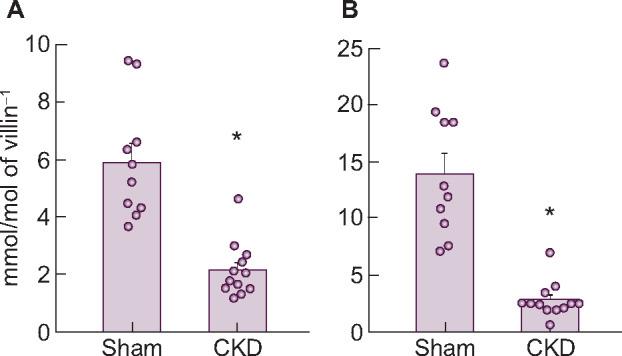
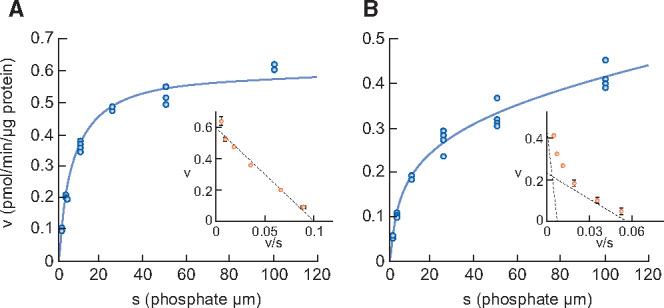
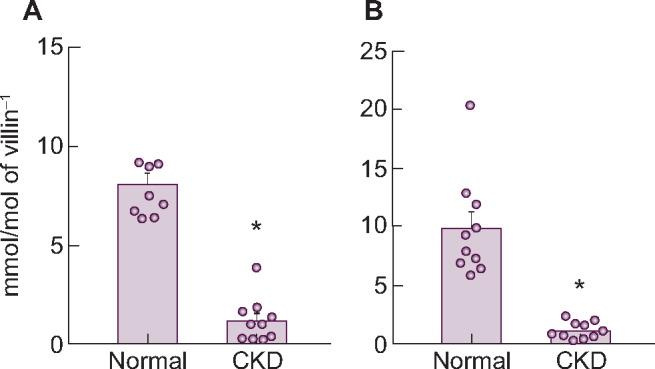
In normal rats, phosphate uptake into BBMV consisted of a single saturable component and its Michaelis constant (Km) was comparable to that of NaPi-IIb. The maximum velocity (Vmax) correlated with mRNA and protein levels of NaPi-IIb. In the CKD models, intestinal phosphate uptake consisted of two saturable components. The Vmax of the higher-affinity transport, which is thought to be responsible for NaPi-IIb, significantly decreased and the decrease correlated with reduced NaPi-IIb expression. The Km of the lower-affinity transport was comparable to that of PiT-1 and -2. PiT-1 mRNA expression was much higher than that of PiT-2, suggesting that PiT-1 was mostly responsible for phosphate transport.
CONCLUSIONS
This study suggests that the contribution of NaPi-IIb to intestinal phosphate absorption dramatically decreases in rats with CKD and that a low-affinity alternative to NaPi-IIb, in particular PiT-1, is upregulated in a compensatory manner in CKD.
背景
磷通过被动流动和主动转运在小肠中被吸收。NaPi-IIb 是一种 II 型钠依赖性磷酸盐转运体,被认为介导啮齿动物的主动磷酸盐转运。为了研究慢性肾脏病(CKD)中肠道磷酸盐转运的调节,我们使用两种 CKD 模型分析了 NaPi-IIb、垂体特异性转录因子 1(PiT-1)和 PiT-2 的表达水平以及肠道磷酸盐转运的动力学。
方法
通过腺嘌呤或 Thy1 抗体注射诱导大鼠 CKD。分析肠刷状缘膜囊泡(BBMV)中磷酸盐的摄取以及 NaPi-IIb、PiT-1 和 PiT-2 的信使 RNA(mRNA)表达。通过质谱法(例如液相色谱串联质谱法)测量 NaPi-IIb 的蛋白表达水平。
结果
在正常大鼠中,BBMV 中的磷酸盐摄取由单个可饱和成分组成,其米氏常数(Km)与 NaPi-IIb 相当。最大速度(Vmax)与 NaPi-IIb 的 mRNA 和蛋白水平相关。在 CKD 模型中,肠道磷酸盐摄取由两个可饱和成分组成。高亲和力转运的 Vmax 显著降低,这与 NaPi-IIb 表达减少有关,而低亲和力转运的 Km 与 PiT-1 和 -2 相当。PiT-1 mRNA 表达远高于 PiT-2,表明 PiT-1 主要负责磷酸盐转运。
结论
本研究表明,CKD 大鼠肠道磷酸盐吸收中 NaPi-IIb 的贡献显著降低,而 NaPi-IIb 的低亲和力替代物,特别是 PiT-1,以代偿性方式上调。



 Zotero 插件