
基于电子健康记录文档评估疑似阿片类药物使用障碍。
Assessment of Probable Opioid Use Disorder Using Electronic Health Record Documentation.
机构信息
Department of Biomedical Science, Schmidt College of Medicine of Florida Atlantic University, Boca Raton.
Geisinger Clinic, Geisinger, Danville, Pennsylvania.
出版信息
JAMA Netw Open. 2020 Sep 1;3(9):e2015909. doi: 10.1001/jamanetworkopen.2020.15909.
IMPORTANCE
Electronic health records are a potentially valuable source of information for identifying patients with opioid use disorder (OUD).
OBJECTIVE
To evaluate whether proxy measures from electronic health record data can be used reliably to identify patients with probable OUD based on Diagnostic and Statistical Manual of Mental Disorders (Fifth Edition) (DSM-5) criteria.
DESIGN, SETTING, AND PARTICIPANTS: This retrospective cross-sectional study analyzed individuals within the Geisinger health system who were prescribed opioids between December 31, 2000, and May 31, 2017, using a mixed-methods approach. The cohort was identified from 16 253 patients enrolled in a contract-based, Geisinger-specific medication monitoring program (GMMP) for opioid use, including patients who maintained or violated contract terms, as well as a demographically matched control group of 16 253 patients who were prescribed opioids but not enrolled in the GMMP. Substance use diagnoses and psychiatric comorbidities were assessed using automated electronic health record summaries. A manual medical record review procedure using DSM-5 criteria for OUD was completed for a subset of patients. The analysis was conducted beginning from June 5, 2017, until May 29, 2020.
MAIN OUTCOMES AND MEASURES
The primary outcome was the prevalence of OUD as defined by proxy measures for DSM-5 criteria for OUD as well as the prevalence of comorbidities among patients prescribed opioids within an integrated health system.
RESULTS
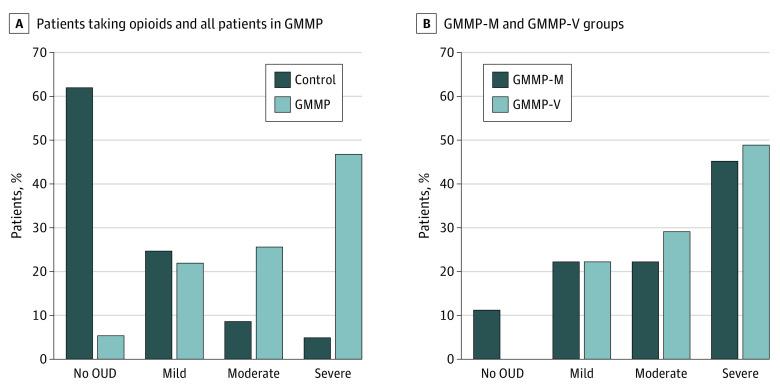
Among the 16 253 patients enrolled in the GMMP (9309 women [57%]; mean [SD] age, 52 [14] years), OUD diagnoses as defined by diagnostic codes were present at a much lower rate than expected (291 [2%]), indicating the necessity for alternative diagnostic strategies. The DSM-5 criteria for OUD can be assessed using manual medical record review; a manual review of 200 patients in the GMMP and 200 control patients identifed a larger percentage of patients with probable moderate to severe OUD (GMMP, 145 of 200 [73%]; and control, 27 of 200 [14%]) compared with the prevalence of OUD assessed using diagnostic codes.
CONCLUSIONS AND RELEVANCE
These results suggest that patients with OUD may be identified using information available in the electronic health record, even when diagnostic codes do not reflect this diagnosis. Furthermore, the study demonstrates the utility of coding for DSM-5 criteria from medical records to generate a quantitative DSM-5 score that is associated with OUD severity.
重要性
电子健康记录是识别患有阿片类药物使用障碍(OUD)的患者的潜在有价值的信息来源。
目的
评估电子健康记录数据中的代理指标是否可以可靠地用于根据《精神障碍诊断与统计手册》(第五版)(DSM-5)标准识别可能患有 OUD 的患者。
设计、地点和参与者:这项回顾性的横断面研究使用混合方法分析了 2000 年 12 月 31 日至 2017 年 5 月 31 日期间在 Geisinger 卫生系统内开处阿片类药物的个体。队列是从参与基于合同的 Geisinger 特定药物监测计划(GMMP)的 16253 名接受阿片类药物治疗的患者中确定的,包括遵守或违反合同条款的患者,以及一组 16253 名接受阿片类药物治疗但未参与 GMMP 的在人口统计学上匹配的对照组。使用自动化电子健康记录摘要评估物质使用诊断和精神共病。对于一小部分患者,使用 DSM-5 标准进行了 OUD 的手动病历审查程序。分析从 2017 年 6 月 5 日开始,直到 2020 年 5 月 29 日结束。
主要结果和措施
主要结果是通过 OUD 的 DSM-5 标准的代理指标定义的 OUD 的患病率,以及在综合卫生系统内开处阿片类药物的患者中的共病患病率。
结果
在参与 GMMP 的 16253 名患者中(9309 名女性[57%];平均[标准差]年龄,52[14]岁),根据诊断代码确定的 OUD 诊断率远低于预期(291[2%]),这表明需要替代诊断策略。可以使用手动病历审查来评估 OUD 的 DSM-5 标准;GMMP 中对 200 名患者和 200 名对照患者的手动审查确定了更大比例的可能患有中度至重度 OUD 的患者(GMMP,200 名中的 145 名[73%];和对照组,200 名中的 27 名[14%]),而不是使用诊断代码评估的 OUD 患病率。
结论和相关性
这些结果表明,即使诊断代码不反映该诊断,也可以使用电子健康记录中的信息识别患有 OUD 的患者。此外,该研究证明了从病历中对 DSM-5 标准进行编码以生成与 OUD 严重程度相关的定量 DSM-5 评分的实用性。

 Zotero 插件