
在 CFTR 调节剂时代的气道炎症和宿主反应。
Airway Inflammation and Host Responses in the Era of CFTR Modulators.
机构信息
Airway Innate Immunity Research (AiiR) group, Wellcome-Wolfson Institute for Experimental Medicine, Queen's University Belfast, Belfast BT9 7BL, Northern Ireland, UK.
Wellcome-Wolfson Institute for Experimental Medicine, Queen's University Belfast, Belfast BT9 7BL, Northern Ireland, UK.
出版信息
Int J Mol Sci. 2020 Sep 2;21(17):6379. doi: 10.3390/ijms21176379.
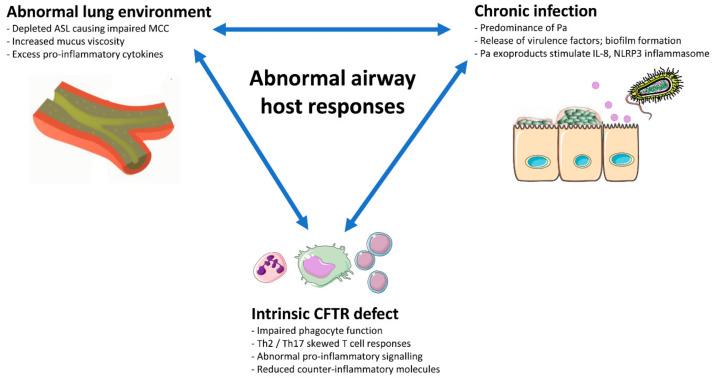
The arrival of cystic fibrosis transmembrane conductance regulator (CFTR) modulators as a new class of treatment for cystic fibrosis (CF) in 2012 represented a pivotal advance in disease management, as these small molecules directly target the upstream underlying protein defect. Further advancements in the development and scope of these genotype-specific therapies have been transformative for an increasing number of people with CF (PWCF). Despite clear improvements in CFTR function and clinical endpoints such as lung function, body mass index (BMI), and frequency of pulmonary exacerbations, current evidence suggests that CFTR modulators do not prevent continued decline in lung function, halt disease progression, or ameliorate pathogenic organisms in those with established lung disease. Furthermore, it remains unknown whether their restorative effects extend to dysfunctional CFTR expressed in phagocytes and other immune cells, which could modulate airway inflammation. In this review, we explore the effects of CFTR modulators on airway inflammation, infection, and their influence on the impaired pulmonary host defences associated with CF lung disease. We also consider the role of inflammation-directed therapies in light of the widespread clinical use of CFTR modulators and identify key areas for future research.
囊性纤维化跨膜电导调节因子 (CFTR) 调节剂作为囊性纤维化 (CF) 的一种新的治疗类别于 2012 年问世,这是疾病管理的一个重要进展,因为这些小分子直接针对上游潜在的蛋白缺陷。这些针对特定基因型的治疗方法在开发和应用范围上的进一步发展,为越来越多的 CF 患者 (PWCF) 带来了变革。尽管 CFTR 功能和临床终点(如肺功能、体重指数 (BMI) 和肺部恶化频率)明显改善,但现有证据表明,CFTR 调节剂不能阻止肺功能持续下降、阻止疾病进展或减轻已患有肺部疾病患者的致病生物。此外,尚不清楚它们的修复作用是否扩展到在吞噬细胞和其他免疫细胞中表达的功能失调的 CFTR,这些细胞可能会调节气道炎症。在这篇综述中,我们探讨了 CFTR 调节剂对气道炎症、感染的影响,以及它们对 CF 肺部疾病相关受损肺宿主防御的影响。我们还考虑了炎症靶向治疗在 CFTR 调节剂广泛临床应用背景下的作用,并确定了未来研究的重点领域。

 Zotero 插件