
实时 RT-PCR 检测 COVID-19 的混合检测:5 份和 10 份混合样本的多中心比较评估。
Pooled testing for COVID-19 diagnosis by real-time RT-PCR: A multi-site comparative evaluation of 5- & 10-sample pooling.
机构信息
Divsion of Epidemiology & Communicable Diseases, Indian Council of Medical Research, New Delhi, India.
Department of Microbiology, King George's Medical University, Lucknow, Uttar Pradesh, India.
出版信息
Indian J Med Res. 2020;152(1 & 2):88-94. doi: 10.4103/ijmr.IJMR_2304_20.
BACKGROUND & OBJECTIVES: Public health and diagnostic laboratories are facing huge sample loads for COVID-19 diagnosis by real-time reverse transcription-polymerase chain reaction (RT-PCR). High sensitivity of optimized real-time RT-PCR assays makes pooled testing a potentially efficient strategy for resource utilization when positivity rates for particular regions or groups of individuals are low. We report here a comparative analysis of pooled testing for 5- and 10-sample pools by real-time RT-PCR across 10 COVID-19 testing laboratories in India.
METHODS
Ten virus research and diagnostic laboratories (VRDLs) testing for COVID-19 by real-time RT-PCR participated in this evaluation. At each laboratory, 100 nasopharyngeal swab samples including 10 positive samples were used to create 5- and 10-sample pools with one positive sample in each pool. RNA extraction and real-time RT-PCR for SARS-CoV-2-specific E gene target were performed for individual positive samples as well as pooled samples. Concordance between individual sample testing and testing in the 5- or 10-sample pools was calculated, and the variation across sites and by sample cycle threshold (C) values was analyzed.
RESULTS
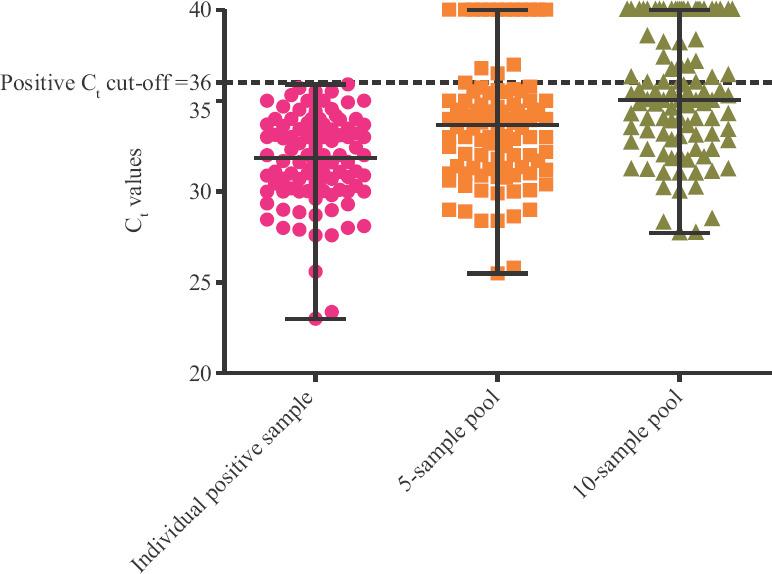
A total of 110 each of 5- and 10-sample pools were evaluated. Concordance between the 5-sample pool and individual sample testing was 100 per cent in the C value ≤30 cycles and 95.5 per cent for Cvalues ≤33 cycles. Overall concordance between the 5-sample pooled and individual sample testing was 88 per cent while that between 10-sample pool and individual sample testing was 66 per cent. Although the concordance rates for both the 5- and 10-sample pooled testing varied across laboratories, yet for samples with C values ≤33 cycles, the concordance was ≥90 per cent across all laboratories for the 5-sample pools.
INTERPRETATION & CONCLUSIONS: Results from this multi-site assessment suggest that pooling five samples for SARS-CoV-2 detection by real-time RT-PCR may be an acceptable strategy without much loss of sensitivity even for low viral loads, while with 10-sample pools, there may be considerably higher numbers of false negatives. However, testing laboratories should perform validations with the specific RNA extraction and RT-PCR kits in use at their centres before initiating pooled testing.
背景与目的
公共卫生和诊断实验室面临着通过实时逆转录-聚合酶链反应(RT-PCR)对 COVID-19 进行诊断的巨大样本量。优化的实时 RT-PCR 检测具有很高的灵敏度,当特定地区或个体的阳性率较低时,混合检测是一种有效的资源利用策略。我们在此报告了在印度的 10 个 COVID-19 检测实验室中,通过实时 RT-PCR 对 5 样本和 10 样本混合检测的比较分析。
方法
10 个进行实时 RT-PCR 检测 COVID-19 的病毒研究和诊断实验室(VRDL)参与了这项评估。在每个实验室,使用 100 个鼻咽拭子样本,包括 10 个阳性样本,每个样本中都有一个阳性样本,创建了 5 样本和 10 样本混合池。对每个阳性样本和混合样本进行 SARS-CoV-2 特异性 E 基因靶标的 RNA 提取和实时 RT-PCR。计算了个体样本检测与 5 或 10 样本混合池检测之间的一致性,并分析了不同地点和样本循环阈值(C)值之间的差异。
结果
共评估了 110 个 5 样本和 10 样本混合池。在 C 值≤30 个周期时,5 样本混合池与个体样本检测之间的一致性为 100%,在 C 值≤33 个周期时,一致性为 95.5%。5 样本混合池与个体样本检测的总一致性为 88%,而 10 样本混合池与个体样本检测的一致性为 66%。虽然 5-和 10 样本混合池检测的一致性率在各实验室之间有所不同,但对于 C 值≤33 个周期的样本,所有实验室的 5 样本混合池的一致性均≥90%。
解释与结论
这项多地点评估的结果表明,即使对于低病毒载量,通过实时 RT-PCR 对 SARS-CoV-2 进行 5 样本混合检测也可能是一种可接受的策略,而不会损失太多的灵敏度,而对于 10 样本混合池,则可能会出现相当多的假阴性。然而,检测实验室在启动混合检测之前,应使用其中心使用的特定 RNA 提取和 RT-PCR 试剂盒进行验证。
 Zotero 插件