
荷兰病例助产护理的女性特征和护理结局:一项回顾性队列研究。
Women's characteristics and care outcomes of caseload midwifery care in the Netherlands: a retrospective cohort study.
机构信息
Research Centre for Midwifery Science, Midwifery Education and Studies Maastricht, ZUYD University, Universiteitssingel 60, 6229 ER, Maastricht, the Netherlands.
TNO, Department of Child Health, Schipholweg 77, 2316 ZL, Leiden, The Netherlands.
出版信息
BMC Pregnancy Childbirth. 2020 Sep 7;20(1):517. doi: 10.1186/s12884-020-03204-3.
BACKGROUND
The maternity care system in the Netherlands is well known for its support of community-based midwifery. However, regular midwifery practices typically do not offer caseload midwifery care - one-to-one continuity of care throughout pregnancy and birth. Because we know very little about the outcomes for women receiving caseload care in the Netherlands, we compared caseload care with regular midwife-led care, looking at maternal and perinatal outcomes, including antenatal and intrapartum referrals to secondary (i.e., obstetrician-led) care.
METHODS
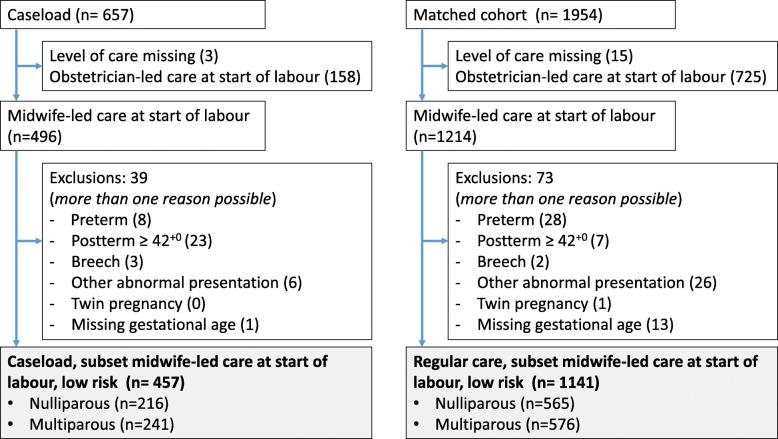
We selected 657 women in caseload care and 1954 matched controls (women in regular midwife-led care) from all women registered in the Dutch Perinatal Registry (Perined) who gave birth in 2015. To be eligible for selection the women had to be in midwife-led antenatal care beyond 28 gestational weeks. Each woman in caseload care was matched with three women in regular midwife-led care, using parity, maternal age, background (Dutch or non-Dutch) and region. These two cohorts were compared for referral rates, mode of birth, and other maternal and perinatal outcomes.
RESULTS
In caseload midwifery care, 46.9% of women were referred to obstetrician-led care (24.2% antenatally and 22.8% in the intrapartum period). In the matched cohort, 65.7% were referred (37.4% antenatally and 28.3% in the intrapartum period). In caseload care, 84.0% experienced a spontaneous vaginal birth versus 77.0% in regular midwife-led care. These patterns were observed for both nulliparous and multiparous women. Women in caseload care had fewer inductions of labour (13.2% vs 21.0%), more homebirths (39.4% vs 16.1%) and less perineal damage (intact perineum: 41.3% vs 28.2%). The incidence of perinatal mortality and a low Apgar score was low in both groups.
CONCLUSIONS
We found that when compared to regular midwife-led care, caseload midwifery care in the Netherlands is associated with a lower referral rate to obstetrician-led care - both antenatally and in the intrapartum period - and a higher spontaneous vaginal birth rate, with similar perinatal safety. The challenge is to include this model as part of the current effort to improve the quality of Dutch maternity care, making caseload care available and affordable for more women.
背景
荷兰的孕产护理体系以支持社区助产士而闻名。然而,常规助产实践通常不提供病例助产护理,即整个孕期和分娩期一对一的连续护理。由于我们对荷兰接受病例护理的女性的结果知之甚少,我们将病例护理与常规助产士主导的护理进行了比较,观察了产妇和围产期结局,包括产前和产时向二级(即产科医生主导)护理的转诊。
方法
我们从所有在 2015 年在荷兰围产儿登记处(Perined)登记并分娩的接受常规助产士主导的产前护理且超过 28 孕周的妇女中,选择了 657 名病例护理组的妇女和 1954 名匹配对照组的妇女。为了有资格入选,每位病例护理组的妇女都需要与三名接受常规助产士主导的产前护理的妇女相匹配,使用产次、产妇年龄、背景(荷兰或非荷兰)和地区。比较这两个队列的转诊率、分娩方式以及其他产妇和围产期结局。
结果
在病例助产护理中,46.9%的妇女被转诊至产科医生主导的护理(产前转诊 24.2%,产时转诊 22.8%)。在匹配的队列中,65.7%的妇女被转诊(产前转诊 37.4%,产时转诊 28.3%)。在病例护理中,84.0%的妇女经历了自然阴道分娩,而在常规助产士主导的护理中为 77.0%。这两种模式在初产妇和经产妇中都有观察到。在病例护理中,催产素使用率较低(13.2%比 21.0%),家庭分娩较多(39.4%比 16.1%),会阴损伤较少(会阴完整:41.3%比 28.2%)。两组的围产儿死亡率和低 Apgar 评分发生率都较低。
结论
与常规助产士主导的护理相比,我们发现荷兰的病例助产护理与较低的产科医生主导的护理转诊率相关,无论是产前还是产时,以及较高的自然阴道分娩率,同时围产期安全性相似。挑战在于将这种模式纳入当前提高荷兰孕产护理质量的努力中,使更多妇女能够获得和负担得起病例助产护理。
 Zotero 插件