
β-肾上腺素能受体信号通过靶向 Sonic hedgehog-Gli1 信号激活驱动前列腺癌进展。
β -adrenergic receptor signaling drives prostate cancer progression by targeting the Sonic hedgehog-Gli1 signaling activation.
机构信息
Institute of Life Sciences, Chongqing Medical University, Chongqing, China.
Department of Biochemistry and Molecular Cell Biology, Shanghai Key Laboratory of Tumor Microenvironment and Inflammation, Shanghai Jiao Tong University School of Medicine, Shanghai, China.
出版信息
Prostate. 2020 Nov;80(15):1328-1340. doi: 10.1002/pros.24060. Epub 2020 Sep 7.
BACKGROUND
Considerable evidence suggests that the sympathetic nervous system, mainly via adrenergic signaling, contributes to prostate cancer (PCa) progression. However, the underlying molecular mechanisms remain unknown.
METHODS
The expression level of β -adrenergic receptor (β -AR) in tissue microarray was evaluated by immunohistochemistry. The effects of isoproterenol (ISO) or Sonic Hedgehog (Shh) signaling inhibitor on tumor growth were analyzed in proliferation and colony formation assays. The apoptosis of cells was analyzed by flow cytometry. Small hairpin RNA-based knockdown of β -AR or Gli1 was validated by Western blot analysis and real-time PCR. Effects of β -AR on prostate carcinogenesis in vivo were observed in a mouse xenograft model. The expression levels of the indicated proteins in xenograft tissues were evaluated by immunohistochemistry. Expression levels of Shh signaling components and downstream proteins were assessed by immunoblotting.
RESULTS
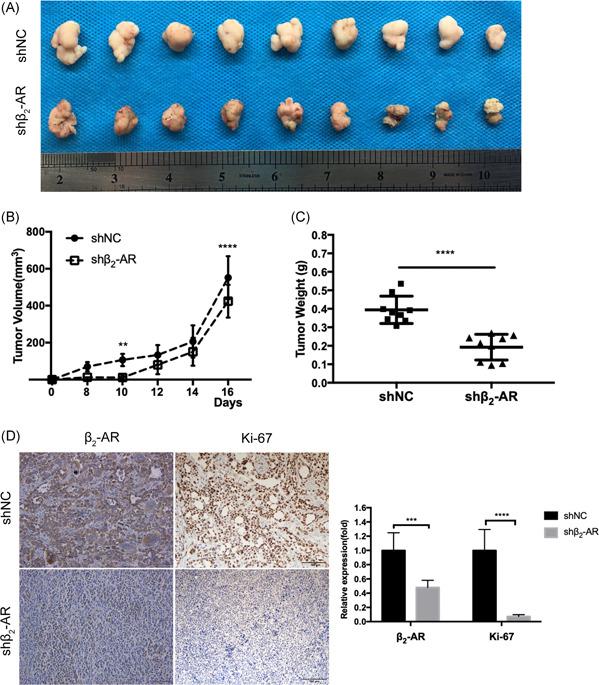
We determined that β -AR was expressed at significantly higher levels in carcinoma than in normal prostate tissues. β -AR signaling also played an essential role in sustaining PCa cell proliferation in vivo and in vitro. We also found that inhibition of Shh signaling or knockdown of Gli1 expression significantly restrained ISO-induced cell proliferation in vitro. ISO alleviated the apoptosis induced by suppressing or knocking down of Gli1. The β -AR agonist ISO upregulated the transcription and protein expression of target genes of Shh signaling, including c-Myc, Cyclin D1, and VEGFA. Conversely, knocking down β -AR markedly suppressed the expression of Shh components in vivo and in vitro. In Gli1 knockdown cells, ISO failed to increase the expression of target genes of Shh signaling.
CONCLUSIONS
In this study, we uncovered an important role of β -AR signaling in regulating the Shh pathway activity in PCa tumorigenesis and provide further insight into the mechanism of the involvement of the Hh signaling pathway. Furthermore, given the efficacy of β -adrenergic modulation on PCa, our study might also add evidence for potential therapeutic options of β-blockers for PCa.
背景
大量证据表明,交感神经系统主要通过肾上腺素能信号传导促进前列腺癌(PCa)的进展。然而,其潜在的分子机制尚不清楚。
方法
通过免疫组织化学评估组织微阵列中β-肾上腺素能受体(β-AR)的表达水平。分析异丙肾上腺素(ISO)或 Sonic Hedgehog(Shh)信号抑制剂对增殖和集落形成测定中肿瘤生长的影响。通过流式细胞术分析细胞凋亡。通过 Western blot 分析和实时 PCR 验证β-AR 或 Gli1 的小发夹 RNA 敲低。在小鼠异种移植模型中观察β-AR 对前列腺癌发生的影响。通过免疫组织化学评估异种组织中指示蛋白的表达水平。通过免疫印迹评估 Shh 信号传导成分和下游蛋白的表达水平。
结果
我们确定β-AR 在癌组织中的表达水平明显高于正常前列腺组织。β-AR 信号在维持 PCa 细胞在体内和体外的增殖中也起着至关重要的作用。我们还发现,抑制 Shh 信号或敲低 Gli1 表达可显著抑制 ISO 诱导的体外细胞增殖。ISO 缓解了抑制或敲低 Gli1 诱导的细胞凋亡。β-AR 激动剂 ISO 上调了 Shh 信号的靶基因,包括 c-Myc、Cyclin D1 和 VEGFA 的转录和蛋白表达。相反,体内和体外敲低β-AR 显着抑制了 Shh 成分的表达。在 Gli1 敲低细胞中,ISO 未能增加 Shh 信号的靶基因的表达。
结论
在这项研究中,我们揭示了β-AR 信号在调节 PCa 肿瘤发生中的 Shh 通路活性中的重要作用,并为 Hh 信号通路的参与机制提供了进一步的见解。此外,鉴于β-肾上腺素能调节对 PCa 的疗效,我们的研究也可能为β-受体阻滞剂治疗 PCa 的潜在治疗选择提供证据。




 Zotero 插件