
卢奥社区用于治疗呼吸系统疾病的药用植物:肯尼亚基苏木东次县的评估
Medicinal plants used in managing diseases of the respiratory system among the Luo community: an appraisal of Kisumu East Sub-County, Kenya.
作者信息
Mailu James Kiamba, Nguta Joseph Mwanzia, Mbaria James Mucunu, Okumu Mitchel Otieno
机构信息
Department of Public Health, Pharmacology, and Toxicology, Faculty of Veterinary Medicine, University of Nairobi, P.O Box 29053-00625, Nairobi, Kenya.
Department of Pharmacy, Kenya Medical Training College, Kisumu Campus Kenya, P.O Box 1594, Kisumu, Kenya.
出版信息
Chin Med. 2020 Sep 3;15:95. doi: 10.1186/s13020-020-00374-2. eCollection 2020.
BACKGROUND
Poor access to healthcare in rural communities causes many people to seek herbalists who use medicinal plants for the treatment of various disease conditions. Most knowledge of traditional herbal medicine makes use of indigenous remedies which are often undocumented and are at risk of being lost. The preservation of this knowledge may facilitate scientific inquiry into promising new therapeutic molecules.
METHODS
Semi-structured questionnaires were used to collect the sociodemographic information of 30 herbalists in Kisumu East Sub County. The local names of medicinal plants used in managing illnesses of the respiratory system, their habit, active parts, indications, methods of preparation, routes of administration, scientific identity, and conservation status were also recorded. Other reported traditional uses, pharmacological activities, and toxicological data were identified via a literature search.
RESULTS
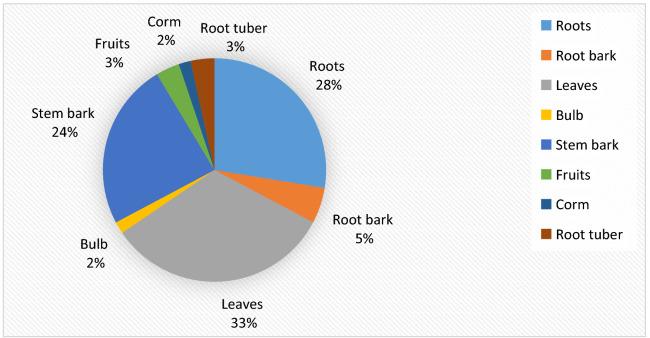
Most herbalists were female (86.7%), aged between 61 and 70 years (43.3%) with no formal education (56.7%), and had 21-30 years of practice (30%). 44 plant species, belonging to 43 genera and 28 families were identified. Leguminosae and Rutaceae plant families were predominant, leaves were frequently used (33%), and trees were the most common habit (44.4%). Most plants were collected in the wild (79.2%), preparation was mainly by decoction (68.8%), and the administration was mainly orally. The main indication was cough and 79.5% of all documented plant species had previously been reported to have a pharmacological activity relevant to the mitigation of respiratory illnesses. Toxicological data was available for 84.1% of the plant species identified.
CONCLUSIONS
The predominant use of roots, root barks, and root tubers by herbalists in Kisumu East Sub County threatens to negatively impact the ecological survival of some plant species. The preservation of herbalists' knowledge of medicinal plants in the study area is a pressing concern considering their advanced age and little formal education. There is a need to conserve some of the medicinal plants documented in this study. The medicinal claims made by herbalists also warrant scientific scrutiny.
背景
农村社区难以获得医疗保健服务,导致许多人求助于使用药用植物治疗各种疾病的草药医生。传统草药的大多数知识都利用本土疗法,这些疗法往往没有记录在案,有失传的风险。保存这些知识可能有助于对有前景的新治疗分子进行科学探究。
方法
使用半结构化问卷收集基苏木东分区30位草药医生的社会人口学信息。还记录了用于治疗呼吸系统疾病的药用植物的当地名称、习性、活性部位、适应症、制备方法、给药途径、科学身份和保护状况。通过文献检索确定其他报告的传统用途、药理活性和毒理学数据。
结果
大多数草药医生为女性(86.7%),年龄在61至70岁之间(43.3%),未接受过正规教育(56.7%),从业21至30年(30%)。共鉴定出44种植物,分属43属28科。豆科和芸香科植物家族占主导,叶子最常被使用(33%),树木是最常见的习性(44.4%)。大多数植物是在野外采集的(79.2%),制备主要采用煎煮法(68.8%),给药主要通过口服。主要适应症为咳嗽,所有记录在案的植物物种中有79.5%此前已被报道具有与缓解呼吸道疾病相关的药理活性。已确定的植物物种中有84.1%有毒理学数据。
结论
基苏木东分区的草药医生对根、根皮和块根的大量使用可能会对某些植物物种的生态生存产生负面影响。考虑到该研究地区草药医生的高龄和较少的正规教育,保护他们关于药用植物的知识是一个紧迫问题。有必要保护本研究中记录的一些药用植物。草药医生提出的药用主张也值得科学审查。


 Zotero 插件