
感染的急、慢性期分泌蛋白的磷酸化。
Phosphorylation of Secreted Proteins during Acute and Chronic Stages of Infection.
机构信息
Signalling in Apicomplexan Parasites Laboratory, The Francis Crick Institute, London, United Kingdom.
Proteomics Science Technology Platform, The Francis Crick Institute, London, United Kingdom.
出版信息
mSphere. 2020 Sep 9;5(5):e00792-20. doi: 10.1128/mSphere.00792-20.
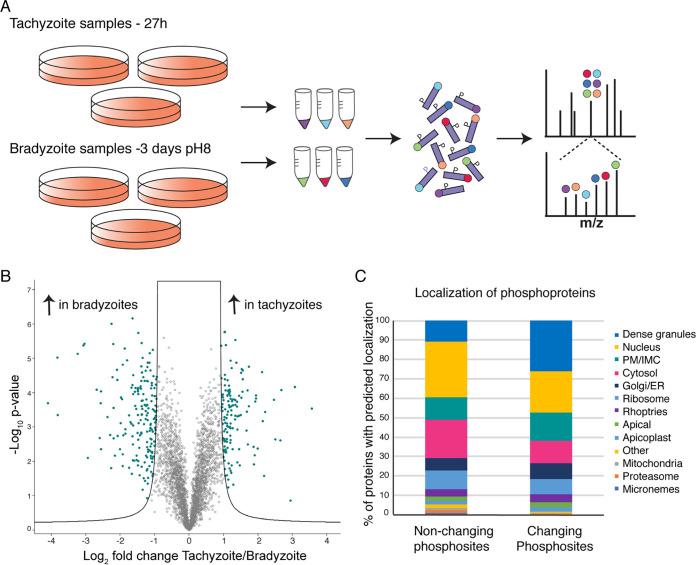
The intracellular parasite resides within a membrane-bound parasitophorous vacuole (PV) and secretes an array of proteins to establish this replicative niche. It has been shown previously that secretes kinases and that numerous proteins are phosphorylated after secretion. Here, we assess the role of the phosphorylation of strand-forming protein 1 (SFP1) and the related protein GRA29, two secreted proteins with unknown function. We show that both proteins form stranded structures in the PV that are independent of the previously described intravacuolar network or actin. SFP1 and GRA29 can each form these structures independently of other secreted proteins, although GRA29 appears to regulate SFP1 strands. We show that an unstructured region at the C termini of SFP1 and GRA29 is required for the formation of strands and that mimicking the phosphorylation of this domain of SFP1 negatively regulates strand development. When tachyzoites convert to chronic-stage bradyzoites, both proteins show a dispersed localization throughout the cyst matrix. Many secreted proteins are reported to dynamically redistribute as the cyst forms, and secreted kinases are known to play a role in cyst formation. Using quantitative phosphoproteome and proteome analyses comparing tachyzoite and early bradyzoite stages, we reveal widespread differential phosphorylation of secreted proteins. While we found no direct evidence for phosphorylation playing a dominant role for SFP1/GRA29 redistribution in the cyst, these data support a model in which secreted kinases and phosphatases contribute to the regulation of secreted proteins during stage conversion. is a common parasite that infects up to one-third of the human population. Initially, the parasite grows rapidly, infecting and destroying cells of the host, but subsequently switches to a slow-growing form and establishes chronic infection. In both stages, the parasite lives within a membrane-bound vacuole within the host cell, but in the chronic stage, a durable cyst wall is synthesized, which provides protection to the parasite during transmission to a new host. secretes proteins into the vacuole to build its replicative niche, and previous studies identified many of these proteins as phosphorylated. We investigate two secreted proteins and show that a phosphorylated region plays an important role in their regulation in acute stages. We also observed widespread phosphorylation of secreted proteins when parasites convert from acute to chronic stages, providing new insight into how the cyst wall may be dynamically regulated.
胞内寄生虫 生活在一个有膜包裹的寄生空泡 (PV) 内,并分泌一系列蛋白质来建立这个复制龛位。先前已经表明, 分泌激酶,并且许多蛋白质在分泌后被磷酸化。在这里,我们评估了磷酸化丝状结构形成蛋白 1 (SFP1) 和相关蛋白 GRA29 的作用,这两种分泌蛋白的功能未知。我们表明,这两种蛋白质在 PV 中形成了丝状结构,这些结构与先前描述的腔内网络或肌动蛋白无关。SFP1 和 GRA29 都可以独立于其他 分泌蛋白形成这些结构,尽管 GRA29 似乎调节 SFP1 链。我们表明,SFP1 和 GRA29 的 C 端无结构区域是形成链所必需的,并且模拟 SFP1 结构域的磷酸化会负调控链的发育。当速殖子转化为慢性阶段缓殖子时,这两种蛋白在整个囊基质中呈现弥散性定位。许多分泌蛋白在囊形成过程中被报道会动态重新分布,并且分泌激酶已知在囊形成中起作用。通过比较速殖子和早期缓殖子阶段的定量磷酸蛋白质组和蛋白质组分析,我们揭示了分泌蛋白广泛的差异磷酸化。虽然我们没有直接证据表明磷酸化在 SFP1/GRA29 在囊中的再分配中起主导作用,但这些数据支持这样一种模型,即分泌激酶和磷酸酶在阶段转换过程中对分泌蛋白的调节起作用。 是一种常见的寄生虫,感染了多达三分之一的人类。最初,寄生虫生长迅速,感染并破坏宿主细胞,但随后转变为缓慢生长的形式并建立慢性感染。在这两个阶段,寄生虫都生活在宿主细胞内的一个有膜包裹的空泡内,但在慢性阶段,合成了一个持久的囊壁,为寄生虫在传播到新宿主时提供保护。 分泌蛋白到空泡中,以建立其复制龛位,先前的研究确定了其中许多蛋白质被磷酸化。我们研究了两种分泌蛋白,并表明磷酸化区域在其急性阶段的调节中起着重要作用。当寄生虫从急性阶段转换为慢性阶段时,我们还观察到分泌蛋白的广泛磷酸化,为囊壁如何动态调节提供了新的见解。


 Zotero 插件