
特发性肺纤维化患者在接受抗纤维化治疗前后用力肺活量下降的预后意义。
Prognostic significance of forced vital capacity decline prior to and following antifibrotic therapy in idiopathic pulmonary fibrosis.
机构信息
Second Division, Department of Internal Medicine, Hamamatsu University School of Medicine, Hamamatsu, Japan.
Second Division, Department of Internal Medicine, Hamamatsu University School of Medicine, 1-20-1 Handayama, Hamamatsu, Shizuoka 431-3192, Japan.
出版信息
Ther Adv Respir Dis. 2020 Jan-Dec;14:1753466620953783. doi: 10.1177/1753466620953783.
BACKGROUND
Idiopathic pulmonary fibrosis (IPF) is a progressive and fatal interstitial lung disease (ILD). Currently, two antifibrotic drugs are available for reducing forced vital capacity (FVC) decline in IPF. However, many pulmonologists wait before initiating treatment, especially when IPF patients have stable disease. This study aimed to investigate the impact on survival outcome of FVC decline and a slow rate of FVC decline prior to and following treatment with these two antifibrotic drugs.
METHODS
Out of the 235 IPF patients treated with antifibrotic therapy that were screened, 105 cases were eligible, who then underwent physiological evaluation at 6 months prior to and following antifibrotic therapy. Clinical characteristics and prognostic outcomes were compared among groups, and prognostic factors were evaluated using a Cox proportional hazards analysis.
RESULTS
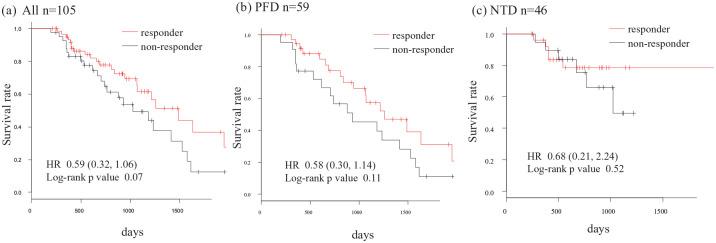
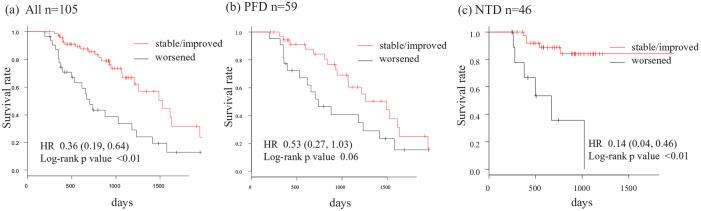
In terms of %FVC decline prior to the therapy and a slow rate of FVC decline, there was no significant difference between stable and worsened groups and responder and non-responder groups, respectively. On the other hand, in terms of %FVC decline (decline >5%) following antifibrotic therapy, the stable/improved group had significantly better prognosis than the worsened group. Prognostic analysis revealed that a stable/improved status following antifibrotic therapy [HR: 0.35 (0.15-0.87)] was significantly associated with a better prognosis.
CONCLUSIONS
Concerning the FVC decline prior to and following antifibrotic therapy and a slow rate of FVC decline, only the FVC decline following the therapy is associated with a greater survival outcome. An early treatment decision may thus be beneficial for IPF.
背景
特发性肺纤维化(IPF)是一种进行性和致命的间质性肺疾病(ILD)。目前,有两种抗纤维化药物可用于减少 IPF 患者用力肺活量(FVC)下降。然而,许多肺病学家在开始治疗前会等待,尤其是当 IPF 患者的疾病稳定时。本研究旨在探讨在开始这两种抗纤维化药物治疗之前和之后,FVC 下降以及 FVC 下降速度较慢对生存结局的影响。
方法
在筛选的 235 例接受抗纤维化治疗的 IPF 患者中,有 105 例符合条件,然后在抗纤维化治疗前和治疗后 6 个月进行生理评估。比较组间的临床特征和预后结局,并使用 Cox 比例风险分析评估预后因素。
结果
在治疗前的 %FVC 下降和 FVC 下降速度较慢方面,稳定组和恶化组以及应答组和非应答组之间没有显著差异。另一方面,在抗纤维化治疗后 %FVC 下降(下降>5%)方面,稳定/改善组的预后明显优于恶化组。预后分析显示,抗纤维化治疗后稳定/改善状态[HR:0.35(0.15-0.87)]与更好的预后显著相关。
结论
就抗纤维化治疗前后的 FVC 下降和 FVC 下降速度较慢而言,只有治疗后的 FVC 下降与更大的生存结局相关。因此,早期治疗决策可能对 IPF 有益。


 Zotero 插件