
世代间病原体诱导的秀丽隐杆线虫滞育受. 调节。
Intergenerational Pathogen-Induced Diapause in Caenorhabditis elegans Is Modulated by .
机构信息
Centro Interdisciplinario de Neurociencia de Valparaíso, Valparaíso, Chile.
Programa de Doctorado Genómica Integrativa, Universidad Mayor, Santiago de Chile, Chile.
出版信息
mBio. 2020 Sep 22;11(5):e01950-20. doi: 10.1128/mBio.01950-20.
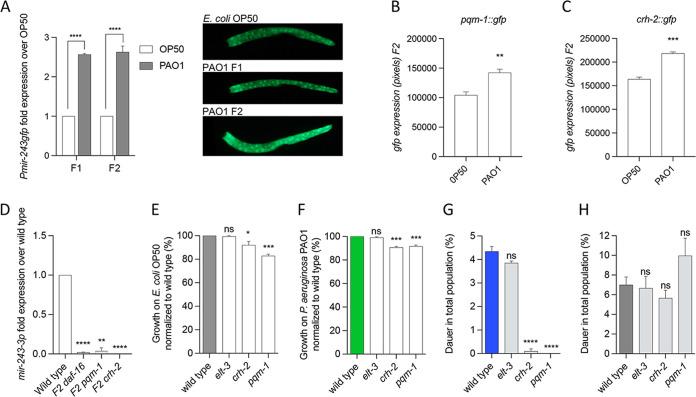
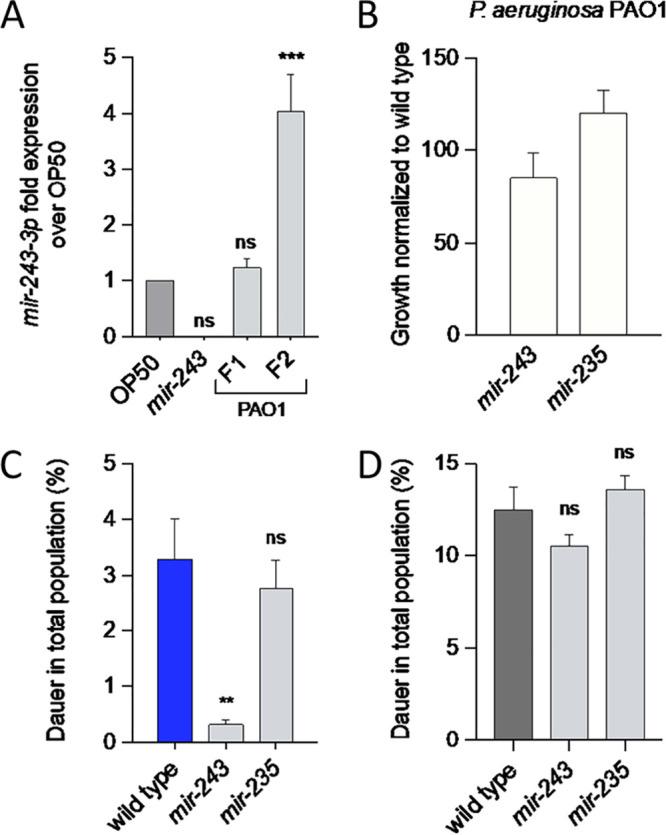
The interaction and communication between bacteria and their hosts modulate many aspects of animal physiology and behavior. Dauer entry as a response to chronic exposure to pathogenic bacteria in is an example of a dramatic survival response. This response is dependent on the RNA interference (RNAi) machinery, suggesting the involvement of small RNAs (sRNAs) as effectors. Interestingly, dauer formation occurs after two generations of interaction with two unrelated moderately pathogenic bacteria. Therefore, we sought to discover the identity of RNAs involved in pathogen-induced diapause. Using transcriptomics and differential expression analysis of coding and long and small noncoding RNAs, we found that (the mature form of ) is the only transcript continuously upregulated in animals exposed to both and for two generations. Phenotypic analysis of mutants showed that is required for dauer formation under pathogenesis but not under starvation. Moreover, DAF-16, a master regulator of defensive responses in the animal and required for dauer formation was found to be necessary for expression. This work highlights the role of a small noncoding RNA in the intergenerational defensive response against pathogenic bacteria and interkingdom communication. Persistent infection of the bacterivore nematode with bacteria such as and makes the worm diapause or hibernate. By doing this, the worm closes its mouth, avoiding infection. This response takes two generations to be implemented. In this work, we looked for genes expressed upon infection that could mediate the worm diapause triggered by pathogens. We identify as the only transcript commonly upregulated when animals feed on and for two consecutive generations. Moreover, we demonstrate that is required for pathogen-induced dauer formation, a new function that has not been previously described for this microRNA (miRNA). We also find that the transcriptional activators DAF-16, PQM-1, and CRH-2 are necessary for the expression of under pathogenesis. Here we establish a relationship between a small RNA and a developmental change that ensures the survival of a percentage of the progeny.
细菌与其宿主之间的相互作用和交流调节着动物生理学和行为的许多方面。作为对慢性暴露于病原菌的反应, dauer 进入是一种显著的生存反应的例子。这种反应依赖于 RNA 干扰(RNAi)机制,表明小分子 RNA(sRNA)作为效应物的参与。有趣的是, dauer 形成发生在与两种不相关的中度致病性细菌相互作用两代之后。因此,我们试图发现参与病原体诱导休眠的 RNA 的身份。使用转录组学和编码和长链及小非编码 RNA 的差异表达分析,我们发现 (成熟形式)是暴露于 和 两代的动物中持续上调的唯一转录本。突变体的表型分析表明, 在发病机制下 dauer 形成是必需的,但在饥饿条件下不是必需的。此外,动物中防御反应的主要调节剂 DAF-16 和 dauer 形成所必需的因子,被发现是 表达所必需的。这项工作突出了一种小非编码 RNA 在针对病原菌的两代防御反应和种间交流中的作用。食细菌线虫 被细菌如 和 持续感染,会使蠕虫休眠或冬眠。通过这样做,蠕虫会闭上嘴,避免感染。这种反应需要两代时间来实现。在这项工作中,我们寻找感染时表达的基因,这些基因可以介导由病原体触发的蠕虫休眠。我们鉴定 为动物连续两代喂食 和 时普遍上调的唯一转录本。此外,我们证明 是病原体诱导 dauer 形成所必需的,这是以前没有描述过这种 microRNA(miRNA)的新功能。我们还发现转录激活因子 DAF-16、PQM-1 和 CRH-2 是 在发病机制下表达 的必要条件。在这里,我们建立了一个小 RNA 和一个发育变化之间的关系,该关系确保了一部分后代的生存。

 Zotero 插件