
2000 年至 2017 年,20 国集团国家为传染病研究提供的 1050 亿美元全球资金分配情况:投资内容分析。
The allocation of USdollar;105 billion in global funding from G20 countries for infectious disease research between 2000 and 2017: a content analysis of investments.
机构信息
Clinical Informatics Research Unit, Faculty of Medicine, University of Southampton, Southampton, UK.
Clinical Informatics Research Unit, Faculty of Medicine, University of Southampton, Southampton, UK.
出版信息
Lancet Glob Health. 2020 Oct;8(10):e1295-e1304. doi: 10.1016/S2214-109X(20)30357-0.
BACKGROUND
Each year, billions of US$ are spent globally on infectious disease research and development. However, there is little systematic tracking of global research and development. We present research on investments into infectious diseases research from funders in the G20 countries across an 18-year time period spanning 2000-17, comparing amounts invested for different conditions and considering the global burden of disease to identify potential areas of relative underfunding.
METHODS
The study examined research awards made between 2000 and 2017 for infectious disease research from G20-based public and philanthropic funders. We searched research databases using a range of keywords, and open access data were extracted from funder websites. Awards were categorised by type of science, specialty, and disease or pathogen. Data collected included study title, abstract, award amount, funder, and year. We used descriptive statistics and Spearman's correlation coefficient to investigate the association between research investment and disease burden, using Global Burden of Disease 2017 study data.
FINDINGS
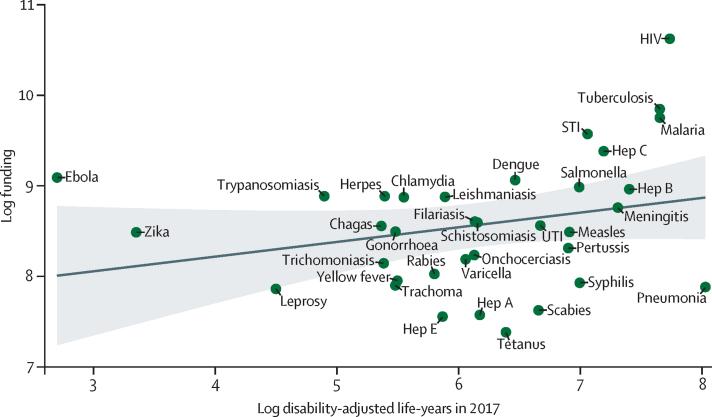
The final 2000-17 dataset included 94 074 awards for infectious disease research, with a sum investment of $104·9 billion (annual range 4·1 billion to 8·4 billion) and a median award size of $257 176 (IQR 62 562-770 661). Pre-clinical research received $61·1 billion (58·2%) across 70 337 (74·8%) awards and public health research received $29·5 billion (28·1%) from 19 197 (20·4%) awards. HIV/AIDS received $42·1 billion (40·1%), tuberculosis received $7·0 billion (6·7%), malaria received $5·6 billion (5·3%), and pneumonia received $3·5 billion (3·3%). Funding for Ebola virus ($1·2 billion), Zika virus ($0·3 billion), influenza ($4·4 billion), and coronavirus ($0·5 billion) was typically highest soon after a high-profile outbreak. There was a general increase in year-on-year investment in infectious disease research between 2000 and 2006, with a decline between 2007 and 2017. Funders based in the USA provided $81·6 billion (77·8%). Based on funding per 2017 disability-adjusted life years (DALYs), HIV/AIDS received the greatest relative investment ($772 per DALY), compared with tuberculosis ($156 per DALY), malaria ($125 per DALY), and pneumonia ($33 per DALY). Syphilis and scabies received the least relative investment (both $9 per DALY). We observed weak positive correlation (r=0·30) between investment and 2017 disease burden.
INTERPRETATION
HIV research received the highest amount of investment relative to DALY burden. Scabies and syphilis received the lowest relative funding. Investments for high-threat pathogens (eg, Ebola virus and coronavirus) were often reactive and followed outbreaks. We found little evidence that funding is proactively guided by global burden or pandemic risk. Our findings show how research investments are allocated and how this relates to disease burden and diseases with pandemic potential.
FUNDING
Bill & Melinda Gates Foundation.
背景
每年,全球在传染病研究和开发上花费了数十亿美元。然而,全球的研究和开发几乎没有系统的跟踪。我们展示了 2000 年至 2017 年期间,来自 20 国集团(G20)国家的资助者对传染病研究的投资情况,对 18 年期间的研究进行了投资,并比较了不同疾病的投资金额,同时考虑了全球疾病负担,以确定潜在的相对投资不足领域。
方法
本研究对 2000 年至 2017 年间来自 G20 公共和慈善资助者的传染病研究的研究奖项进行了检查。我们使用了一系列关键词在研究数据库中进行搜索,并从资助者网站中提取了开放获取数据。奖项按科学类型、专业和疾病或病原体进行分类。收集的数据包括研究标题、摘要、奖励金额、资助者和年份。我们使用描述性统计和斯皮尔曼相关系数来研究研究投资与疾病负担之间的关联,使用 2017 年全球疾病负担研究数据。
结果
最终的 2000-17 年数据集包括 94074 项传染病研究奖励,投资总额为 1049 亿美元(年度范围为 41 亿美元至 84 亿美元),平均奖励规模为 257176 美元(四分位距为 62562 美元至 770661 美元)。在 70337 项(74.8%)奖励中,有 611 亿美元(58.2%)用于临床前研究,有 19197 项(20.4%)奖励获得了 295 亿美元(28.1%)的公共卫生研究。艾滋病毒/艾滋病获得了 421 亿美元(40.1%),结核病获得了 70 亿美元(6.7%),疟疾获得了 56 亿美元(5.3%),肺炎获得了 35 亿美元(3.3%)。埃博拉病毒(12 亿美元)、寨卡病毒(3 亿美元)、流感(44 亿美元)和冠状病毒(5 亿美元)的资金通常在高知名度疫情爆发后最高。2000 年至 2006 年间,传染病研究的年度投资呈总体增长趋势,2007 年至 2017 年间则呈下降趋势。来自美国的资助者提供了 816 亿美元(77.8%)。根据 2017 年残疾调整生命年(DALY)的资金投入,艾滋病毒/艾滋病的相对投资最高(每 DALY 772 美元),其次是结核病(每 DALY 156 美元)、疟疾(每 DALY 125 美元)和肺炎(每 DALY 33 美元)。梅毒和疥疮的相对投资最低(均为每 DALY 9 美元)。我们观察到投资与 2017 年疾病负担之间存在微弱的正相关(r=0.30)。
解释
艾滋病毒研究的投资相对于 DALY 负担来说是最高的。疥疮和梅毒获得的资金最少。针对高威胁病原体(如埃博拉病毒和冠状病毒)的投资通常是被动的,是对疫情爆发的反应。我们几乎没有证据表明资金是主动根据全球负担或大流行风险进行引导的。我们的研究结果展示了研究投资的分配情况,以及这与疾病负担和具有大流行潜力的疾病之间的关系。
资金来源
比尔和梅琳达·盖茨基金会。


 Zotero 插件