
促进慢性多微生物囊性纤维化相关感染治疗中的创新:探索天冬氨酸和琥珀酸作为环丙沙星佐剂
Fostering Innovation in the Treatment of Chronic Polymicrobial Cystic Fibrosis-Associated Infections Exploring Aspartic Acid and Succinic Acid as Ciprofloxacin Adjuvants.
作者信息
Silva Eduarda, Monteiro Rosana, Grainha Tânia, Alves Diana, Pereira Maria Olivia, Sousa Ana Margarida
机构信息
CEB - Centre of Biological Engineering, LIBRO - Laboratório de Investigação em Biofilmes Rosário Oliveira, University of Minho, Braga, Portugal.
出版信息
Front Cell Infect Microbiol. 2020 Aug 27;10:441. doi: 10.3389/fcimb.2020.00441. eCollection 2020.
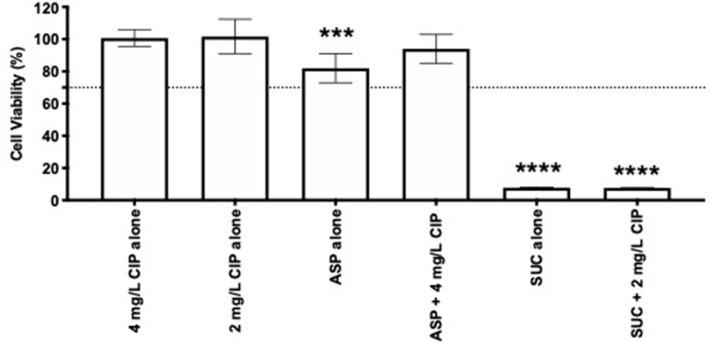
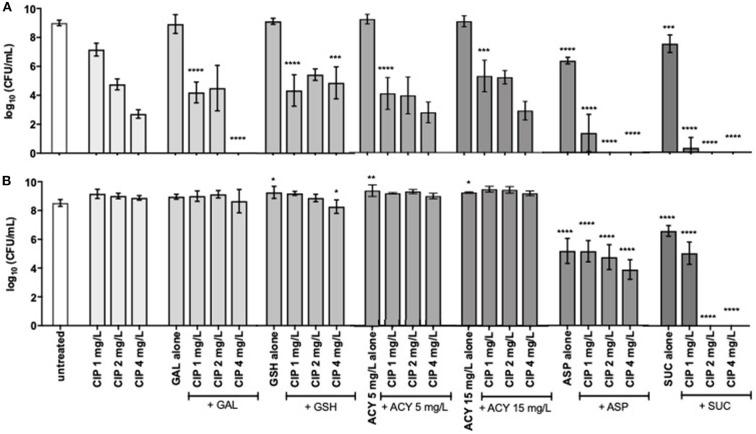
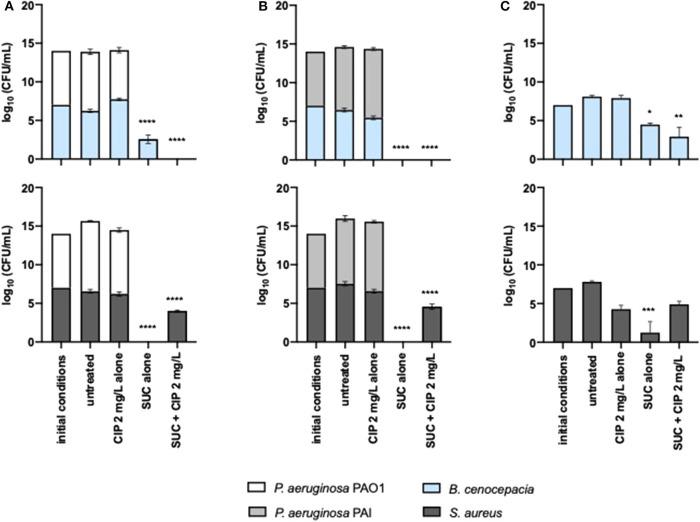
Cystic fibrosis (CF) disease provokes the accumulation of thick and viscous sputum in the lungs, favoring the development of chronic and polymicrobial infections. is the main bacterium responsible for these chronic infections, and much of the difficulty involved in eradicating it is due to biofilm formation. However, this could be mitigated using adjuvant compounds that help or potentiate the antibiotic action. Therefore, the main goal of this study was to search for substances that function as adjuvants and also as biofilm-controlling compounds, preventing or dismantling biofilms formed in an CF airway environment. Dual combinations of compounds with subinhibitory (1 and 2 mg/L) and inhibitory concentrations (4 mg/L) of ciprofloxacin were tested to inhibit the bacterial growth and biofilm formation (prophylactic approach) and to eradicate 24-h-old populations, including planktonic cells and biofilms (treatment approach). Our results revealed that aspartic acid (Asp) and succinic acid (Suc) restored ciprofloxacin action against . Suc combined with 2 mg/L of ciprofloxacin (Suc-Cip) was able to eradicate bacteria, and Asp combined with 4 mg/L of ciprofloxacin (Asp-Cip) seemed to eradicate the whole 24-h-old populations, including planktonic cells and biofilms. Based on biomass depletion data, we noted that Asp induced cell death and Suc seemed somehow to block or reduce the expression of ciprofloxacin resistance. As far as we know, this kind of action had not been reported up till now. The presence of and did not affect the efficacy of the Asp-Cip and Suc-Cip therapies against and, also important, depletion from polymicrobial communities did not create a window of opportunity for these species to thrive. Rather the contrary, Asp and Suc also improved ciprofloxacin action against . Further studies on the cytotoxicity using lung epithelial cells indicated toxicity of Suc-Cip caused by the Suc. In conclusion, we provided evidences that Asp and Suc could be potential ciprofloxacin adjuvants to eradicate living within polymicrobial communities. Asp-Cip and Suc-Cip could be promising therapeutic options to cope with CF treatment failures.
囊性纤维化(CF)疾病会导致肺部积聚浓稠且黏稠的痰液,从而助长慢性和多种微生物感染的发展。铜绿假单胞菌是导致这些慢性感染的主要细菌,而根除该细菌的诸多困难源于生物膜的形成。然而,使用有助于或增强抗生素作用的辅助化合物或许可以缓解这一情况。因此,本研究的主要目标是寻找兼具辅助剂功能以及生物膜控制化合物功能的物质,以预防或拆解在CF气道环境中形成的铜绿假单胞菌生物膜。测试了化合物与亚抑制浓度(1和2毫克/升)以及抑制浓度(4毫克/升)的环丙沙星的双重组合,以抑制细菌生长和生物膜形成(预防方法),并根除24小时龄的细菌群体,包括浮游细胞和生物膜(治疗方法)。我们的结果显示,天冬氨酸(Asp)和琥珀酸(Suc)可恢复环丙沙星对铜绿假单胞菌的作用。琥珀酸与2毫克/升的环丙沙星组合(Suc-Cip)能够根除细菌,而天冬氨酸与4毫克/升的环丙沙星组合(Asp-Cip)似乎能根除整个24小时龄的细菌群体,包括浮游细胞和生物膜。基于生物量消耗数据,我们注意到天冬氨酸可诱导细胞死亡,而琥珀酸似乎以某种方式阻断或降低了环丙沙星耐药性的表达。据我们所知,这种作用至今尚未见报道。铜绿假单胞菌和金黄色葡萄球菌的存在并不影响Asp-Cip和Suc-Cip疗法对铜绿假单胞菌的疗效,同样重要的是,多种微生物群落中这两种菌的减少并未为这些菌种的繁衍创造机会窗口。恰恰相反,天冬氨酸和琥珀酸还增强了环丙沙星对金黄色葡萄球菌的作用。使用肺上皮细胞对细胞毒性进行的进一步研究表明,Suc-Cip的毒性是由琥珀酸引起的。总之,我们提供的证据表明,天冬氨酸和琥珀酸可能是根除多种微生物群落中铜绿假单胞菌的潜在环丙沙星辅助剂。Asp-Cip和Suc-Cip可能是应对CF治疗失败的有前景的治疗选择。



 Zotero 插件