
美国不同收入水平人群中心血管疾病的患病趋势。
Trends in Cardiovascular Disease Prevalence by Income Level in the United States.
机构信息
Department of Epidemiology, Boston University School of Public Health, Boston, Massachusetts.
Boston University School of Public Health, Boston, Massachusetts.
出版信息
JAMA Netw Open. 2020 Sep 1;3(9):e2018150. doi: 10.1001/jamanetworkopen.2020.18150.
IMPORTANCE
Income disparity between persons with the most resources (the top 20% of earners) and the remainder of the population in the United States has dramatically widened over the past few decades. Given the well-established association between income and health, this increasing income gap may provide insights into the dynamics of cardiovascular disease (CVD) burden among adults in the US.
OBJECTIVE
To quantify the contribution of people in the highest-resources group and the remainder of the population to the burden of CVD, and to estimate the trends in the prevalence of CVD for the 2 groups in the United States from 1999 to 2016.
DESIGN, SETTING, AND PARTICIPANTS: This serial cross-sectional analysis used nationally representative data from 9 cycles of the National Health and Nutrition Examination Survey (NHANES) between 1999 and 2016. Survey participants were adults 20 years or older. Statistical analysis of the data was conducted in December 2019.
MAIN OUTCOMES AND MEASURES
Age-standardized prevalence of CVD was calculated using the 2010 census estimates. Participants were stratified by income group using the NHANES income to poverty ratio, which was converted into a binary variable: a ratio of 5 or greater for the highest-resources group and a ratio of less than 5 for the remainder of the population.
RESULTS
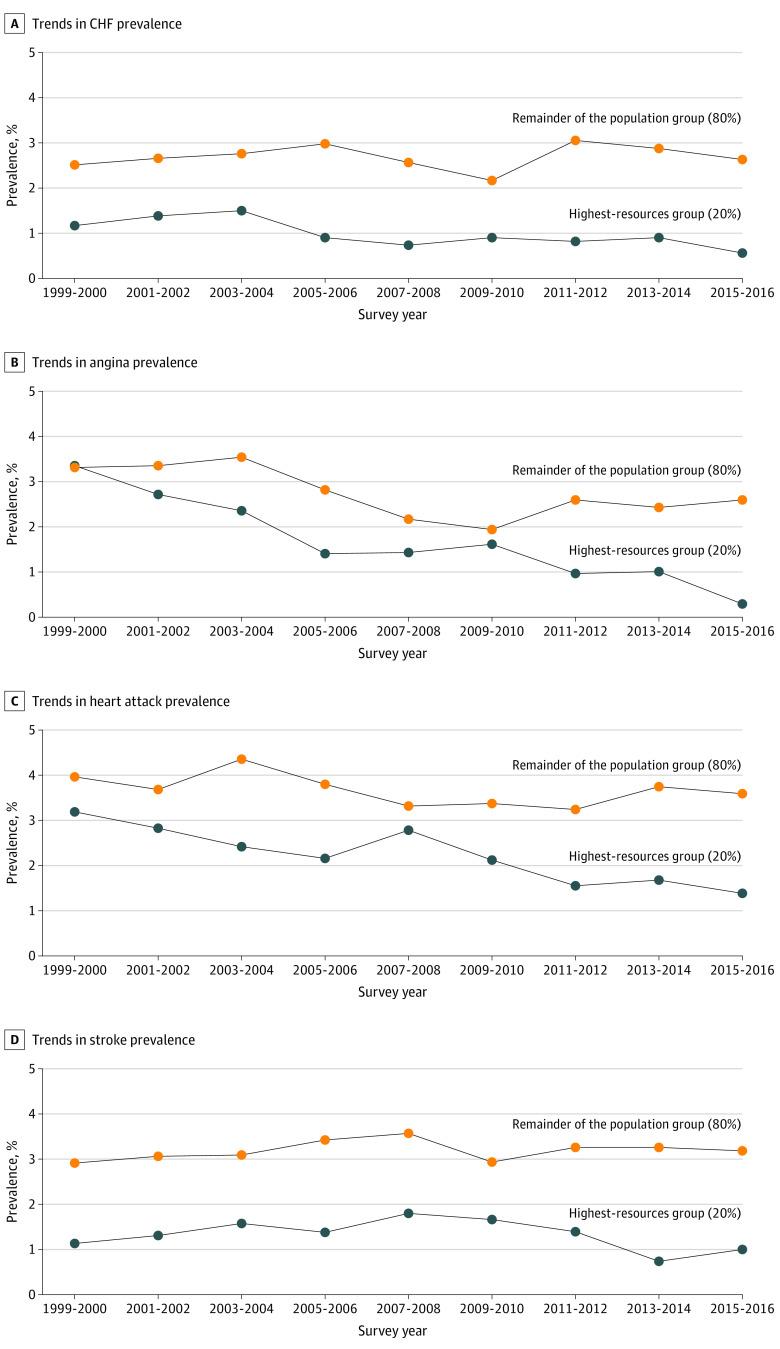
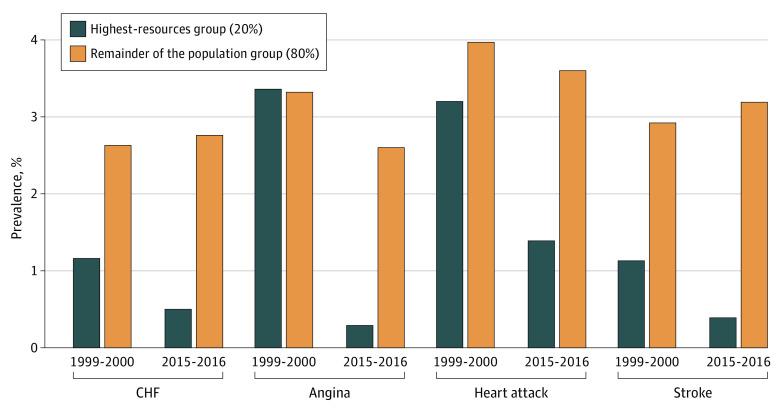
This analysis included 44 986 participants. Among the 7926 participants in the highest-resources group, 3290 (50.3%) were in the 40- to 59-year age group and 4094 (51.9%) were men. Among the 37 060 participants in the remainder of the population, 10 840 (34.1%) were in the 40- to 59-year age group and 19 470 (53.2%) were women. The age-standardized prevalence of CVD decreased in the highest-resources group during the study period (1999-2016): angina from 3.4% (n = 24) to 0.3% (n = 5), heart attack from 3.2% (n = 24) to 1.4% (n = 19), congestive heart failure (CHF) from 1.2% (n = 11) to 0.5% (n = 7), and stroke from 1.1% to 1.0% (n = 8). In the remainder of the population, the prevalence of angina decreased from 3.3% (n = 131) in 1999 to 2.6% (n = 118) in 2016 and heart attack from 4.0% (n = 160) in 1999 to 3.6% (n = 201) in 2016. Conversely, an increase was observed in the prevalence of CHF from 2.6% (n = 123) in 1999 to 2.8% (n = 176) in 2016 and stroke from 2.9% (n = 152) in 1999 to 3.2% (n = 178) in 2016. Over time, the odds of reporting angina (odds ratio [OR], 0.80; 95% CI, 0.73-0.87; P < .001), heart attack (OR, 0.91; 95% CI, 0.86-0.97; P = .003), and CHF (OR, 0.90; 95% CI, 0.82-0.99; P = .03) decreased among those in the highest-resources group, while there was no significant change in the odds of reporting stroke (OR, 0.97; 95% CI, 0.90-1.05; P = .43). Among the remainder of the population, the odds of reporting angina (OR, 0.95; 95% CI, 0.92-0.99; P < .05) and heart attack (OR, 0.99; 95% CI, 0.97-1.02; P = .06) decreased over time. Conversely, there was no statistically significant change in the odds of reporting CHF (OR, 1.02; 95% CI, 1.00-1.05; P = .08) and stroke (OR, 1.02; 95% CI, 0.99-1.04; P = .21).
CONCLUSIONS AND RELEVANCE
This study found substantial and increasing disparities in CVD prevalence between the richest and poorest participants in the NHANES from 1999 to 2016, with lower CVD rate reported among the highest-resources group. Additional research into the dynamics of income inequality and health outcomes as well as policy and public health efforts to mitigate this inequality are needed.
重要性:过去几十年,美国最富有的 20%的人和其余人口之间的收入差距急剧扩大。鉴于收入与健康之间的关系已得到充分证实,这种不断扩大的收入差距可能为了解美国成年人心血管疾病(CVD)负担的动态提供了线索。
目的:量化最高资源群体和其余人群对 CVD 负担的贡献,并估计美国这两个群体在 1999 年至 2016 年期间 CVD 的患病率趋势。
设计、地点和参与者:这是一项使用 1999 年至 2016 年期间进行的 9 个国家健康和营养检查调查(NHANES)周期的全国代表性数据进行的连续横断面分析。调查参与者为 20 岁或以上的成年人。对数据进行了 2019 年 12 月的统计分析。
主要结果和措施:使用 2010 年人口普查估计值计算 CVD 的年龄标准化患病率。参与者按 NHANES 收入与贫困比例的收入组分层,该比例转换为二进制变量:比例为 5 或更高的为最高资源组,比例低于 5 的为其余人群。
结果:这项分析包括 44986 名参与者。在 7926 名最高资源组参与者中,3290 名(50.3%)处于 40 至 59 岁年龄组,4094 名(51.9%)为男性。在 37060 名其余人群参与者中,10840 名(34.1%)处于 40 至 59 岁年龄组,19470 名(53.2%)为女性。在研究期间,最高资源组的 CVD 年龄标准化患病率下降:心绞痛从 3.4%(n=24)降至 0.3%(n=5),心脏病发作从 3.2%(n=24)降至 1.4%(n=19),充血性心力衰竭(CHF)从 1.2%(n=11)降至 0.5%(n=7),中风从 1.1%降至 1.0%(n=8)。在其余人群中,心绞痛的患病率从 1999 年的 3.3%(n=131)降至 2016 年的 2.6%(n=118),心脏病发作的患病率从 1999 年的 4.0%(n=160)降至 2016 年的 3.6%(n=201)。相反,CHF 的患病率从 1999 年的 2.6%(n=123)上升至 2016 年的 2.8%(n=176),中风的患病率从 1999 年的 2.9%(n=152)上升至 2016 年的 3.2%(n=178)。随着时间的推移,报告心绞痛(比值比[OR],0.80;95%置信区间[CI],0.73-0.87;P<0.001)、心脏病发作(OR,0.91;95%CI,0.86-0.97;P=0.003)和 CHF(OR,0.90;95%CI,0.82-0.99;P=0.03)的可能性在最高资源组中降低,而报告中风的可能性(OR,0.97;95%CI,0.90-1.05;P=0.43)没有显著变化。在其余人群中,报告心绞痛(OR,0.95;95%CI,0.92-0.99;P<0.05)和心脏病发作(OR,0.99;95%CI,0.97-1.02;P=0.66)的可能性随着时间的推移而降低。相反,报告 CHF(OR,1.02;95%CI,1.00-1.05;P=0.08)和中风(OR,1.02;95%CI,0.99-1.04;P=0.21)的可能性没有统计学意义的变化。
结论和相关性:这项研究发现,NHANES 从 1999 年到 2016 年,最富有和最贫穷参与者之间 CVD 患病率存在显著且不断扩大的差距,最高资源组报告的 CVD 率较低。需要进一步研究收入不平等与健康结果的动态以及减轻这种不平等的政策和公共卫生努力。


 Zotero 插件