
室内表面化学:构建室内界面反应的分子图景
Indoor Surface Chemistry: Developing a Molecular Picture of Reactions on Indoor Interfaces.
作者信息
Ault Andrew P, Grassian Vicki H, Carslaw Nicola, Collins Douglas B, Destaillats Hugo, Donaldson D James, Farmer Delphine K, Jimenez Jose L, McNeill V Faye, Morrison Glenn C, O'Brien Rachel E, Shiraiwa Manabu, Vance Marina E, Wells J R, Xiong Wei
机构信息
Department of Chemistry, University of Michigan, Ann Arbor, MI 48109, USA.
Department of Chemistry and Biochemistry, University of California, San Diego, La Jolla, CA 92093, USA.
出版信息
Chem. 2020 Dec 3;6(12):3203-3218. doi: 10.1016/j.chempr.2020.08.023. Epub 2020 Sep 19.
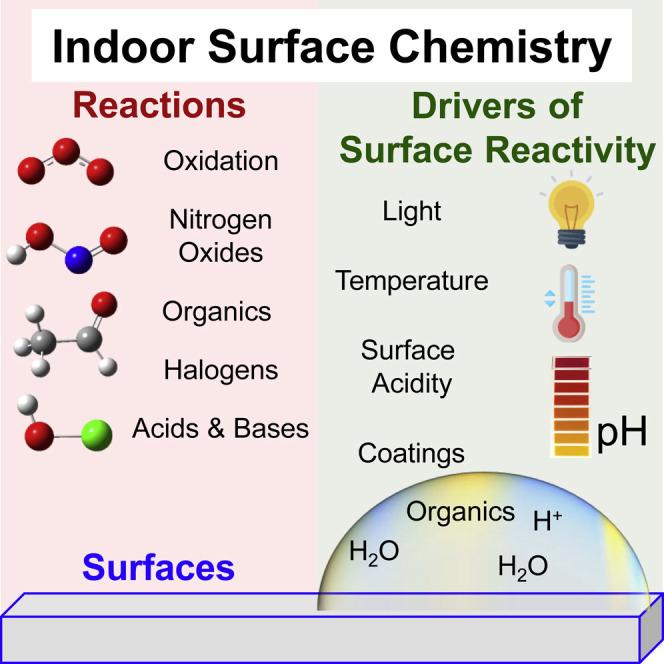
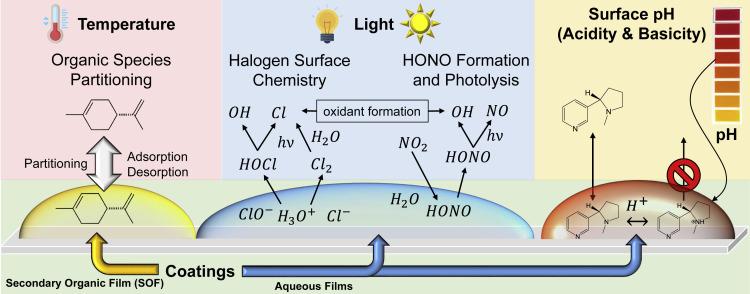
Chemical reactions on indoor surfaces play an important role in air quality in indoor environments, where humans spend 90% of their time. We focus on the challenges of understanding the complex chemistry that takes place on indoor surfaces and identify crucial steps necessary to gain a molecular-level understanding of environmental indoor surface chemistry: (1) elucidate key surface reaction mechanisms and kinetics important to indoor air chemistry, (2) define a range of relevant and representative surfaces to probe, and (3) define the drivers of surface reactivity, particularly with respect to the surface composition, light, and temperature. Within the drivers of surface composition are the roles of adsorbed/absorbed water associated with indoor surfaces and the prevalence, inhomogeneity, and properties of secondary organic films that can impact surface reactivity. By combining laboratory studies, field measurements, and modeling we can gain insights into the molecular processes necessary to further our understanding of the indoor environment.
室内表面上的化学反应在室内环境空气质量中起着重要作用,人类有90%的时间处于室内环境中。我们关注理解发生在室内表面的复杂化学过程所面临的挑战,并确定在分子水平上理解室内环境表面化学所需的关键步骤:(1)阐明对室内空气化学重要的关键表面反应机制和动力学,(2)定义一系列相关且具有代表性的表面进行探测,(3)确定表面反应性的驱动因素,特别是关于表面组成、光照和温度的驱动因素。在表面组成的驱动因素中,与室内表面相关的吸附/吸收水的作用以及可能影响表面反应性的二次有机膜的普遍性、不均匀性和特性。通过结合实验室研究、实地测量和建模,我们可以深入了解分子过程,以进一步增进我们对室内环境的理解。


 Zotero 插件