
不同聚(d-丙交酯)嵌段长度的聚(l-丙交酯)/四臂聚(ε-己内酯)-嵌段-聚(d-丙交酯)共混物的结晶和碱性降解行为
Crystallization and Alkaline Degradation Behaviors of Poly(l-Lactide)/4-Armed Poly(ε-Caprolactone)-Block-Poly(d-Lactide) Blends with Different Poly(d-Lactide) Block Lengths.
作者信息
Dai Suyang, Wang Min, Zhuang Zhuoxin, Ning Zhenbo
机构信息
State Key Laboratory of Organic-Inorganic Composites, Beijing Laboratory of Biomedical Materials, College of Life Science and Technology, Beijing University of Chemical Technology, Beijing 100029, China.
出版信息
Polymers (Basel). 2020 Sep 25;12(10):2195. doi: 10.3390/polym12102195.
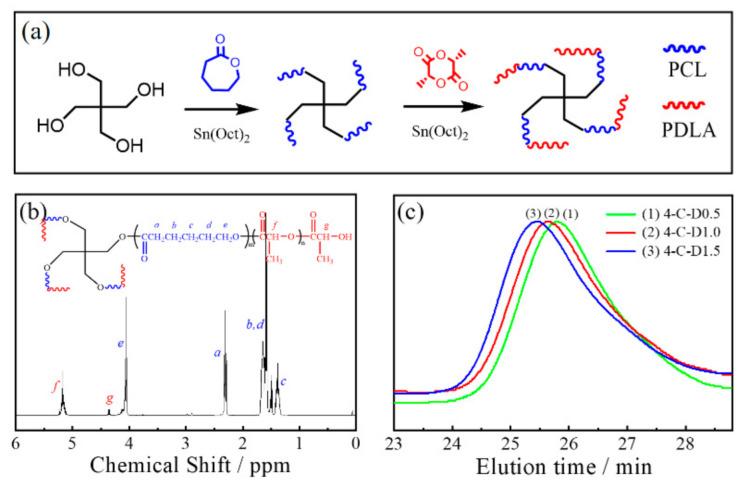
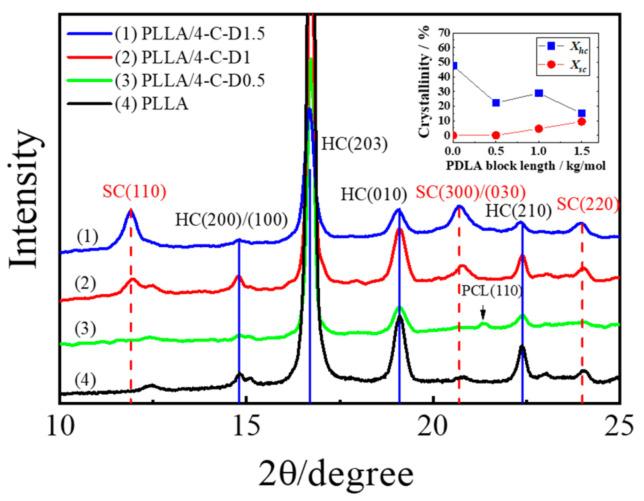
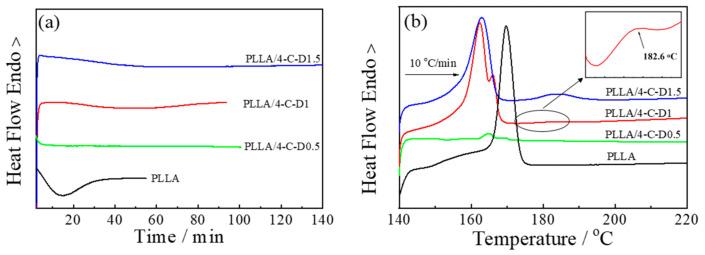
Four-armed poly(ε-caprolactone)--poly(d-lactide) (4-C-D) copolymers with different poly(d-lactide) (PDLA) block lengths (s) were synthesized by sequential ring-opening polymerization (ROP). The formation of stereocomplex (SC) crystallites in the 80/20 poly(l-lactide) (PLLA)/4-C-D blends were investigated with the change of from 0.5 to 1.5 kg/mol. It was found that the crystallization and alkaline degradation of the blends were profoundly affected by the formed SC crystallites. The PLLA/4-C-D0.5 blend had the lowest crystallization rate of the three blends, and it was difficult to see spherulites in this blend by polarized optical microscopy (POM) observation after isothermal crystallization at 140 °C for 4 h. Meanwhile, when was 1 kg/mol or 1.5 kg/mol, SC crystallites could be formed in the PLLA/4-C-D blend and acted as nucleators for the crystallization of PLLA homo-crystals. However, the overall crystallization rates of the two blends were still lower than that of the neat PLLA. In the PLLA/4-C-D1.5 blend, the Raman results showed that small isolated SC spherulites were trapped inside the big PLLA homo-spherulites during isothermal crystallization. The degradation rate of the PLLA/4-C-D blend decreased when increased from 0.5 to 1.5 kg/mol, and the degradation morphologies had a close relationship with the crystallization state of the blends. This work revealed the gradual formation of SC crystallites with the increase in in the PLLA/4-C-D blends and its significant effect on the crystallization and degradation behaviors of the blend films.
通过顺序开环聚合(ROP)合成了具有不同聚(d-丙交酯)(PDLA)嵌段长度(s)的四臂聚(ε-己内酯)-聚(d-丙交酯)(4-C-D)共聚物。研究了80/20聚(l-丙交酯)(PLLA)/4-C-D共混物中立体复合物(SC)微晶的形成随s从0.5至1.5 kg/mol的变化情况。结果发现,共混物的结晶和碱性降解受到所形成的SC微晶的深刻影响。PLLA/4-C-D0.5共混物在三种共混物中结晶速率最低,在140℃等温结晶4小时后,通过偏光光学显微镜(POM)观察很难在该共混物中看到球晶。同时,当s为1 kg/mol或1.5 kg/mol时,PLLA/4-C-D共混物中可形成SC微晶,并作为PLLA均相晶体结晶的成核剂。然而,这两种共混物的总体结晶速率仍低于纯PLLA。在PLLA/4-C-D1.5共混物中,拉曼结果表明,等温结晶过程中,小的孤立SC球晶被困在大的PLLA均相球晶内部。当s从0.5增加到1.5 kg/mol时,PLLA/4-C-D共混物的降解速率降低,降解形态与共混物的结晶状态密切相关。这项工作揭示了随着PLLA/4-C-D共混物中s的增加,SC微晶逐渐形成,以及其对共混物薄膜结晶和降解行为的显著影响。



 Zotero 插件