
在接受他莫昔芬预防乳腺癌 5 年的绝经前妇女队列中,乳腺密度的变化。
Mammographic density change in a cohort of premenopausal women receiving tamoxifen for breast cancer prevention over 5 years.
机构信息
Centre for Cancer Prevention, Wolfson Institute of Preventive Medicine, Queen Mary University of London, Charterhouse Square, London, EC1M 6BQ, UK.
Department of Radiology, Addenbrooke's Hospital, University of Cambridge, Cambridge, UK.
出版信息
Breast Cancer Res. 2020 Sep 29;22(1):101. doi: 10.1186/s13058-020-01340-4.
BACKGROUND
A decrease in breast density due to tamoxifen preventive therapy might indicate greater benefit from the drug. It is not known whether mammographic density continues to decline after 1 year of therapy, or whether measures of breast density change are sufficiently stable for personalised recommendations.
METHODS
Mammographic density was measured annually over up to 5 years in premenopausal women with no previous diagnosis of breast cancer but at increased risk of breast cancer attending a family-history clinic in Manchester, UK (baseline 2010-2013). Tamoxifen (20 mg/day) for prevention was prescribed for up to 5 years in one group; the other group did not receive tamoxifen and were matched by age. Fully automatic methods were used on mammograms over the 5-year follow-up: three area-based measures (NN-VAS, Stratus, Densitas) and one volumetric (Volpara). Additionally, percentage breast density at baseline and first follow-up mammograms was measured visually. The size of density declines at the first follow-up mammogram and thereafter was estimated using a linear mixed model adjusted for age and body mass index. The stability of density change at 1 year was assessed by evaluating mean squared error loss from predictions based on individual or mean density change at 1 year.
RESULTS
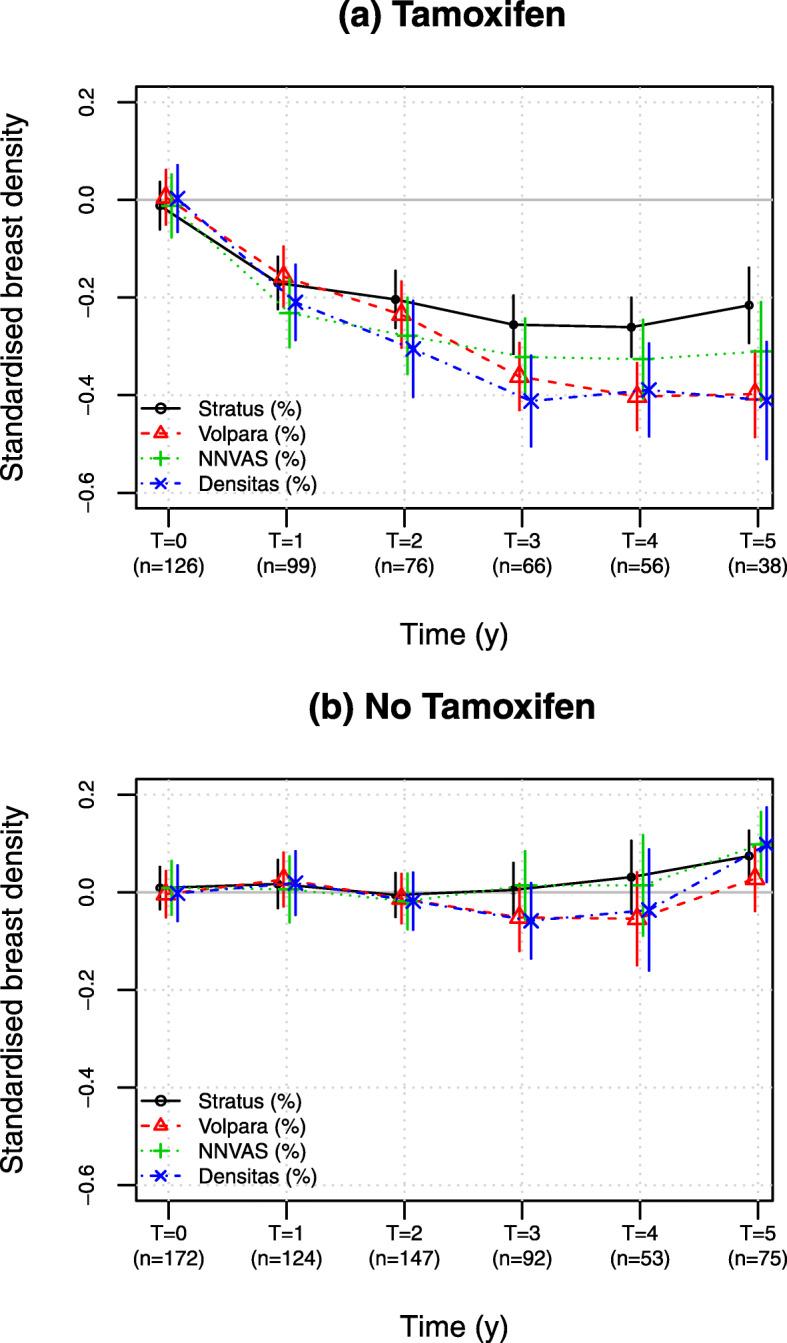
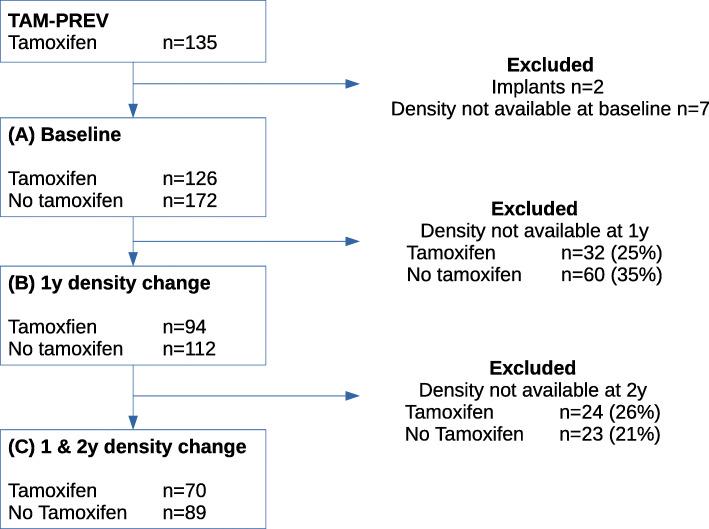
Analysis used mammograms from 126 healthy premenopausal women before and as they received tamoxifen for prevention (median age 42 years) and 172 matched controls (median age 41 years), with median 3 years follow-up. There was a strong correlation between percentage density measures used on the same mammogram in both the tamoxifen and no tamoxifen groups (all correlation coeficients > 0.8). Tamoxifen reduced mean breast density in year 1 by approximately 17-25% of the inter-quartile range of four automated percentage density measures at baseline, and from year 2, it decreased further by approximately 2-7% per year. Predicting change at 2 years using individual change at 1 year was approximately 60-300% worse than using mean change at 1year.
CONCLUSIONS
All measures showed a consistent and large average tamoxifen-induced change in density over the first year, and a continued decline thereafter. However, these measures of density change at 1 year were not stable on an individual basis.
背景
由于他莫昔芬预防治疗导致的乳房密度降低可能表明药物的获益更大。尚不清楚治疗 1 年后乳房密度是否继续下降,或者乳房密度变化的测量是否足够稳定以用于个体化建议。
方法
在英国曼彻斯特的一个家族史诊所,对没有乳腺癌既往诊断但乳腺癌风险增加的绝经前妇女进行了长达 5 年的年度乳房 X 线密度测量(基线时间为 2010-2013 年)。一组妇女接受为期 5 年的他莫昔芬(20 mg/天)预防治疗;另一组未接受他莫昔芬治疗,且与年龄匹配。在 5 年的随访期间,使用全自动方法对乳房 X 线片进行了以下三种基于面积的测量(NN-VAS、Stratus、Densitas)和一种基于体积的测量(Volpara):NN-VAS(非结节性与结节性腺体体积比)、Stratus(腺体百分比)、Densitas(腺体密度)和 Volpara(体积密度)。此外,还通过视觉测量基线和第一次随访乳房 X 线片上的百分比乳腺密度。使用线性混合模型对年龄和体重指数进行调整,以估计第一次随访乳房 X 线片上密度下降的幅度和此后的幅度。通过评估基于个体或 1 年时密度变化的预测的均方误差损失,评估 1 年时密度变化的稳定性。
结果
分析使用了来自 126 名接受他莫昔芬预防治疗的健康绝经前妇女(中位年龄 42 岁)和 172 名匹配对照者(中位年龄 41 岁)的乳房 X 线片,中位随访时间为 3 年。在他莫昔芬组和未接受他莫昔芬组中,使用相同乳房 X 线片上的百分比密度测量之间存在很强的相关性(所有相关系数>0.8)。在第 1 年中,他莫昔芬使平均乳腺密度降低了约 17-25%,4 种自动百分比密度测量中四分位间距的范围,从第 2 年开始,每年进一步降低约 2-7%。使用 1 年时的个体变化预测 2 年时的变化,比使用 1 年时的平均变化预测大约差 60-300%。
结论
所有测量方法在第一年都显示出一致的、较大的、平均的他莫昔芬诱导的密度变化,此后继续下降。然而,这些基于个体的 1 年密度变化测量方法并不稳定。
 Zotero 插件