
恩格列净与 KDIGO 风险类别心血管和肾脏结局:一项随机、双盲、安慰剂对照、多国试验分析。
Empagliflozin and Cardiovascular and Kidney Outcomes across KDIGO Risk Categories: Analysis of a Randomized, Double-Blind, Placebo-Controlled, Multinational Trial.
机构信息
Division of Nephrology, University of British Columbia, Vancouver, Canada.
The George Institute for Global Health, University of New South Wales, Sydney, Australia.
出版信息
Clin J Am Soc Nephrol. 2020 Oct 7;15(10):1433-1444. doi: 10.2215/CJN.14901219. Epub 2020 Sep 29.
BACKGROUND AND OBJECTIVES
In the Empagliflozin Cardiovascular Outcome Event Trial in Type 2 Diabetes Mellitus Patients (EMPA-REG Outcome), empagliflozin, in addition to standard of care, significantly reduced risk of cardiovascular death by 38%, hospitalization for heart failure by 35%, and incident or worsening nephropathy by 39% compared with placebo in patients with type 2 diabetes and established cardiovascular disease. Using EMPA-REG Outcome data, we assessed whether the Kidney Disease Improving Global Outcomes (KDIGO) CKD classification had an influence on the treatment effect of empagliflozin.
DESIGN, SETTING, PARTICIPANTS, & MEASUREMENTS: Patients with type 2 diabetes, established atherosclerotic cardiovascular disease, and eGFR≥30 ml/min per 1.73 m at screening were randomized to receive empagliflozin 10 mg, empagliflozin 25 mg, or placebo once daily in addition to standard of care. , we analyzed cardiovascular and kidney outcomes, and safety, using the two-dimensional KDIGO classification framework.
RESULTS
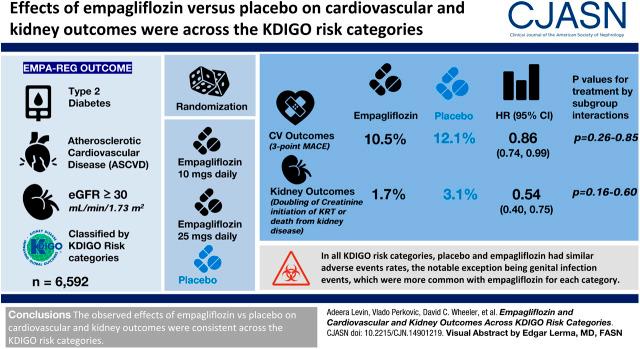
Of 6952 patients with baseline eGFR and urinary albumin-creatinine ratio values, 47%, 29%, 15%, and 8% were classified into low, moderately increased, high, and very high KDIGO risk categories, respectively. Empagliflozin showed consistent risk reductions across KDIGO categories for cardiovascular outcomes ( values for treatment by subgroup interactions ranged from 0.26 to 0.85) and kidney outcomes ( values for treatment by subgroup interactions ranged from 0.16 to 0.60). In all KDIGO risk categories, placebo and empagliflozin had similar adverse event rates, the notable exception being genital infection events, which were more common with empagliflozin for each category.
CONCLUSIONS
The observed effects of empagliflozin versus placebo on cardiovascular and kidney outcomes were consistent across the KDIGO risk categories, indicating that the effect of treatment benefit of empagliflozin was unaffected by baseline CKD status.
CLINICAL TRIAL REGISTRY NAME AND REGISTRATION NUMBER
EMPA-REG OUTCOME, NCT01131676.
背景与目的
在 2 型糖尿病患者的恩格列净心血管结局事件试验(EMPA-REG 结局)中,与安慰剂相比,恩格列净除了标准治疗外,还显著降低了 38%的心血管死亡风险、35%的心衰住院风险以及 39%的新发或恶化肾病风险,这些患者患有 2 型糖尿病和已确诊的心血管疾病。利用 EMPA-REG 结局的数据,我们评估了肾脏病改善全球结局(KDIGO)慢性肾脏病(CKD)分类对恩格列净治疗效果的影响。
设计、地点、参与者和测量:在这项研究中,筛选时 eGFR≥30ml/min/1.73m2的 2 型糖尿病患者、已确诊的动脉粥样硬化性心血管疾病患者被随机分配接受恩格列净 10mg、恩格列净 25mg 或安慰剂,每日一次,同时接受标准治疗。我们分析了心血管和肾脏结局以及安全性,使用二维 KDIGO 分类框架。
结果
在 6952 例基线 eGFR 和尿白蛋白/肌酐比值患者中,分别有 47%、29%、15%和 8%被归类为低、中升高、高和极高 KDIGO 风险类别。在所有 KDIGO 风险类别中,恩格列净在心血管结局(治疗亚组间交互作用值范围为 0.26 至 0.85)和肾脏结局(治疗亚组间交互作用值范围为 0.16 至 0.60)方面均显示出一致的风险降低。在所有 KDIGO 风险类别中,安慰剂和恩格列净的不良事件发生率相似,唯一的例外是生殖器官感染事件,在每个类别中,恩格列净的发生率都更高。
结论
与安慰剂相比,恩格列净在心血管和肾脏结局方面的观察效果在 KDIGO 风险类别中是一致的,这表明恩格列净治疗获益的效果不受基线 CKD 状态的影响。
临床试验注册名称和注册号
EMPA-REG 结局,NCT01131676。
 Zotero 插件