
褪黑素与衰老相关神经退行性疾病中的自噬作用。
Melatonin and Autophagy in Aging-Related Neurodegenerative Diseases.
机构信息
Department of Neurosurgery, Brigham and Women's Hospital, Harvard Medical School, Boston, MA 02115, USA.
Section of Molecular Pharmacology and Toxicology, Laboratory of Membrane Biochemistry and Biophysics, National Institute on Alcohol Abuse and Alcoholism, National Institutes of Health, Rockville, MD 20892, USA.
出版信息
Int J Mol Sci. 2020 Sep 28;21(19):7174. doi: 10.3390/ijms21197174.
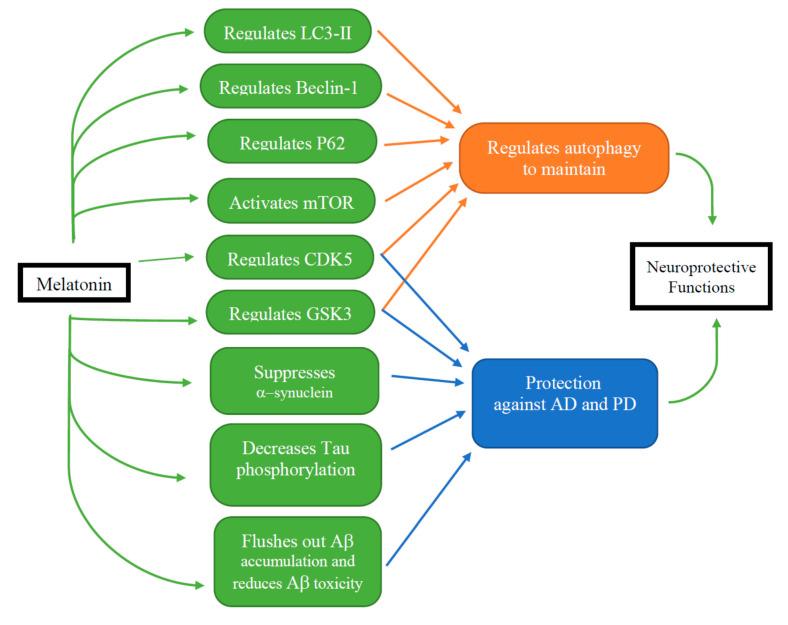
With aging, the nervous system gradually undergoes degeneration. Increased oxidative stress, endoplasmic reticulum stress, mitochondrial dysfunction, and cell death are considered to be common pathophysiological mechanisms of various neurodegenerative diseases (NDDs) such as Alzheimer's disease (AD), Parkinson's disease (PD), Huntington's disease (HD), organophosphate-induced delayed neuropathy (OPIDN), and amyotrophic lateral sclerosis (ALS). Autophagy is a cellular basic metabolic process that degrades the aggregated or misfolded proteins and abnormal organelles in cells. The abnormal regulation of neuronal autophagy is accompanied by the accumulation and deposition of irregular proteins, leading to changes in neuron homeostasis and neurodegeneration. Autophagy exhibits both a protective mechanism and a damage pathway related to programmed cell death. Because of its "double-edged sword", autophagy plays an important role in neurological damage and NDDs including AD, PD, HD, OPIDN, and ALS. Melatonin is a neuroendocrine hormone mainly synthesized in the pineal gland and exhibits a wide range of biological functions, such as sleep control, regulating circadian rhythm, immune enhancement, metabolism regulation, antioxidant, anti-aging, and anti-tumor effects. It can prevent cell death, reduce inflammation, block calcium channels, etc. In this review, we briefly discuss the neuroprotective role of melatonin against various NDDs via regulating autophagy, which could be a new field for future translational research and clinical studies to discover preventive or therapeutic agents for many NDDs.
随着年龄的增长,神经系统逐渐发生退化。氧化应激增加、内质网应激、线粒体功能障碍和细胞死亡被认为是各种神经退行性疾病(NDDs)的常见病理生理机制,如阿尔茨海默病(AD)、帕金森病(PD)、亨廷顿病(HD)、有机磷诱导的迟发性神经病(OPIDN)和肌萎缩侧索硬化症(ALS)。自噬是一种细胞基本代谢过程,可降解细胞内聚集或错误折叠的蛋白质和异常细胞器。神经元自噬的异常调节伴随着异常蛋白质的积累和沉积,导致神经元内稳态的改变和神经退行性变。自噬表现出与程序性细胞死亡相关的保护机制和损伤途径。由于其“双刃剑”的特性,自噬在包括 AD、PD、HD、OPIDN 和 ALS 在内的神经损伤和 NDDs 中发挥着重要作用。褪黑素是一种主要由松果体合成的神经内分泌激素,具有广泛的生物学功能,如睡眠控制、调节昼夜节律、增强免疫、代谢调节、抗氧化、抗衰老和抗肿瘤作用。它可以防止细胞死亡、减少炎症、阻断钙通道等。在这篇综述中,我们简要讨论了褪黑素通过调节自噬对各种 NDDs 的神经保护作用,这可能是未来转化研究和临床研究发现许多 NDDs 的预防或治疗药物的一个新领域。
 Zotero 插件