
两种新型荧光探针作为多种金属离子的系统传感器:聚焦于汞的检测
Two Novel Fluorescent Probes as Systematic Sensors for Multiple Metal Ions: Focus on Detection of Hg.
作者信息
Zhong Wenxia, Wang Lizhen, Qin Dawei, Zhou Jianhua, Duan Hongdong
机构信息
School of Chemistry and Chemical Engineering, Qilu University of Technology (Shandong Academy of Sciences), Ji'nan 250353, Shandong, China.
Biology Institute, Qilu University of Technology (Shandong Academy of Sciences), Ji'nan 250014, Shandong, China.
出版信息
ACS Omega. 2020 Sep 14;5(38):24285-24295. doi: 10.1021/acsomega.0c02481. eCollection 2020 Sep 29.
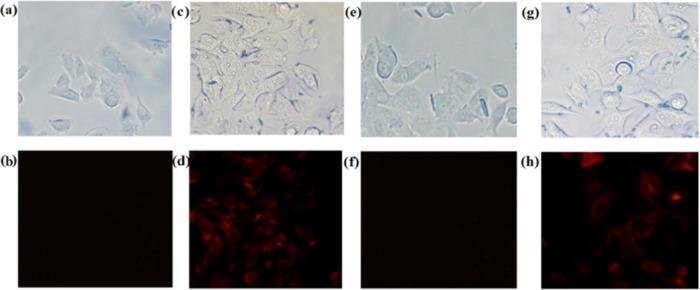
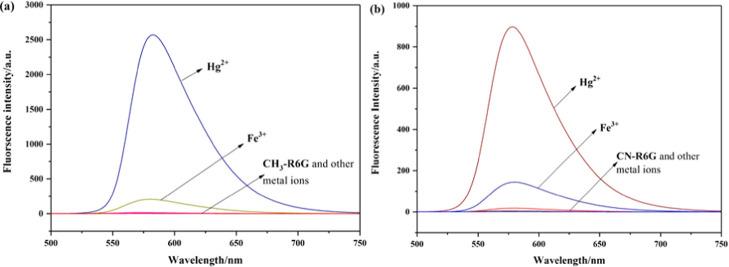
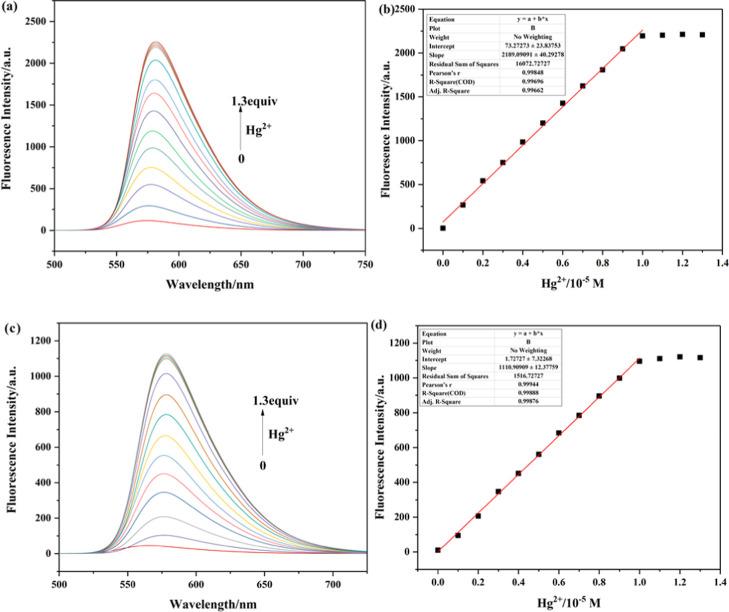
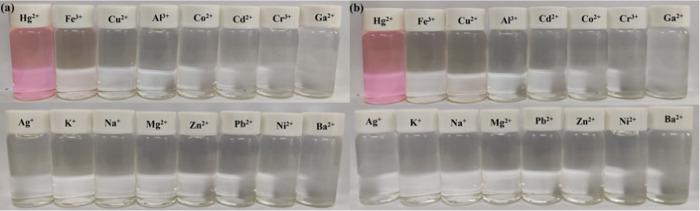
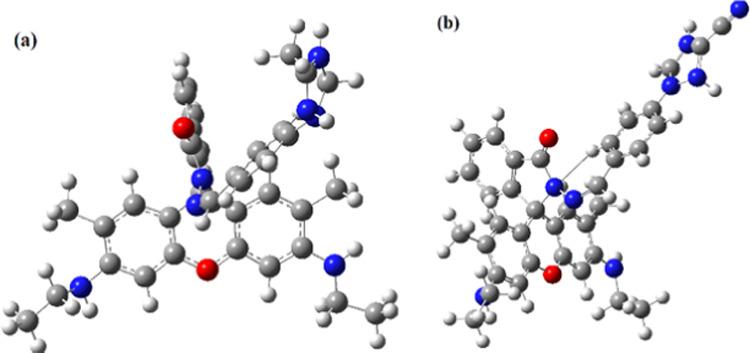
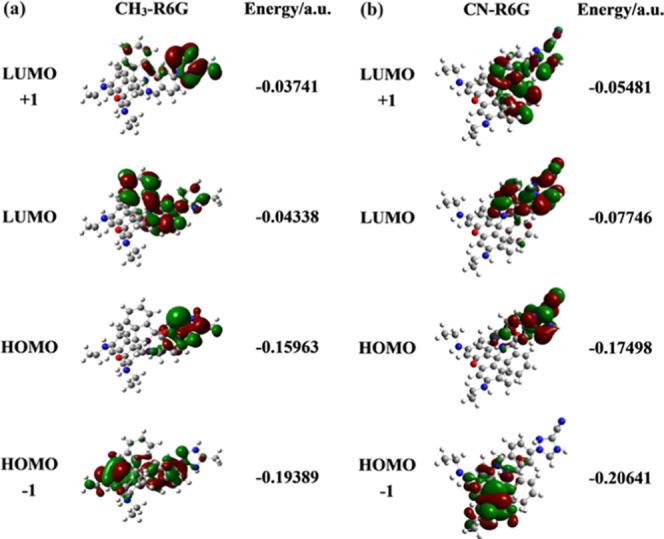
Many precedents prove that fluorescent probes are promising candidates for detection of metal ions in the environment and biological systems. Herein, two novel photoinduced electron transfer (PET)-based fluorescent probes, and , were rationally synthesized by incorporating a triazolyl benzaldehyde moiety into the rhodamine 6G fluorophore. The optical properties of these probes were studied using an ultraviolet-visible (UV-vis) absorption spectrophotometer and a fluorescence spectrophotometer. Through the analysis of the test results, it is concluded that the selectivity and sensitivity of these two probes to Hg are better than to other metal ions (Ag, Al, Ba, Cd, Co, Cu, Cr, Fe, Ga, K, Mg, Na, Ni, Pb, and Zn). According to the standard curve diagram, the detection limits of and were determined to be 1.34 × 10 and 1.56 × 10 M, respectively. Reaction of the probes with Hg resulted in a color change of the solution from colorless to pink. The corresponding molecular geometric configuration, orbital electron distribution, and orbital energy of these two compounds were predicted by density functional theory (DFT). The two probes and have been successfully used for imaging Hg in live breast cancer cells, thereby indicating their great potential for the micro-detection of Hg in vivo.
许多先例证明,荧光探针是检测环境和生物系统中金属离子的有前途的候选物。在此,通过将三唑基苯甲醛部分引入罗丹明6G荧光团,合理合成了两种新型的基于光诱导电子转移(PET)的荧光探针 和 。使用紫外可见(UV-vis)吸收分光光度计和荧光分光光度计研究了这些探针的光学性质。通过对测试结果的分析得出,这两种探针对Hg的选择性和灵敏度优于其他金属离子(Ag、Al、Ba、Cd、Co、Cu、Cr、Fe、Ga、K、Mg、Na、Ni、Pb和Zn)。根据标准曲线图, 和 的检测限分别确定为1.34×10 和1.56×10 M。探针与Hg反应导致溶液颜色从无色变为粉红色。通过密度泛函理论(DFT)预测了这两种化合物相应的分子几何构型、轨道电子分布和轨道能量。 和 这两种探针已成功用于活乳腺癌细胞中Hg的成像,从而表明它们在体内微量检测Hg方面具有巨大潜力。








 Zotero 插件