
肠道通透性的改变伴随着细菌易位,是调节机体对 SARS-CoV-2 全身免疫反应的关键事件:一个工作假说。
Intestinal permeability changes with bacterial translocation as key events modulating systemic host immune response to SARS-CoV-2: A working hypothesis.
机构信息
Department of Medico-Surgical Sciences and Biotechnologies, Sapienza University of Rome, Viale dell'Università 37, Rome 00185, Italy.
Pancreato-biliary Endoscopy and Endosonography Division, Pancreas Translational and Clinical Research Center, San Raffaele Scientific Institute IRCCS, Milan, Italy.
出版信息
Dig Liver Dis. 2020 Dec;52(12):1383-1389. doi: 10.1016/j.dld.2020.09.009. Epub 2020 Sep 16.
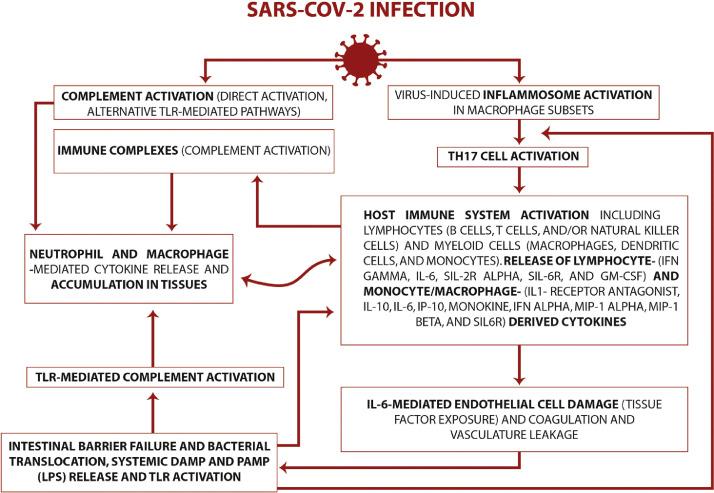
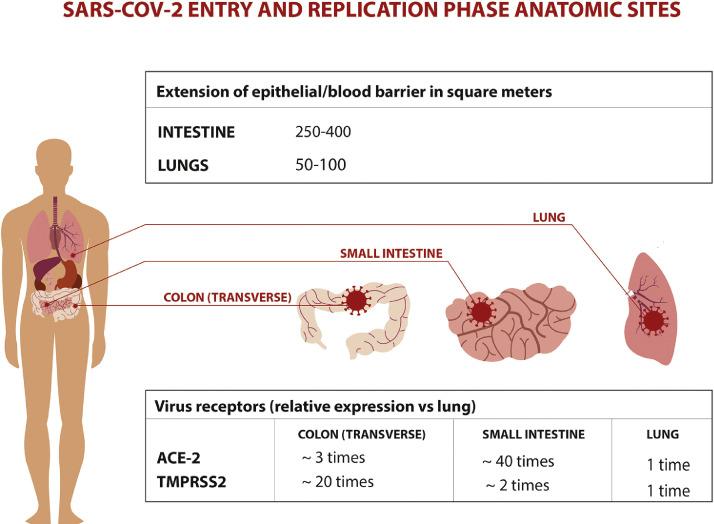
The microbiota-gut-liver-lung axis plays a bidirectional role in the pathophysiology of a number of infectious diseases. During the course of severe acute respiratory syndrome coronavirus 1 (SARS-CoV-1) and 2 (SARS-CoV-2) infection, this pathway is unbalanced due to intestinal involvement and systemic inflammatory response. Moreover, there is convincing preliminary evidence linking microbiota-gut-liver axis perturbations, proinflammatory status, and endothelial damage in noncommunicable preventable diseases with coronavirus disease 2019 (Covid-19) severity. Intestinal damage due to SARS-CoV-2 infection, systemic inflammation-induced dysfunction, and IL-6-mediated diffuse vascular damage may increase intestinal permeability and precipitate bacterial translocation. The systemic release of damage- and pathogen-associated molecular patterns (e.g. lipopolysaccharides) and consequent immune-activation may in turn auto-fuel vicious cycles of systemic inflammation and tissue damage. Thus, intestinal bacterial translocation may play an additive/synergistic role in the cytokine release syndrome in Covid-19. This review provides evidence on gut-liver axis involvement in Covid-19 as well as insights into the hypothesis that intestinal endotheliitis and permeability changes with bacterial translocation are key pathophysiologic events modulating systemic inflammatory response. Moreover, it presents an overview of readily applicable measures for the modulation of the gut-liver axis and microbiota in clinical practice.
肠道菌群-肠-肝-肺轴在多种感染性疾病的病理生理学中发挥着双向作用。在严重急性呼吸综合征冠状病毒 1(SARS-CoV-1)和 2(SARS-CoV-2)感染过程中,由于肠道受累和全身炎症反应,这条途径失去了平衡。此外,有令人信服的初步证据表明,非传染性可预防疾病中的肠道菌群-肠-肝轴紊乱、促炎状态和内皮损伤与 2019 年冠状病毒病(COVID-19)的严重程度有关。SARS-CoV-2 感染导致的肠道损伤、全身炎症诱导的功能障碍和 IL-6 介导的弥漫性血管损伤可能会增加肠道通透性并促使细菌易位。损伤和病原体相关分子模式(例如脂多糖)的全身释放以及随之而来的免疫激活可能反过来引发全身炎症和组织损伤的恶性循环。因此,肠道细菌易位可能在 COVID-19 的细胞因子释放综合征中起附加/协同作用。这篇综述提供了肠道-肝脏轴在 COVID-19 中的作用的证据,并提出了一个假设,即肠道内皮炎症和通透性变化与细菌易位是调节全身炎症反应的关键病理生理事件。此外,它还概述了在临床实践中易于应用的调节肠道-肝脏轴和微生物组的措施。
 Zotero 插件