
基于科学网的骨缺损研究热点与趋势:文献计量分析
Research hotspots and trends of bone defects based on Web of Science: a bibliometric analysis.
作者信息
Lin Haixiong, Wang Xiaotong, Huang Minling, Li Zige, Shen Zhen, Feng Junjie, Chen Huamei, Wu Jingjing, Gao Junyan, Wen Zheng, Huang Feng, Jiang Ziwei
机构信息
The First School of Clinical Medicine, Guangzhou University of Chinese Medicine, NO. 12 Jichang Road, Baiyun District, Guangzhou, 510405, People's Republic of China.
Clinical Medical College of Acupuncture, Moxibustion and Rehabilitation, Guangzhou University of Chinese Medicine, Guangzhou, 510006, People's Republic of China.
出版信息
J Orthop Surg Res. 2020 Oct 8;15(1):463. doi: 10.1186/s13018-020-01973-3.
BACKGROUND
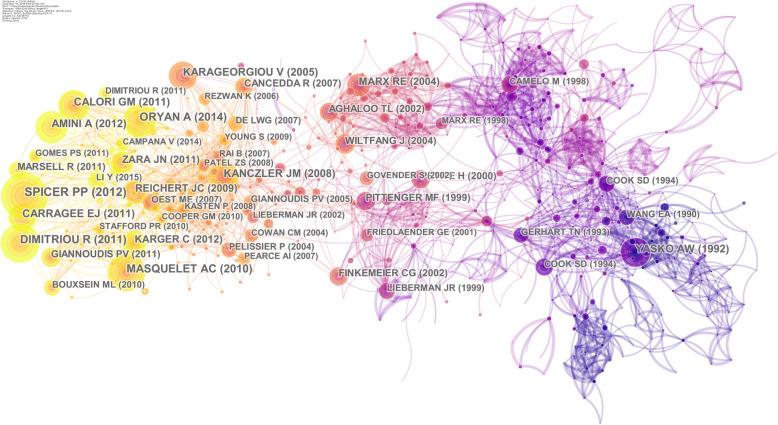
Bone defects can be seen everywhere in the clinic, but it is still a challenge for clinicians. Bibliometrics tool CiteSpace is based on the principle of "co-citation analysis theory" to reveal new technologies, hotspots, and trends in the medical field. In this study, CiteSpace was used to perform co-citation analysis on authors, countries (regions) and institutions, journals and cited journals, authors and cited literature, as well as keywords to reveal leaders, cooperative institutions, and research hotspots of bone defects and predict development trends.
METHOD
Data related to bone defect from 1994 to 2019 were retrieved from the Web of Science core collection; then, we use Excel to construct an exponential function to predict the number of annual publications; conduct a descriptive analysis on the top 10 journals with the largest number of publications; and perform co-citation analysis on authors, countries (regions) and institutions, journals and cited journals, authors and cited reference, and keywords using CiteSpace V5.5 and use the Burst Detection Algorithm to perform analysis on the countries (regions) and institutions and keywords, as well as cluster the keywords using log-likelihood ratio.
RESULTS
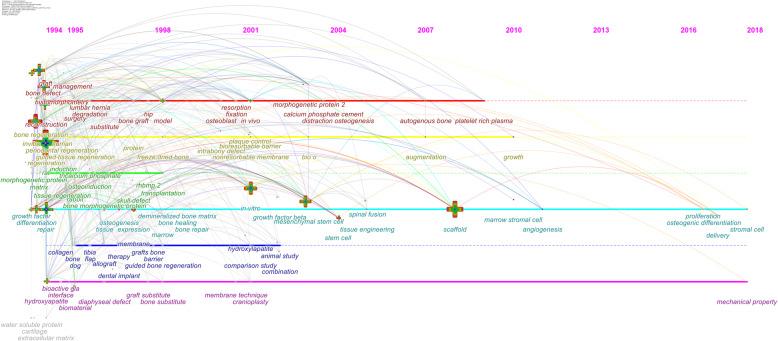
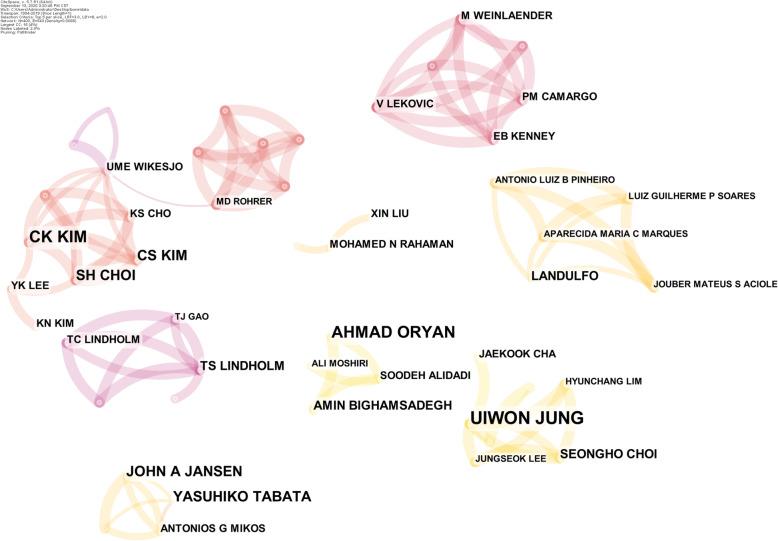
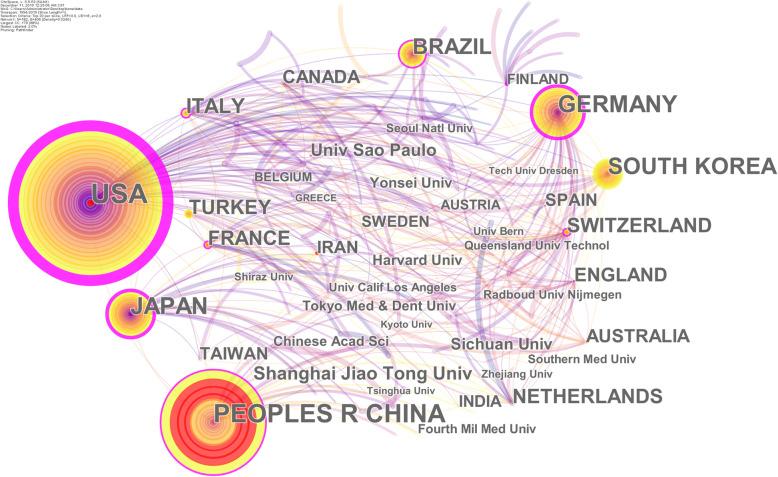
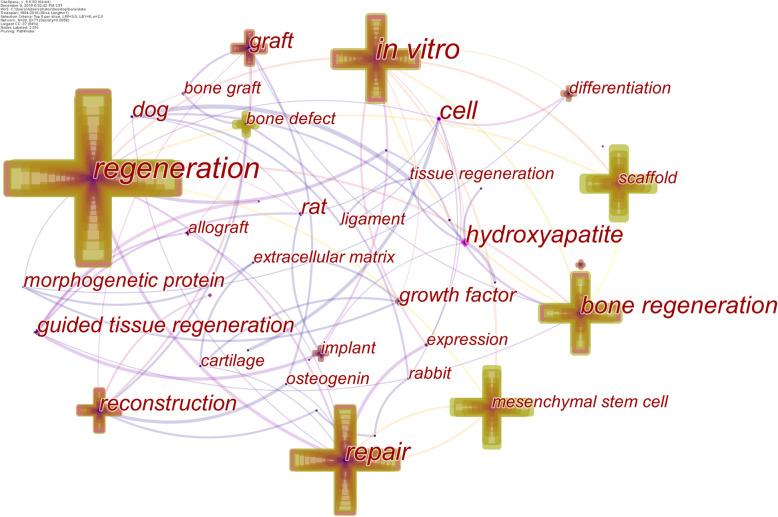
A total of 5193 studies were retrieved, and the number of annual publications of bone defects showed an exponential function Y = 1×10 (R = 0.9778). The high-yield author was Choi Seong-Ho at Yonsei University in South Korea. The high-yielding countries were the USA and Germany, and the high-yielding institutions were the Sao Paulo University and China and the Chinese Academy of Sciences which were the emerging research countries and institutions. The research results were mainly published in the fields of dentistry, bone, and metabolism. Among them, the Journal of Dental Research and Journal of Bone and Mineral Research were high-quality journals that report bone defect research, but the most cited journal was the Clinical Orthopaedics and Related Research. Hot keywords were regeneration, repair, in vitro, bone regeneration, reconstruction, and graft. The keywords that were strongly cited in 2010-2019 were transportation, osteogenic differentiation, proliferation, and biomaterials. After 2018, proliferation, osteogenic differentiation, stromal cells, transmission, and mechanical properties have become new vocabulary. The drug delivery, vascularization, osteogenic differentiation and biomaterial properties of bone defects were expected to be further studied.
CONCLUSION
The application of CiteSpace can reveal the leaders, cooperating institutions and research hotspots of bone defects and provide references for new technologies and further research directions.
背景
骨缺损在临床上随处可见,但对临床医生来说仍是一项挑战。文献计量学工具CiteSpace基于“共被引分析理论”原则,以揭示医学领域的新技术、热点和趋势。在本研究中,使用CiteSpace对作者、国家(地区)和机构、期刊和被引期刊、作者和被引文献以及关键词进行共被引分析,以揭示骨缺损领域的领军人物、合作机构和研究热点,并预测发展趋势。
方法
从Web of Science核心合集中检索1994年至2019年与骨缺损相关的数据;然后,我们使用Excel构建指数函数来预测年度发文数量;对发文量排名前10的期刊进行描述性分析;并使用CiteSpace V5.5对作者、国家(地区)和机构、期刊和被引期刊、作者和被引参考文献以及关键词进行共被引分析,并使用突发检测算法对国家(地区)和机构以及关键词进行分析,同时使用对数似然比方法对关键词进行聚类。
结果
共检索到5193项研究,骨缺损的年度发文数量呈指数函数Y = 1×10(R = 0.9778)。高产作者是韩国延世大学的Choi Seong-Ho。高产国家是美国和德国,高产机构是圣保罗大学以及作为新兴研究国家和机构的中国和中国科学院。研究成果主要发表在牙科、骨骼和代谢领域。其中,《牙科研究杂志》和《骨与矿物质研究杂志》是报道骨缺损研究的高质量期刊,但被引次数最多的期刊是《临床骨科学及相关研究》。热门关键词有再生、修复、体外、骨再生、重建和移植。2010 - 2019年被强烈引用的关键词有转运、成骨分化、增殖和生物材料。2018年后,增殖、成骨分化、基质细胞、传导和力学性能成为新的词汇。骨缺损的药物递送、血管化、成骨分化和生物材料性能有望得到进一步研究。
结论
CiteSpace的应用能够揭示骨缺损领域的领军人物、合作机构和研究热点,为新技术和进一步的研究方向提供参考。




 Zotero 插件