
肾纤维化中部分上皮-间质转化的作用及机制新见解
New Insights Into the Role and Mechanism of Partial Epithelial-Mesenchymal Transition in Kidney Fibrosis.
作者信息
Sheng Lili, Zhuang Shougang
机构信息
Department of Nephrology, Shanghai East Hospital, Tongji University School of Medicine, Shanghai, China.
Department of Medicine, Rhode Island Hospital and Alpert Medical School, Brown University, Providence, RI, United States.
出版信息
Front Physiol. 2020 Sep 15;11:569322. doi: 10.3389/fphys.2020.569322. eCollection 2020.
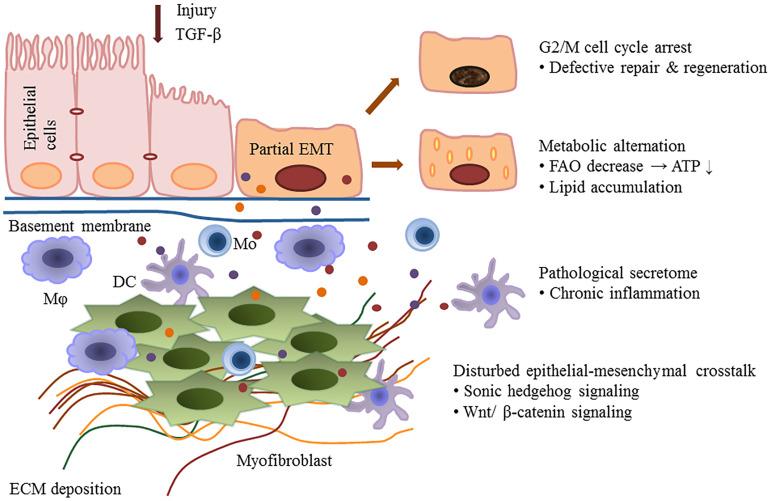
Epithelial-mesenchymal transition (EMT) is described as the process in which injured renal tubular epithelial cells undergo a phenotype change, acquiring mesenchymal characteristics and morphing into fibroblasts. Initially, it was widely thought of as a critical mechanism of fibrogenesis underlying chronic kidney disease. However, evidence that renal tubular epithelial cells can cross the basement membrane and become fibroblasts in the renal interstitium is rare, leading to debate about the existence of EMT. Recent research has demonstrated that after injury, renal tubular epithelial cells acquire mesenchymal characteristics and the ability to produce a variety of profibrotic factors and cytokines, but remain attached to the basement membrane. On this basis, a new concept of "partial epithelial-mesenchymal transition (pEMT)" was proposed to explain the contribution of renal epithelial cells to renal fibrogenesis. In this review, we discuss the concept of pEMT and the most recent findings related to this process, including cell cycle arrest, metabolic alternation of epithelial cells, infiltration of immune cells, epigenetic regulation as well as the novel signaling pathways that mediate this disturbed epithelial-mesenchymal communication. A deeper understanding of the role and the mechanism of pEMT may help in developing novel therapies to prevent and halt fibrosis in kidney disease.
上皮-间质转化(EMT)被描述为受损肾小管上皮细胞发生表型改变、获得间质特征并转变为成纤维细胞的过程。最初,它被广泛认为是慢性肾脏病纤维化形成的关键机制。然而,肾小管上皮细胞能够穿过基底膜并在肾间质中成为成纤维细胞的证据很少,这引发了关于EMT是否存在的争论。最近的研究表明,损伤后肾小管上皮细胞获得间质特征以及产生多种促纤维化因子和细胞因子的能力,但仍附着于基底膜。在此基础上,提出了“部分上皮-间质转化(pEMT)”这一新概念,以解释肾上皮细胞在肾纤维化形成中的作用。在这篇综述中,我们讨论了pEMT的概念以及与该过程相关的最新研究发现,包括细胞周期停滞、上皮细胞的代谢改变、免疫细胞浸润、表观遗传调控以及介导这种紊乱的上皮-间质通讯的新信号通路。对pEMT的作用和机制有更深入的了解可能有助于开发预防和阻止肾脏疾病纤维化的新疗法。
 Zotero 插件