
寄生虫靶标脱氧鸟苷酸合酶的结构特征和检测平台的开发,该靶标来源于班氏吴策线虫和利什曼原虫。
Structural features and development of an assay platform of the parasite target deoxyhypusine synthase of Brugia malayi and Leishmania major.
机构信息
Chemistry Institute, São Paulo State University-UNESP, Araraquara, SP, Brazil.
School of Pharmaceutical Sciences, São Paulo State University-UNESP, Araraquara, SP, Brazil.
出版信息
PLoS Negl Trop Dis. 2020 Oct 12;14(10):e0008762. doi: 10.1371/journal.pntd.0008762. eCollection 2020 Oct.
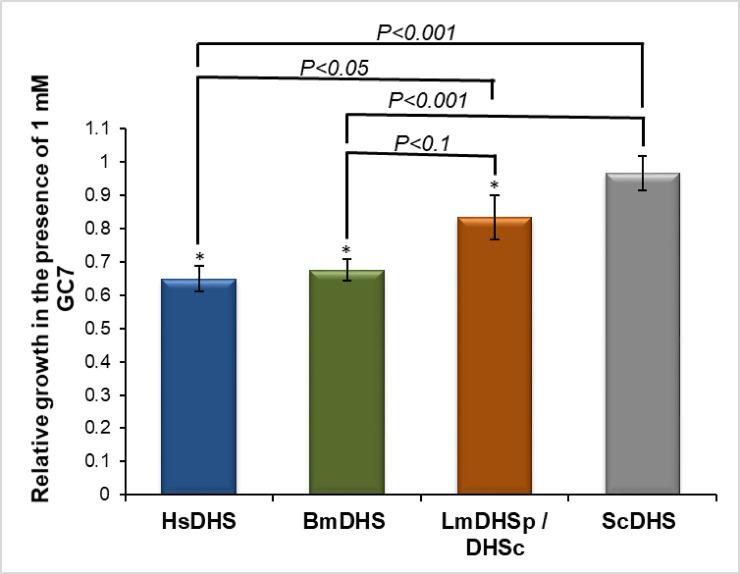
Deoxyhypusine synthase (DHS) catalyzes the first step of the post-translational modification of eukaryotic translation factor 5A (eIF5A), which is the only known protein containing the amino acid hypusine. Both proteins are essential for eukaryotic cell viability, and DHS has been suggested as a good candidate target for small molecule-based therapies against eukaryotic pathogens. In this work, we focused on the DHS enzymes from Brugia malayi and Leishmania major, the causative agents of lymphatic filariasis and cutaneous leishmaniasis, respectively. To enable B. malayi (Bm)DHS for future target-based drug discovery programs, we determined its crystal structure bound to cofactor NAD+. We also reported an in vitro biochemical assay for this enzyme that is amenable to a high-throughput screening format. The L. major genome encodes two DHS paralogs, and attempts to produce them recombinantly in bacterial cells were not successful. Nevertheless, we showed that ectopic expression of both LmDHS paralogs can rescue yeast cells lacking the endogenous DHS-encoding gene (dys1). Thus, functionally complemented dys1Δ yeast mutants can be used to screen for new inhibitors of the L. major enzyme. We used the known human DHS inhibitor GC7 to validate both in vitro and yeast-based DHS assays. Our results show that BmDHS is a homotetrameric enzyme that shares many features with its human homologue, whereas LmDHS paralogs are likely to form a heterotetrameric complex and have a distinct regulatory mechanism. We expect our work to facilitate the identification and development of new DHS inhibitors that can be used to validate these enzymes as vulnerable targets for therapeutic interventions against B. malayi and L. major infections.
脱羟鸟氨酸合酶(DHS)催化真核翻译起始因子 5A(eIF5A)的翻译后修饰的第一步,它是唯一已知的含有羟赖氨酸的蛋白质。这两种蛋白质对真核细胞的存活都是必不可少的,DHS 已被提议作为针对真核病原体的小分子治疗的良好候选靶标。在这项工作中,我们专注于引起淋巴丝虫病和皮肤利什曼病的分别是班氏丝虫和利什曼原虫中的 DHS 酶。为了使班氏丝虫(Bm)DHS 能够用于未来基于靶标的药物发现计划,我们确定了与辅因子 NAD+结合的 BmDHS 的晶体结构。我们还报告了一种可用于高通量筛选格式的该酶的体外生化测定法。L. major 基因组编码两个 DHS 旁系同源物,但在细菌细胞中重组产生它们的尝试并未成功。尽管如此,我们表明异位表达这两个 LmDHS 旁系同源物都可以拯救缺乏内源性 DHS 编码基因(dys1)的酵母细胞。因此,功能互补的 dys1Δ 酵母突变体可用于筛选新的 L. major 酶抑制剂。我们使用已知的人 DHS 抑制剂 GC7 验证了体外和酵母 DHS 测定法。我们的结果表明,BmDHS 是一种同四聚体酶,与人类同源物有许多共同特征,而 LmDHS 旁系同源物可能形成异四聚体复合物,具有独特的调节机制。我们希望我们的工作能够促进 DHS 抑制剂的鉴定和开发,这些抑制剂可用于验证这些酶作为针对 B. malayi 和 L. major 感染的治疗干预的脆弱靶标。


 Zotero 插件