
非洲环境下应对 COVID-19 疫情的策略:一项数学建模研究。
Response strategies for COVID-19 epidemics in African settings: a mathematical modelling study.
机构信息
Department of Infectious Disease Epidemiology, Centre for Mathematical Modelling of Infectious Diseases, London School of Hygiene and Tropical Medicine, Keppel Street,, London, WC1E 7HT, UK.
South African Centre for Epidemiological Modelling and Analysis, Stellenbosch University, Stellenbosch, Republic of South Africa.
出版信息
BMC Med. 2020 Oct 14;18(1):324. doi: 10.1186/s12916-020-01789-2.
BACKGROUND
The health impact of COVID-19 may differ in African settings as compared to countries in Europe or China due to demographic, epidemiological, environmental and socio-economic factors. We evaluated strategies to reduce SARS-CoV-2 burden in African countries, so as to support decisions that balance minimising mortality, protecting health services and safeguarding livelihoods.
METHODS
We used a Susceptible-Exposed-Infectious-Recovered mathematical model, stratified by age, to predict the evolution of COVID-19 epidemics in three countries representing a range of age distributions in Africa (from oldest to youngest average age: Mauritius, Nigeria and Niger), under various effectiveness assumptions for combinations of different non-pharmaceutical interventions: self-isolation of symptomatic people, physical distancing and 'shielding' (physical isolation) of the high-risk population. We adapted model parameters to better represent uncertainty about what might be expected in African populations, in particular by shifting the distribution of severity risk towards younger ages and increasing the case-fatality ratio. We also present sensitivity analyses for key model parameters subject to uncertainty.
RESULTS
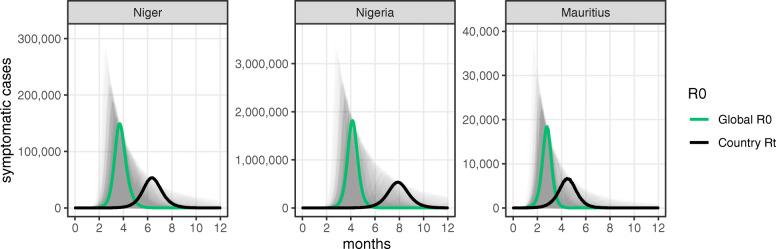
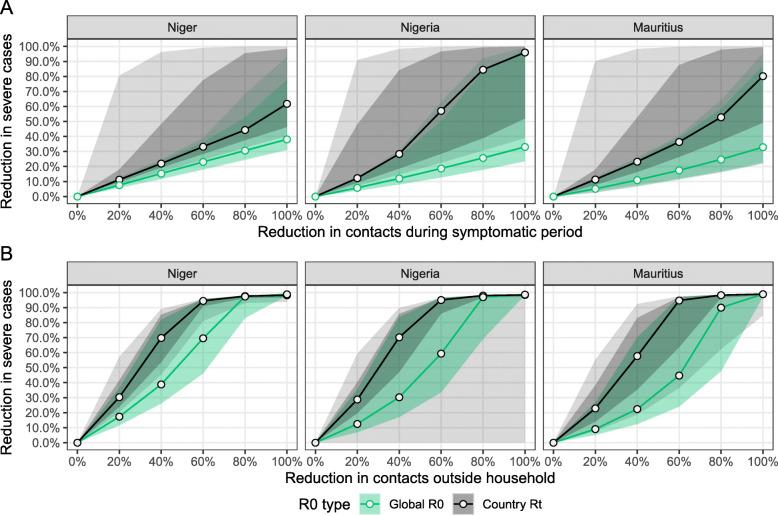
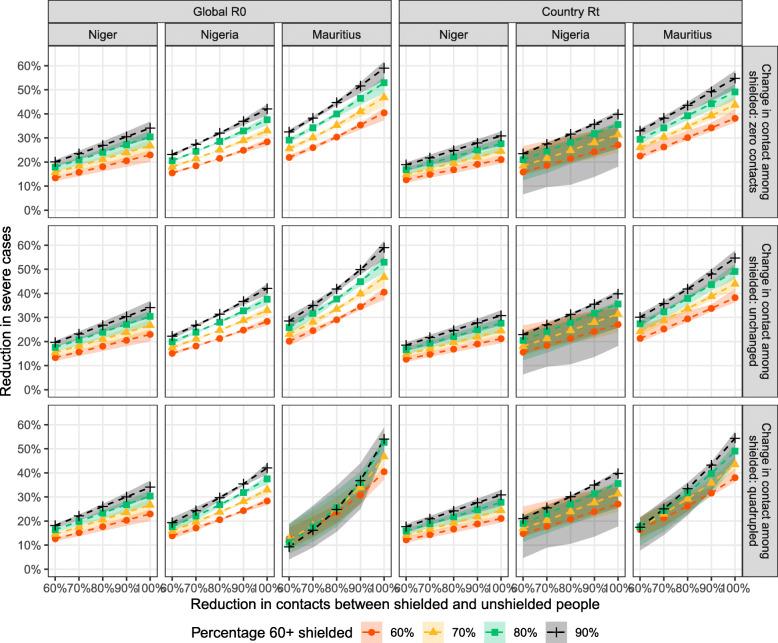
We predicted median symptomatic attack rates over the first 12 months of 23% (Niger) to 42% (Mauritius), peaking at 2-4 months, if epidemics were unmitigated. Self-isolation while symptomatic had a maximum impact of about 30% on reducing severe cases, while the impact of physical distancing varied widely depending on percent contact reduction and R. The effect of shielding high-risk people, e.g. by rehousing them in physical isolation, was sensitive mainly to residual contact with low-risk people, and to a lesser extent to contact among shielded individuals. Mitigation strategies incorporating self-isolation of symptomatic individuals, moderate physical distancing and high uptake of shielding reduced predicted peak bed demand and mortality by around 50%. Lockdowns delayed epidemics by about 3 months. Estimates were sensitive to differences in age-specific social mixing patterns, as published in the literature, and assumptions on transmissibility, infectiousness of asymptomatic cases and risk of severe disease or death by age.
CONCLUSIONS
In African settings, as elsewhere, current evidence suggests large COVID-19 epidemics are expected. However, African countries have fewer means to suppress transmission and manage cases. We found that self-isolation of symptomatic persons and general physical distancing are unlikely to avert very large epidemics, unless distancing takes the form of stringent lockdown measures. However, both interventions help to mitigate the epidemic. Shielding of high-risk individuals can reduce health service demand and, even more markedly, mortality if it features high uptake and low contact of shielded and unshielded people, with no increase in contact among shielded people. Strategies combining self-isolation, moderate physical distancing and shielding could achieve substantial reductions in mortality in African countries. Temporary lockdowns, where socioeconomically acceptable, can help gain crucial time for planning and expanding health service capacity.
背景
由于人口结构、流行病学、环境和社会经济等因素,新冠疫情对非洲国家的影响可能与欧洲或中国的国家不同。我们评估了在非洲国家减少 SARS-CoV-2 负担的策略,以支持平衡死亡率最小化、保护卫生服务和保障生计的决策。
方法
我们使用了一个易感-暴露-感染-恢复的数学模型,按年龄分层,以预测在三个国家的 COVID-19 疫情演变,这三个国家代表了非洲不同年龄分布的范围(从最年长到最年轻的平均年龄:毛里求斯、尼日利亚和尼日尔),不同非药物干预措施的组合具有不同的有效性假设:有症状者的自我隔离、身体距离和高危人群的“隔离”(身体隔离)。我们调整了模型参数,以更好地代表非洲人群中可能出现的不确定性,特别是通过将严重风险的分布转移到年轻年龄,并增加病死率。我们还对受不确定性影响的关键模型参数进行了敏感性分析。
结果
我们预测,如果疫情不得到缓解,前 12 个月内有症状的攻击率中位数将在 23%(尼日尔)到 42%(毛里求斯)之间,峰值出现在 2-4 个月。有症状时自我隔离的最大影响约为 30%,可减少重症病例,而身体距离的影响则因减少接触的百分比和 R 而异。对高危人群(例如,将他们隔离在物理隔离中)进行隔离的效果主要取决于与低危人群的残留接触,以及在较小程度上取决于隔离人群之间的接触。纳入有症状者自我隔离、适度身体距离和高比例隔离高危人群的缓解策略将预测的峰值床位需求和死亡率降低约 50%。封锁使疫情延迟了约 3 个月。估计值对文献中公布的特定年龄社会混合模式的差异以及对传染性、无症状病例的传染性和年龄相关严重疾病或死亡风险的假设敏感。
结论
在非洲国家,与其他地方一样,目前的证据表明,预计会出现大规模的 COVID-19 疫情。然而,非洲国家在抑制传播和管理病例方面手段较少。我们发现,除非距离采取严格封锁措施的形式,否则自我隔离和普遍的身体距离不太可能避免非常大的疫情。然而,这两种干预措施都有助于减轻疫情。如果高危人群的隔离具有高参与度和低隔离与未隔离人群的接触,且隔离人群之间的接触没有增加,则可以减少卫生服务需求,死亡率降低更为明显。结合自我隔离、适度身体距离和隔离的策略可以在非洲国家实现死亡率的大幅降低。在社会经济上可以接受的情况下,临时封锁可以为规划和扩大卫生服务能力争取宝贵的时间。

 Zotero 插件