
双组分应答调节子 Ssk1 和丝裂原活化蛋白激酶 Hog1 控制新型致病真菌耳念珠菌的抗真菌药物耐药性和细胞壁结构。
The Two-Component Response Regulator Ssk1 and the Mitogen-Activated Protein Kinase Hog1 Control Antifungal Drug Resistance and Cell Wall Architecture of Candida auris.
机构信息
Public Health Research Institute, Rutgers, The State University of New Jersey, Newark, New Jersey, USA.
Medical University of Vienna, Department of Medical Biochemistry, Max Perutz Labs Vienna, Vienna, Austria.
出版信息
mSphere. 2020 Oct 14;5(5):e00973-20. doi: 10.1128/mSphere.00973-20.
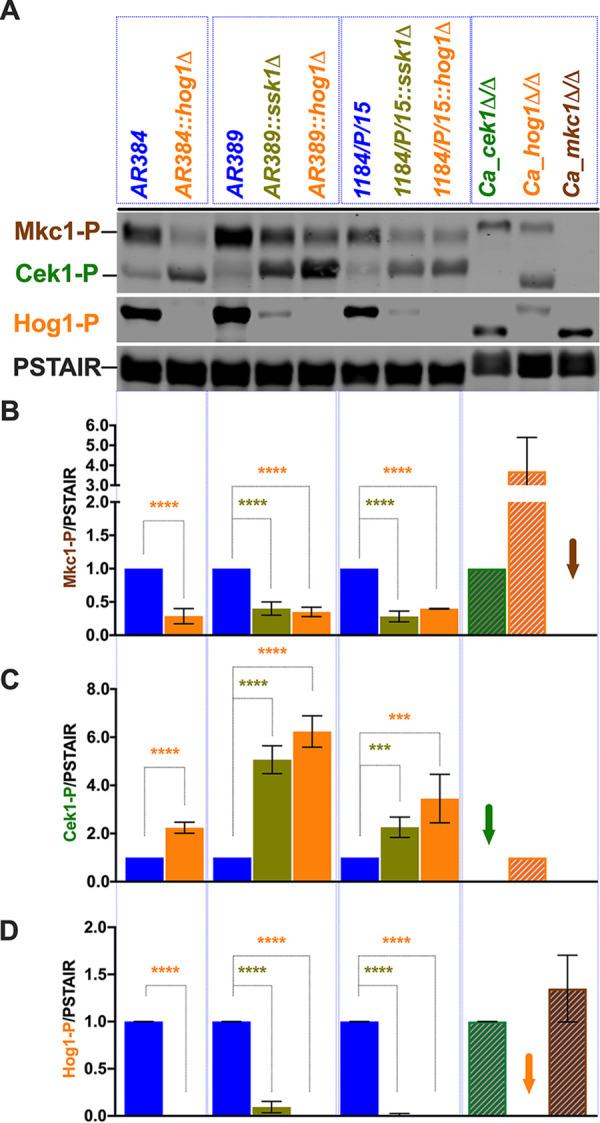
is an emerging multidrug-resistant human fungal pathogen refractory to treatment by several classes of antifungal drugs. Unlike other species, can adhere to human skin for prolonged periods of time, allowing for efficient skin-to-skin transmission in the hospital environments. However, molecular mechanisms underlying pronounced multidrug resistance and adhesion traits are poorly understood. Two-component signal transduction and mitogen-activated protein (MAP) kinase signaling are important regulators of adherence, antifungal drug resistance, and virulence. Here, we report that genetic removal of encoding a response regulator and the mitogen-associated protein kinase restores the susceptibility to both amphotericin B (AMB) and caspofungin (CAS) in clinical strains. The loss of and alters membrane lipid permeability, cell wall mannan content, and hyperresistance to cell wall-perturbing agents. Interestingly, our data reveal variable functions of and in different clinical isolates, suggesting a pronounced genetic plasticity affecting cell wall function, stress adaptation, and multidrug resistance. Taken together, our data suggest that targeting two-component signal transduction systems could be suitable for restoring susceptibility to antifungal drugs. is an emerging multidrug-resistant (MDR) fungal pathogen that presents a serious global threat to human health. The Centers for Disease Control and Prevention (CDC) have classified as an urgent threat to public health for the next decade due to its major clinical and economic impact and the lack of effective antifungal drugs and because of future projections concerning new infections. Importantly, the Global Antimicrobial Resistance Surveillance System (GLASS) has highlighted the need for more robust and efficacious global surveillance schemes enabling the identification and monitoring of antifungal resistance in infections. Despite the clinical relevance of infections, our overall understanding of its pathophysiology and virulence, its response to human immune surveillance, and the molecular basis of multiple antifungal resistance remains in its infancy. Here, we show a marked phenotypic plasticity of clinical isolates. Further, we demonstrate critical roles of stress response mechanisms in regulating multidrug resistance and show that cell wall architecture and composition are key elements that determine antifungal drug susceptibilities. Our data promise new therapeutic options to treat drug-refractory infections.
是一种新兴的多药耐药人类真菌病原体,对几类抗真菌药物的治疗具有抗药性。与其他物种不同,它可以在人体皮肤上长时间附着,从而在医院环境中实现有效的皮肤到皮肤传播。然而,导致其明显的多药耐药性和粘附特性的分子机制尚未得到充分理解。双组分信号转导和丝裂原激活蛋白 (MAP) 激酶信号转导是粘附、抗真菌药物耐药性和毒力的重要调节剂。在这里,我们报告说,遗传去除编码响应调节剂和有丝分裂原相关蛋白激酶的 可恢复 临床株对两性霉素 B (AMB) 和卡泊芬净 (CAS) 的敏感性。 和 的缺失改变了膜脂通透性、细胞壁甘露聚糖含量和对细胞壁破坏剂的超抗性。有趣的是,我们的数据揭示了 在不同 临床分离株中的可变功能,表明细胞细胞壁功能、应激适应和多药耐药性的显著遗传可塑性。总之,我们的数据表明,靶向双组分信号转导系统可能适合恢复 对抗真菌药物的敏感性。 是一种新兴的多药耐药(MDR)真菌病原体,对人类健康构成严重的全球威胁。由于其对临床和经济的重大影响以及缺乏有效的抗真菌药物,以及未来对新的 的感染的预测,疾病控制与预防中心 (CDC) 将其列为未来十年对公共卫生的紧急威胁。重要的是,全球抗菌药物耐药性监测系统 (GLASS) 强调需要更强大和有效的全球监测计划,以识别和监测 感染中的抗真菌耐药性。尽管 感染具有临床相关性,但我们对其病理生理学和毒力、对人体免疫监测的反应以及多重抗真菌耐药性的分子基础的总体理解仍处于起步阶段。在这里,我们展示了 临床分离株的明显表型可塑性。此外,我们证明了应激反应机制在调节多药耐药性方面的关键作用,并表明细胞壁结构和组成是决定抗真菌药物敏感性的关键因素。我们的数据为治疗耐药性 感染提供了新的治疗选择。


 Zotero 插件