
DNA 甲基化和表观遗传钟对中年韩国人代谢性疾病的影响。
The influences of DNA methylation and epigenetic clocks, on metabolic disease, in middle-aged Koreans.
机构信息
Interdisciplinary Program in Bioinformatics and Department of Statistics, Seoul National University, 1 Kwanak-Ro, Kwanak-gu, Seoul, 151-747, Republic of Korea.
Toxicology Division, Daegu Institute, National Forensic Service, 33-14 Hogukrp, Waegwaneup, Gyeongsangbukdo, 39872, Republic of Korea.
出版信息
Clin Epigenetics. 2020 Oct 15;12(1):148. doi: 10.1186/s13148-020-00936-z.
BACKGROUND
Considering that DNA methylation (DNAm) profiles are, in large part, modifiable by lifestyle and environmental influences, it has been proposed that epigenetic clocks provide a better estimate of biological age than chronological age, as associated with current health status. Even though metabolic diseases induce precocious aging, little is known about associations between metabolic syndrome (MetS) and DNA methylation clocks, and stochastic epigenetic mutations (SEMs), in a Korean population. Therefore, we assessed four different epigenetic clocks (Pan-tissue, Hannum, PhenoAge, and GrimAge), and their accelerations, on MetS and MetS-related lifestyle factors, in Koreans. We measured genome-wide DNA methylation (485,512 CpGs), using an Illumina 450 methylation BeadChip array, with data from 349 blood samples.
RESULTS
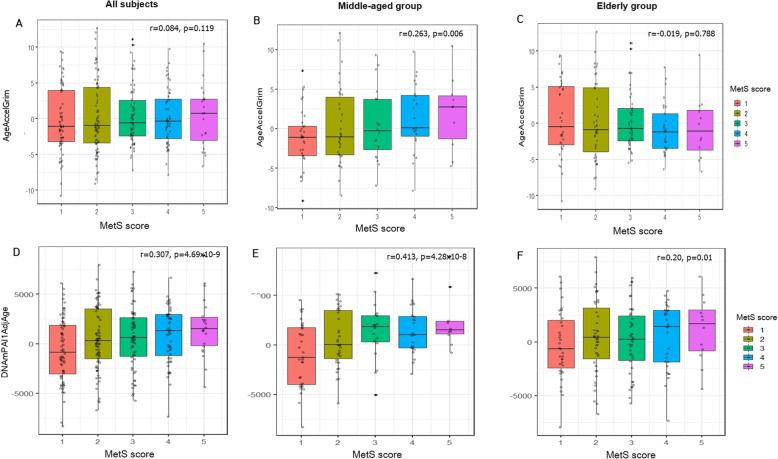
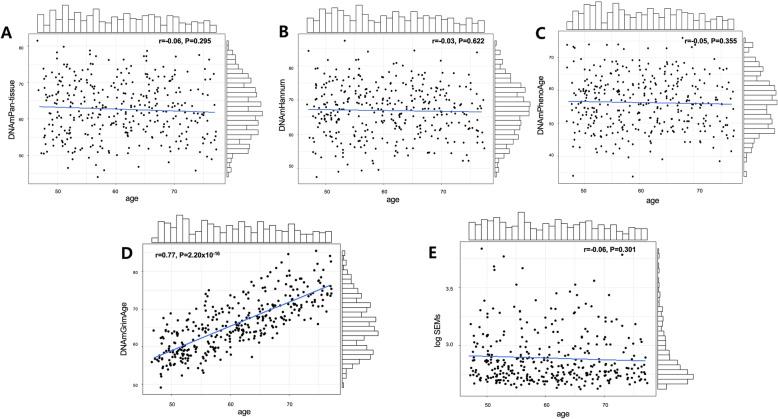
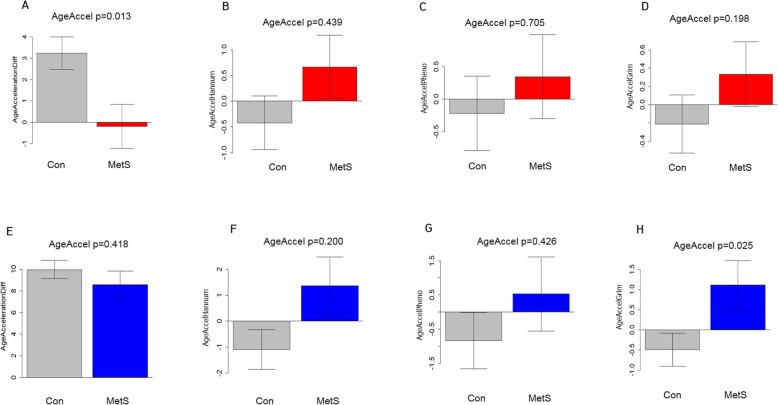
DNAm GrimAge strongly correlated with chronological age (r = 0.77, p < 0.001) compared to the other three epigenetic clocks and SEMs. DNAm-based surrogate markers, with regard to MetS, including the gene encoding plasminogen activator inhibitor-1 (PAI1), also correlated with chronological age. Within cohorts stratified by age group, sex, regional area, smoking, and alcohol drinking, a positive correlation was observed between DNAm GrimAge and chronological age (0.43 ≤ r ≤ 0.78). In particular, we identified MetS to associate with accelerated GrimAge, and age-adjusted PAI1, in the middle-age group. Accerelated GrimAge also associated with risk of MetS in the middle-age group (odds ratio = 1.16, p = 0.046), which appears to mediate their associations with fasting glucose. Multiple linear regression showed that DNAm GrimAge, and its acceleration, associate with MetS scores, in the middle-age group (r = 0.26, p = 0.006). Age-adjusted PAI1 was also significantly different between the MetS and control groups, and further associated with MetS scores (r = 0.31, P < 0.001), in the middle age group.
CONCLUSION
DNAm GrimAge is a surrogate marker for MetS, and its component score, in Koreans. This association can be observed only in middle age. Therefore, appropriate DNA methylation clocks may aid in the prediction of Korean metabolic diseases.
背景
考虑到 DNA 甲基化(DNAm)谱在很大程度上可受生活方式和环境影响的调节,因此有人提出,与当前健康状况相关的表观遗传时钟比实际年龄能更好地估计生物年龄。尽管代谢疾病会导致早衰,但在韩国人群中,代谢综合征(MetS)与 DNA 甲基化时钟和随机表观遗传突变(SEMs)之间的关联还知之甚少。因此,我们评估了四个不同的表观遗传时钟(Pan-tissue、Hannum、PhenoAge 和 GrimAge),以及它们在韩国人群中对 MetS 和与 MetS 相关的生活方式因素的加速作用。我们使用 Illumina 450 甲基化 BeadChip 阵列测量了 349 份血液样本的全基因组 DNA 甲基化(485,512 个 CpGs)。
结果
与其他三个表观遗传时钟和 SEMs 相比,DNAm GrimAge 与实际年龄(r = 0.77,p < 0.001)具有很强的相关性。与 MetS 相关的 DNAm 替代标志物,包括编码纤溶酶原激活物抑制剂-1(PAI1)的基因,也与实际年龄相关。在按年龄组、性别、地区、吸烟和饮酒分层的队列中,DNAm GrimAge 与实际年龄呈正相关(0.43≤r≤0.78)。特别是,我们发现中间年龄组的 MetS 与加速的 GrimAge 和年龄调整后的 PAI1 相关。加速的 GrimAge 也与中间年龄组 MetS 的风险相关(比值比=1.16,p=0.046),这似乎介导了它们与空腹血糖的关联。多元线性回归显示,中间年龄组的 DNAm GrimAge 及其加速与 MetS 评分相关(r = 0.26,p = 0.006)。年龄调整后的 PAI1 在 MetS 组和对照组之间也有显著差异,并且与中间年龄组的 MetS 评分进一步相关(r = 0.31,P <0.001)。
结论
在韩国人群中,DNAm GrimAge 是 MetS 的替代标志物,也是其组成分数的替代标志物。这种关联只能在中年时观察到。因此,适当的 DNA 甲基化时钟可能有助于预测韩国的代谢疾病。
 Zotero 插件