
质谱细胞术分析自然杀伤细胞受体-配体谱揭示登革热感染儿童与成人之间的独特差异。
Mass Cytometry Analysis of the NK Cell Receptor-Ligand Repertoire Reveals Unique Differences between Dengue-Infected Children and Adults.
机构信息
Program in Immunology, Stanford University School of Medicine, Stanford, CA 94305.
Department of Research in Virology and Biotechnology, Gorgas Memorial Institute for Health Studies, Panama City, Panama.
出版信息
Immunohorizons. 2020 Oct 16;4(10):634-647. doi: 10.4049/immunohorizons.2000074.
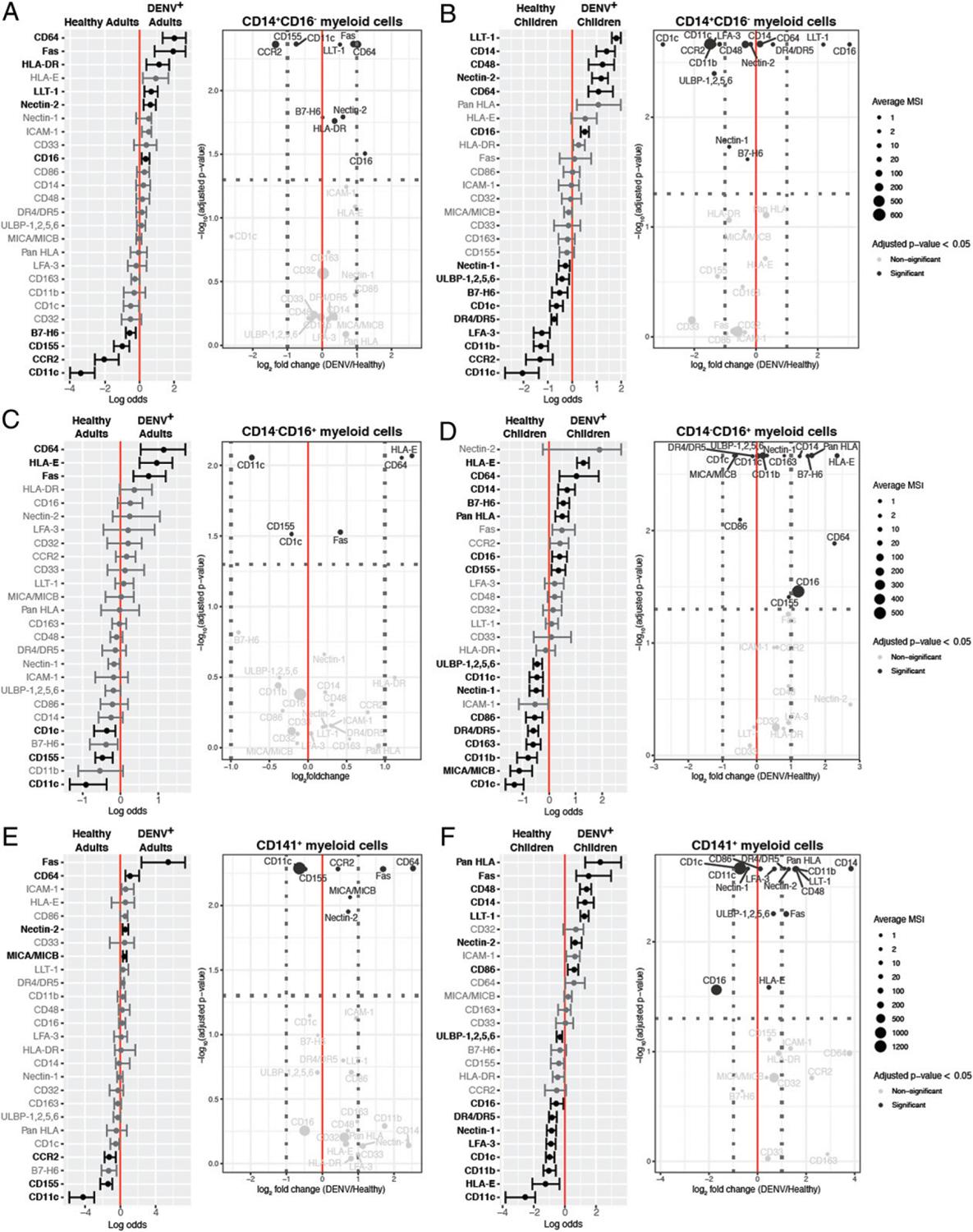
Dengue virus (DENV) is a significant cause of morbidity in many regions of the world, with children at the greatest risk of developing severe dengue. NK cells, characterized by their ability to rapidly recognize and kill virally infected cells, are activated during acute DENV infection. However, their role in viral clearance versus pathogenesis has not been fully elucidated. Our goal was to profile the NK cell receptor-ligand repertoire to provide further insight into the function of NK cells during pediatric and adult DENV infection. We used mass cytometry to phenotype isolate NK cells and PBMCs from a cohort of DENV-infected children and adults. Using unsupervised clustering, we found that pediatric DENV infection leads to a decrease in total NK cell frequency with a reduction in the percentage of CD56CD38 NK cells and an increase in the percentage of CD56perforin NK cells. No such changes were observed in adults. Next, we identified markers predictive of DENV infection using a differential state test. In adults, NK cell expression of activation markers, including CD69, perforin, and Fas-L, and myeloid cell expression of activating NK cell ligands, namely Fas, were predictive of infection. In contrast, increased NK cell expression of the maturation marker CD57 and myeloid cell expression of inhibitory ligands, such as HLA class I molecules, were predictive of pediatric DENV infection. These findings suggest that acute pediatric DENV infection may result in diminished NK cell activation, which could contribute to enhanced pathogenesis and disease severity.
登革热病毒(DENV)是世界上许多地区发病率的重要原因,儿童面临着发展为重症登革热的最大风险。NK 细胞的特点是能够快速识别和杀死病毒感染的细胞,在急性 DENV 感染期间被激活。然而,它们在清除病毒与发病机制中的作用尚未完全阐明。我们的目标是描绘 NK 细胞受体-配体谱,以进一步了解 NK 细胞在儿童和成人 DENV 感染中的功能。我们使用质谱细胞术对来自 DENV 感染儿童和成人队列的 NK 细胞和 PBMC 进行表型分析。通过无监督聚类,我们发现儿科 DENV 感染导致总 NK 细胞频率降低,CD56CD38 NK 细胞的百分比减少,CD56perforin NK 细胞的百分比增加。在成年人中没有观察到这种变化。接下来,我们使用差异状态测试确定了预测 DENV 感染的标志物。在成年人中,NK 细胞表达的激活标志物,包括 CD69、穿孔素和 Fas-L,以及髓样细胞表达的激活 NK 细胞配体,即 Fas,是感染的预测指标。相比之下,NK 细胞表达成熟标志物 CD57 和髓样细胞表达抑制配体(如 HLA Ⅰ类分子)的增加与儿科 DENV 感染相关。这些发现表明,急性儿科 DENV 感染可能导致 NK 细胞激活减少,这可能导致发病机制增强和疾病严重程度增加。


 Zotero 插件