
无线、非侵入式、可穿戴设备,用于连续远程监测控制失血性休克猪模型的血液动力学参数。
Wireless, non-invasive, wearable device for continuous remote monitoring of hemodynamic parameters in a swine model of controlled hemorrhagic shock.
机构信息
Institute for Research in Military Medicine, Faculty of Medicine, The Hebrew University of Jerusalem and the Israel Defense Force Medical Corps, Ein-Kerem Campus, POB 12272, 9112001, Jerusalem, Israel.
Heart Institute, Hadassah Ein Kerem Medical Center, POB 12000, 9112001, Jerusalem, Israel.
出版信息
Sci Rep. 2020 Oct 19;10(1):17684. doi: 10.1038/s41598-020-74686-6.
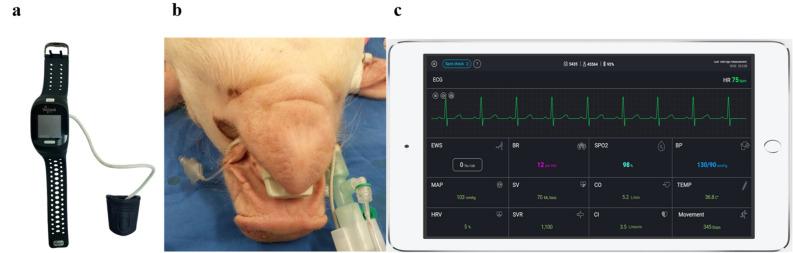
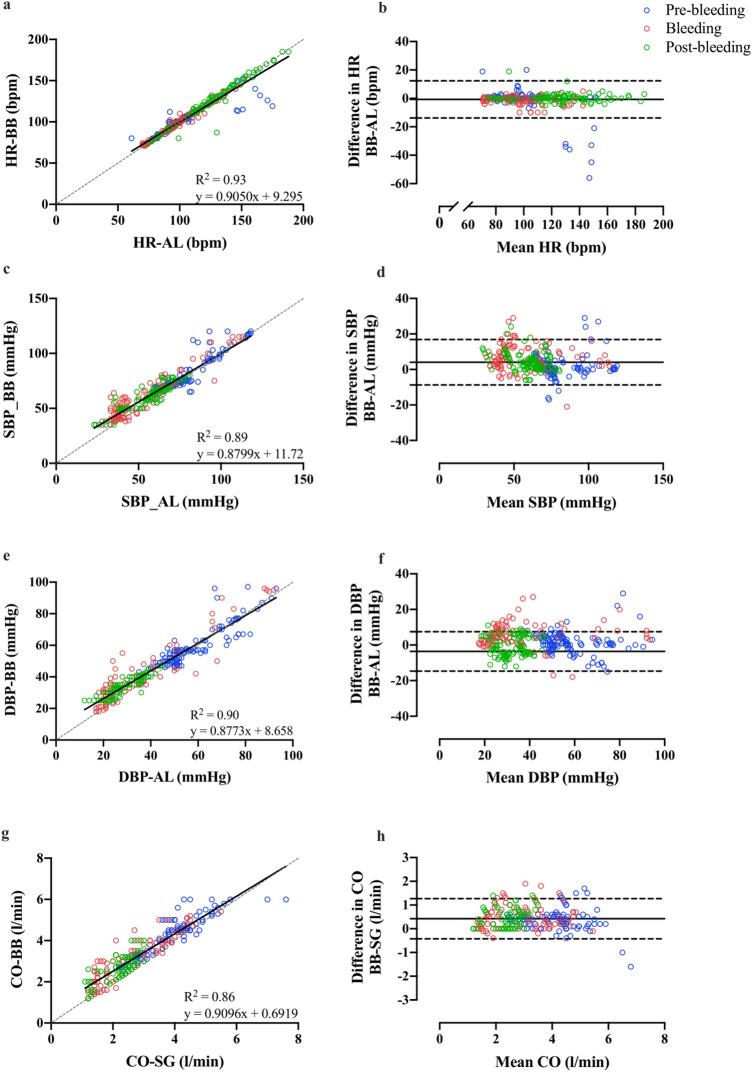
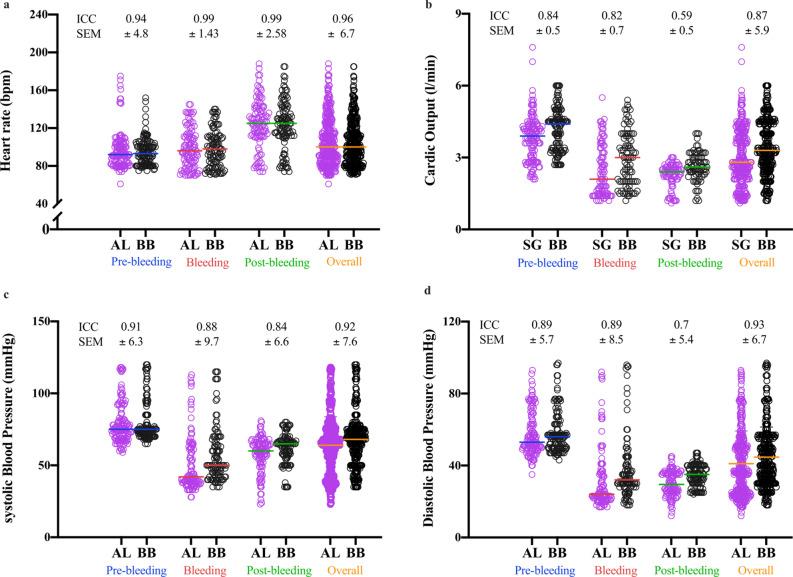
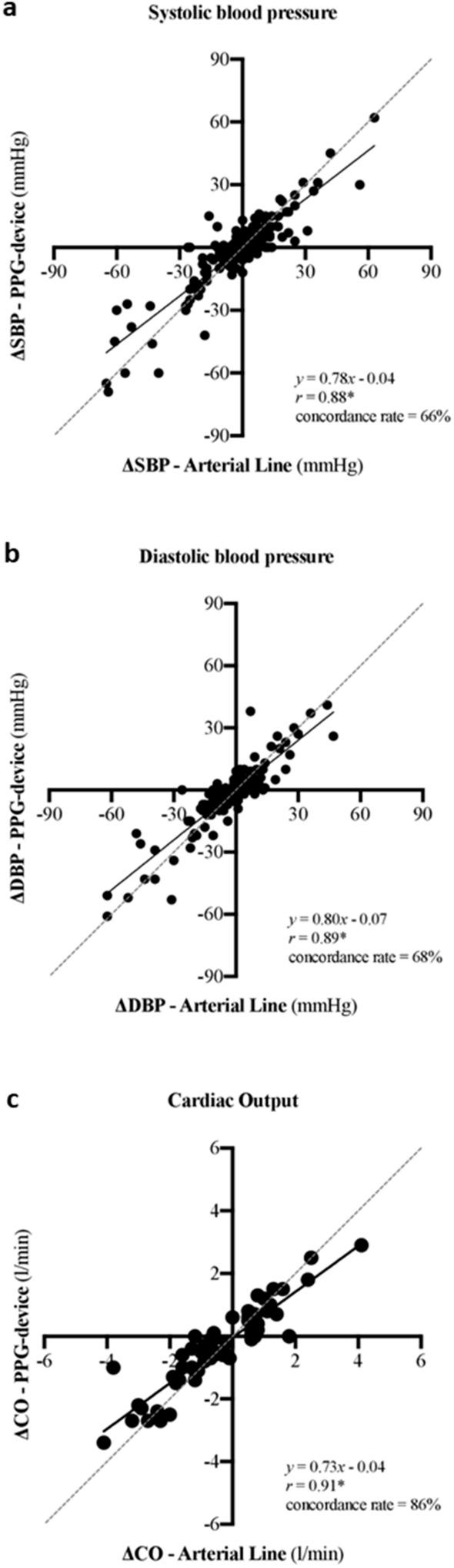
Accurate and continuous monitoring of critically ill patients is frequently achieved using invasive catheters, which is technically complex. Our purpose was to evaluate the validity and accuracy of a photoplethysmography (PPG)-based remote monitoring device compared to invasive methods of arterial line (AL) and Swan-Ganz (SG) catheters in a swine model of controlled hemorrhagic shock. Following a baseline phase, hemorrhagic shock was induced in 11 pigs by bleeding 35% of their blood volume, followed by a post-bleeding follow-up phase. Animals were monitored concomitantly by the PPG device, an AL and a SG catheter, for a median period of 447 min. Heart rate (HR), systolic and diastolic blood pressure (SBP and DBP, respectively), and cardiac output (CO) were recorded continuously. The complete data set consisted of 1312 paired observations. Correlations between the PPG-based technique and the invasive methods were significant (p < 0.001) during baseline, bleeding and follow-up phases for HR (r = 0.90-0.98), SBP (r = 0.90-0.94), DBP (r = 0.89-0.93), and CO (r = 0.76-0.90). Intraclass correlations for all phases combined were 0.96, 0.92, 0.93 and 0.87 for HR, SBP, DBP and CO, respectively. Correlations for changes in CO, SBP and DBP were significant (p < 0.001) and strong (r > 0.88), with concordance rates (determined by quadrant plots) of 86%, 66% and 68%, respectively. The novel PPG-based device was accurate and valid compared to existing invasive techniques and might be used for continuous monitoring in several clinical settings following further studies.
精确且连续地监测危重症患者通常需要使用有创导管,这在技术上较为复杂。我们的目的是评估一种基于光电容积脉搏波(PPG)的远程监测设备与动脉置管(AL)和 Swan-Ganz(SG)导管等有创方法相比,在控制失血性休克猪模型中的有效性和准确性。在基线阶段后,通过放血 35%的血容量使 11 头猪发生失血性休克,然后进行出血后随访阶段。使用 PPG 设备、AL 和 SG 导管同时对动物进行监测,中位监测时间为 447 分钟。连续记录心率(HR)、收缩压和舒张压(SBP 和 DBP)和心输出量(CO)。完整数据集包含 1312 对配对观察结果。在基线、出血和随访阶段,PPG 技术与有创方法之间的相关性均具有统计学意义(p < 0.001),HR(r = 0.90-0.98)、SBP(r = 0.90-0.94)、DBP(r = 0.89-0.93)和 CO(r = 0.76-0.90)。所有阶段的组内相关系数分别为 HR(0.96)、SBP(0.92)、DBP(0.93)和 CO(0.87)。CO、SBP 和 DBP 的变化相关性具有统计学意义(p < 0.001)且较强(r > 0.88),一致性率(通过象限图确定)分别为 86%、66%和 68%。与现有有创技术相比,新型 PPG 基于设备准确且有效,在进一步研究后可能用于多种临床环境的连续监测。
 Zotero 插件