
晚期糖基化终产物与妊娠期糖尿病的关系:系统评价和荟萃分析。
The relationship between advanced glycation end products and gestational diabetes: A systematic review and meta-analysis.
机构信息
Department of Pharmacology and Toxicology, School of Pharmacy, College of Health and Medical Sciences, Haramaya University, Harar, Ethiopia.
Department of Clinical Pharmacy, School of Pharmacy, College of Health and Medical Sciences, Haramaya University, Harar, Ethiopia.
出版信息
PLoS One. 2020 Oct 21;15(10):e0240382. doi: 10.1371/journal.pone.0240382. eCollection 2020.
INTRODUCTION
Gestational Diabetes Mellitus (GDM) is a condition in which women without history of diabetes experience hyperglycemia during pregnancy, especially at the second and third trimesters. In women who have had GDM, an elevated body mass index (BMI) may have a substantial impact for persistent hyperglycemia in their lives after gestation. Beyond hyperglycemia, increased local oxidative stress directly promotes the formation of Advanced Glycation End-products (AGEs). Hence, this systematic review and meta-analysis was aimed to determine the relationship between the level of AGEs and/or related metabolic biomarkers with GDM.
METHODS
Literature search was carried out through visiting electronic databases, indexing services, and directories including PubMed/MEDLINE (Ovid®), EMBASE (Ovid®), google scholar and WorldCat to retrieve studies without time limit. Following screening and eligibility evaluation, relevant data were extracted from included studies and analyzed using Rev-Man 5.3 and STATA 15.0. Inverse variance method with random effects pooling model was used for the analysis of outcome measures at 95% confidence interval. Hedge's adjusted g statistics was applied to calculate the standardized mean difference (SMD) to consider the small sample bias. Besides, meta-regression, meta-influence, and publication bias analyses were conducted. The protocol has been registered on PROSPERO with ID: CRD42020173867.
RESULTS
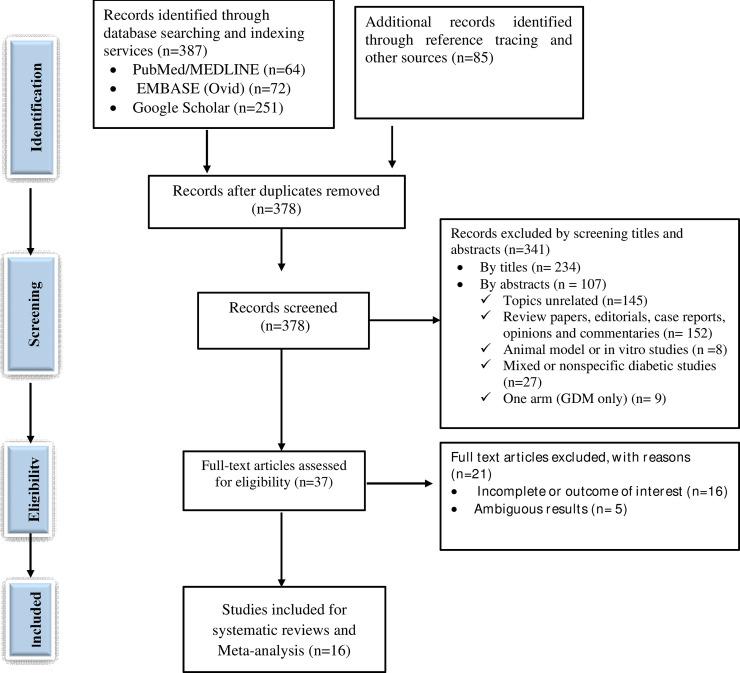
A total of 16 original studies were included for the systematic review and meta-analysis. Compared with women with pregnant controls, the level of AGE was significantly higher in women with GDM (SMD [95% CI] = 2.26 [1.50‒3.02], Z = 5.83, P < 0.00001; I2 = 97%, P< 0.0001). The BMI was also significantly higher in women with GDM (SMD [95% CI] = 0.97 [0.33‒1.62], Z = 2.98, P = 0.003) compared to controls. Regarding specific and related metabolic biomarkers, there was higher level of HOMA-IR (SMD [95% CI] = 0.39 [0.22-0.55], Z = 4.65, P < 0.0001, after sensitivity analysis) and HbA1c (SMD [95% CI] = 0.58 [0.03‒1.12], Z = 2.07, P = 0.04, after sensitivity analysis) in gestational diabetic women. Subgroup analyses indicated that studies conducted in Asia and Europe, at third trimester of pregnancy and blood/plasma AGE samples showed a significant difference in AGE level among women with GDM compared to pregnant controls. What is more, meta-regression with the sample size (regression coefficient (Q) = -0.0092, P = 0.207) and year of publication (Q = 0.0035, P = 0.984) suggested that the covariates had no significant effect on the heterogeneity.
CONCLUSION
The study indicated that there was a strong relationship between AGE and GDM. Besides, the BMI and other specific biomarkers showed a significant difference between the two groups indicating the high risk of developing long-standing type 2 diabetes and its complications in gestational diabetic women. Early detection of these biomarkers may play a pivotal role in controlling postpartum diabetic complications.
简介
妊娠糖尿病(GDM)是一种女性在怀孕期间出现血糖升高的疾病,特别是在第二和第三个三个月。在患有 GDM 的女性中,升高的体重指数(BMI)可能对其产后持续高血糖有重大影响。除了高血糖外,局部氧化应激的增加直接促进了晚期糖基化终产物(AGEs)的形成。因此,本系统评价和荟萃分析旨在确定 AGEs 水平和/或相关代谢生物标志物与 GDM 之间的关系。
方法
通过访问电子数据库、索引服务和目录,包括 PubMed/MEDLINE(Ovid®)、EMBASE(Ovid®)、谷歌学术和 WorldCat,进行文献检索,无时间限制。在筛选和资格评估后,从纳入的研究中提取相关数据,并使用 Rev-Man 5.3 和 STATA 15.0 进行分析。采用随机效应模型的逆方差法,在 95%置信区间内分析结果指标。采用 Hedge's 调整 g 统计量计算标准化均数差(SMD),以考虑小样本偏差。此外,还进行了荟萃回归、荟萃影响和发表偏倚分析。该方案已在 PROSPERO 上注册,注册号为 CRD42020173867。
结果
共有 16 项原始研究被纳入系统评价和荟萃分析。与孕妇对照组相比,患有 GDM 的女性的 AGE 水平明显更高(SMD[95%CI]=2.26[1.50-3.02],Z=5.83,P<0.00001;I2=97%,P<0.0001)。与对照组相比,患有 GDM 的女性的 BMI 也明显更高(SMD[95%CI]=0.97[0.33-1.62],Z=2.98,P=0.003)。关于特定和相关的代谢生物标志物,妊娠期糖尿病女性的 HOMA-IR(SMD[95%CI]=0.39[0.22-0.55],Z=4.65,P<0.0001,经敏感性分析)和 HbA1c(SMD[95%CI]=0.58[0.03-1.12],Z=2.07,P=0.04,经敏感性分析)水平更高。亚组分析表明,在亚洲和欧洲进行的研究、在妊娠第三个三个月进行的研究以及在血液/血浆 AGE 样本中,与孕妇对照组相比,患有 GDM 的女性的 AGE 水平存在显著差异。此外,荟萃回归分析表明,样本量(回归系数(Q)=-0.0092,P=0.207)和发表年份(Q=0.0035,P=0.984)的协变量对异质性没有显著影响。
结论
该研究表明 AGE 与 GDM 之间存在很强的关系。此外,BMI 和其他特定生物标志物在两组之间存在显著差异,表明妊娠糖尿病女性发生长期 2 型糖尿病及其并发症的风险较高。早期检测这些生物标志物可能在控制产后糖尿病并发症方面发挥关键作用。



 Zotero 插件