
类风湿关节炎持续中度疾病活动患者残疾相关因素:一项回顾性队列研究。
Factors associated with disability in patients with rheumatoid arthritis with persistent moderate disease activity: a retrospective cohort study.
作者信息
Scott Ian C, Mount Julie, Barry Jane, Kirkham Bruce
机构信息
Primary Care Centre Versus Arthritis, School of Primary, Community and Social Care, Keele University, Keele, Staffordshire ST5 5BG UK.
Haywood Academic Rheumatology Centre, Haywood Hospital, Midlands Partnership NHS Foundation Trust, High Lane, Burslem, Staffordshire ST6 7AG UK.
出版信息
BMC Rheumatol. 2020 Oct 21;4:63. doi: 10.1186/s41927-020-00161-4. eCollection 2020.
BACKGROUND
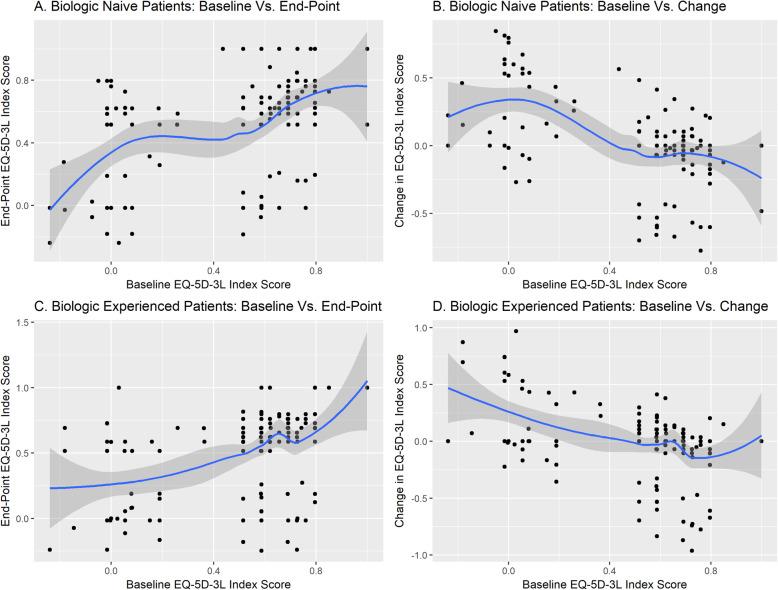
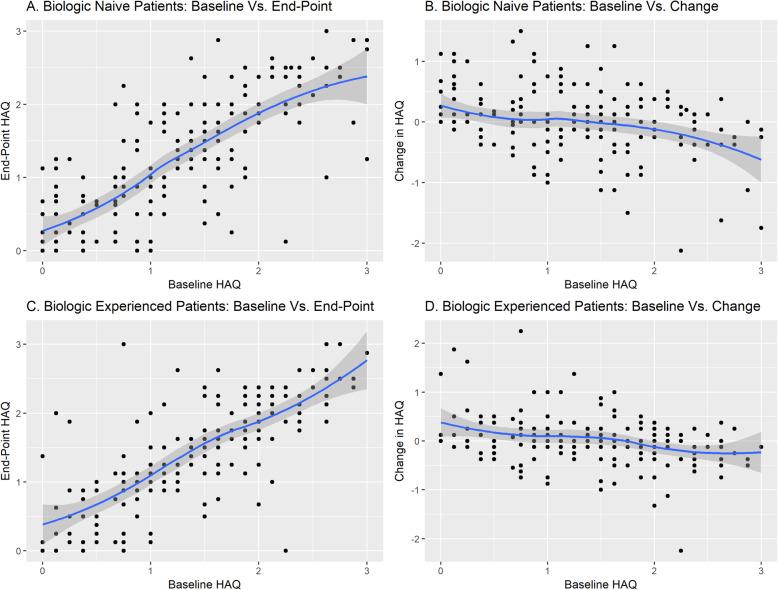
Many patients with rheumatoid arthritis (RA) do not attain remission/low disease activity, remaining in a moderate disease activity state (MDAS) with ongoing disability and impaired quality of life (QoL). If patients in persistent MDAS with poor future outcomes could be prospectively identified, they could arguably be treated more intensively. We evaluated baseline factors predicting function (Health Assessment Questionnaire-Disability Index [HAQ-DI] scores) and QoL (3-level EuroQol-5 dimensions questionnaire [EQ-5D-3L] index scores) at 12 months in patients with RA in persistent MDAS in a real-world setting.
METHODS
Patients with persistent MDAS (Disease Activity Score for 28-joint count based on erythrocyte sedimentation rate [DAS28-ESR] 3.2-5.1 on at least two consecutive outpatient appointments over 12 months) were identified retrospectively from Guy's Hospital RA Centre and analysed in two groups: (1) biologic naïve at baseline or (2) receiving/ever received biologics. The baseline timepoint was the second-visit MDAS DAS28-ESR score; the endpoint was the closest visit to 12 months. Linear regression analyses evaluated relationships between baseline variables and (1) 12-month HAQ-DI scores, (2) 12-month rank-transformed EQ-5D-3L index scores, (3) 12-month changes in HAQ-DI scores, and (4) 12-month changes in EQ-5D-3L index scores.
RESULTS
The analysis included 207 biologic-naïve and 188 biologic-experienced patients. All patients had moderate disability (mean HAQ-DI 1.21 and 1.46) and impaired QoL (mean EQ-5D-3L index scores 0.52 and 0.50). Many reported moderate/severe pain (93 and 96%) and showed little change in HAQ-DI and EQ-5D-3L index scores over 12 months. In both biologic-naïve and biologic-experienced groups, multivariate analysis revealed a significant association between baseline HAQ-DI scores and endpoint HAQ-DI scores (β = 0.67, < 0.001 and β = 0.76, < 0.001, respectively), 12-month changes in HAQ-DI scores (both β = - 0.21, < 0.001), and 12-month EQ-5D-3L index scores (β = - 0.57, < 0.001 and β = - 0.29, = 0.004, respectively). Baseline EQ-5D-3L index scores were significantly associated with 12-month changes in EQ-5D-3L index scores in both groups (β = - 0.73, < 0.001 and β = - 0.40, = 0.003, respectively).
CONCLUSIONS
Patients with RA in persistent MDAS experience substantial ongoing physical disability, poor QoL, and pain. HAQ-DI is an important predictor of future disability and reduced QoL, supporting current national recommendations to measure HAQ-DI in routine care.
背景
许多类风湿关节炎(RA)患者无法实现缓解/低疾病活动度,而是处于中度疾病活动状态(MDAS),持续存在残疾且生活质量(QoL)受损。如果能够前瞻性地识别出处于持续性MDAS且未来预后较差的患者,那么可以认为对他们进行更强化的治疗是合理的。我们在现实环境中评估了持续性MDAS的RA患者在12个月时预测功能(健康评估问卷-残疾指数[HAQ-DI]评分)和QoL(3级欧洲五维健康量表[EQ-5D-3L]指数评分)的基线因素。
方法
从盖伊医院类风湿关节炎中心回顾性识别出持续性MDAS患者(基于红细胞沉降率的28个关节计数的疾病活动评分[DAS28-ESR]在12个月内至少连续两次门诊就诊时为3.2 - 5.1),并分为两组进行分析:(1)基线时未使用生物制剂的患者;(2)正在接受/曾接受生物制剂治疗的患者。基线时间点为第二次就诊时的MDAS DAS28-ESR评分;终点为最接近12个月的就诊时间。线性回归分析评估了基线变量与以下各项之间的关系:(1)12个月时的HAQ-DI评分;(2)12个月时经秩转换的EQ-5D-3L指数评分;(3)12个月内HAQ-DI评分的变化;(4)12个月内EQ-5D-3L指数评分的变化。
结果
分析纳入了207例未使用生物制剂的患者和188例使用过生物制剂的患者。所有患者均有中度残疾(平均HAQ-DI分别为1.21和1.46)且QoL受损(平均EQ-5D-3L指数评分分别为0.52和0.50)。许多患者报告有中度/重度疼痛(分别为93%和96%),且12个月内HAQ-DI和EQ-5D-3L指数评分变化不大。在未使用生物制剂组和使用过生物制剂组中,多因素分析均显示基线HAQ-DI评分与终点HAQ-DI评分之间存在显著关联(β分别为0.67,P < 0.001和β为0.76,P < 0.001),与12个月内HAQ-DI评分的变化(β均为 - 0.21,P < 0.001)以及12个月时的EQ-5D-3L指数评分(β分别为 - 0.57,P < 0.001和β为 - 0.29,P = 0.004)之间也存在显著关联。两组中基线EQ-5D-3L指数评分均与12个月内EQ-5D-3L指数评分的变化显著相关(β分别为 - 0.73,P < 0.001和β为 - 0.40,P = 0.003)。
结论
持续性MDAS的RA患者经历着持续的严重身体残疾、较差的QoL和疼痛。HAQ-DI是未来残疾和QoL降低的重要预测指标,支持当前国家在常规护理中测量HAQ-DI的建议。
 Zotero 插件