
青春期启动时间与姐妹研究队列乳腺癌风险的关系
Pubertal timing and breast cancer risk in the Sister Study cohort.
机构信息
Epidemiology Branch, National Institute of Environmental Health Sciences, 111 TW Alexander Dr, Research Triangle Park, NC, 27709, USA.
Social and Scientific Systems, Durham, NC, USA.
出版信息
Breast Cancer Res. 2020 Oct 27;22(1):112. doi: 10.1186/s13058-020-01326-2.
BACKGROUND
Earlier age at menarche is an established risk factor for breast cancer. While age at menarche has been fairly stable over the past half-century, age at breast development (thelarche) has continued to decrease. Recently, earlier age at thelarche and a longer time between thelarche and menarche (pubertal tempo) were shown to be associated with increased breast cancer risk. Our objective was to examine how breast cancer risk was associated with pubertal timing and tempo in a prospective US cohort.
METHODS
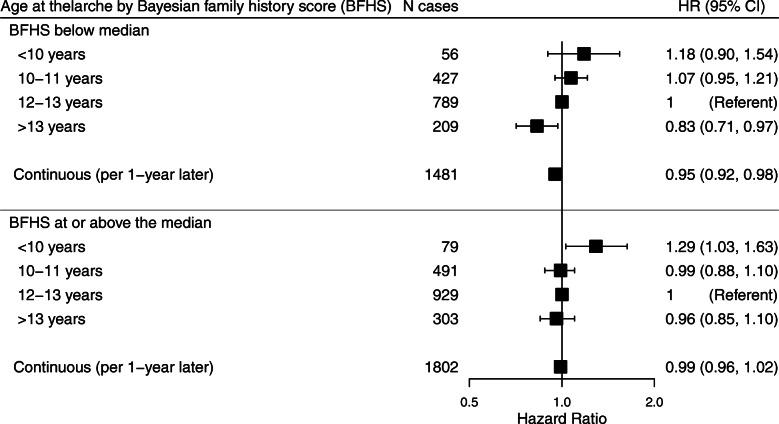
Women ages 35-74 years without a history of breast cancer, but who had a sister previously diagnosed with breast cancer, were enrolled in the Sister Study from 2003 to 2009 (N = 50,884). At enrollment, participants reported their ages at thelarche and menarche. Pubertal tempo was age at menarche minus age at thelarche. We estimated adjusted hazard ratios (HRs) and 95% confidence intervals (CIs) for each pubertal milestone and risk of breast cancer (invasive or ductal carcinoma in situ) using Cox proportional hazards regression. We examined whether associations between age at thelarche and breast cancer risk were modified by birth cohort, race/ethnicity, weight at age 10, and extent of breast cancer family history, as characterized by a Bayesian score based on first-degree family structure.
RESULTS
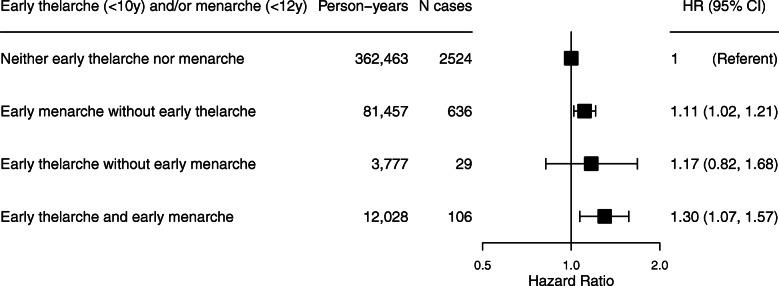
During follow-up (mean = 9.3 years), 3295 eligible women were diagnosed with breast cancer. Early ages at thelarche (HR = 1.23, 95% CI 1.03-1.46 for < 10 vs. 12-13 years) and menarche (HR = 1.10, 95% CI 1.01-1.20 for < 12 vs. 12-13 years) were positively associated with breast cancer risk. Pubertal tempo was not associated with breast cancer risk (HR = 0.99, 95% CI 0.97-1.02 per 1-year longer tempo). When considering early thelarche (< 10 years) and early menarche (< 12 years) jointly, women with both had a 30% greater risk of breast cancer compared with women with neither risk factor (95% CI 1.07-1.57). The association between age at thelarche and breast cancer risk did not significantly vary by birth cohort, race/ethnicity, childhood weight, or Bayesian family history score.
CONCLUSIONS
Earlier ages at thelarche and menarche may enhance susceptibility to breast carcinogenesis. Age at thelarche is an important risk factor to consider given secular trends towards earlier development.
背景
初潮年龄较早是乳腺癌的既定风险因素。尽管在过去半个世纪中,初潮年龄相对稳定,但乳房发育(乳房发育)的年龄却持续下降。最近,乳房发育的年龄较早,乳房发育和初潮之间的时间间隔较长(青春期速度)与乳腺癌风险增加有关。我们的目的是在一项前瞻性美国队列研究中检查青春期时间和速度与乳腺癌风险的关系。
方法
2003 年至 2009 年,招募了 50884 名年龄在 35-74 岁之间、没有乳腺癌病史但有一位姐姐曾被诊断患有乳腺癌的女性参加了姐妹研究(Sister Study)。在入组时,参与者报告了她们的乳房发育和初潮年龄。青春期速度为初潮年龄减去乳房发育年龄。我们使用 Cox 比例风险回归估计了每个青春期里程碑与乳腺癌(浸润性或导管原位癌)风险的调整后的危险比(HR)和 95%置信区间(CI)。我们检查了乳房发育年龄与乳腺癌风险之间的关联是否受出生队列、种族/民族、10 岁时的体重以及一级家族结构为特征的乳腺癌家族史程度的影响,该程度由基于贝叶斯分数来表示。
结果
在随访期间(平均=9.3 年),有 3295 名符合条件的女性被诊断出患有乳腺癌。乳房发育年龄较早(HR=1.23,95%CI 1.03-1.46,<10 岁与 12-13 岁)和初潮年龄较早(HR=1.10,95%CI 1.01-1.20,<12 岁与 12-13 岁)与乳腺癌风险呈正相关。青春期速度与乳腺癌风险无关(HR=0.99,95%CI 0.97-1.02,每提前 1 年青春期速度)。当同时考虑早期乳房发育(<10 岁)和早期初潮(<12 岁)时,与没有这两个风险因素的女性相比,有这两个因素的女性乳腺癌风险增加 30%(95%CI 1.07-1.57)。乳房发育年龄与乳腺癌风险之间的关联不受出生队列、种族/民族、儿童期体重或贝叶斯家族史评分的显著影响。
结论
乳房发育和初潮年龄较早可能会增强乳腺癌发生的易感性。鉴于乳房发育的时间呈明显的下降趋势,乳房发育年龄是一个需要考虑的重要危险因素。
 Zotero 插件