
使用改良药物效应问卷评估的慢性非癌性疼痛患者的阿片类药物使用情况及其与阿片类药物使用障碍的关联。
Opioid Medication Use Among Chronic Non-Cancer Pain Patients Assessed with a Modified Drug Effects Questionnaire and the Association with Opioid Use Disorder.
作者信息
Boscarino Joseph A, Withey Carrie A, Dugan Ryan J, Hu Yirui, Auciello Jessica, Alfieri Thomas
机构信息
Department of Population Health Sciences, Geisinger Clinic, Danville, PA, 17822, USA.
Medical Affairs, Purdue Pharma L.P, Stamford, CT 06901, USA.
出版信息
J Pain Res. 2020 Oct 23;13:2697-2705. doi: 10.2147/JPR.S275397. eCollection 2020.
PURPOSE
Identifying opioid use disorder (OUD) in patients prescribed opioid therapy for chronic pain is challenging but critically important. Patients may have multiple reasons for taking medications, which they may not reveal if not properly interviewed. In this study, modified Drug Effects Questionnaires (DEQ) were used to assess the liking of and desire to take prescription opioids both for reasons of pain relief and for reasons excluding pain relief. We hypothesized patients would more strongly endorse their medications for reasons of pain relief compared to reasons excluding pain relief, and patients who endorse medications for reasons excluding pain relief may be at higher risk of developing OUD.
PATIENTS AND METHODS
A cross-sectional telephone survey was administered to 200 adult outpatients currently being prescribed opioids. A two-year retrospective analysis of electronic health records supplemented survey findings.
RESULTS
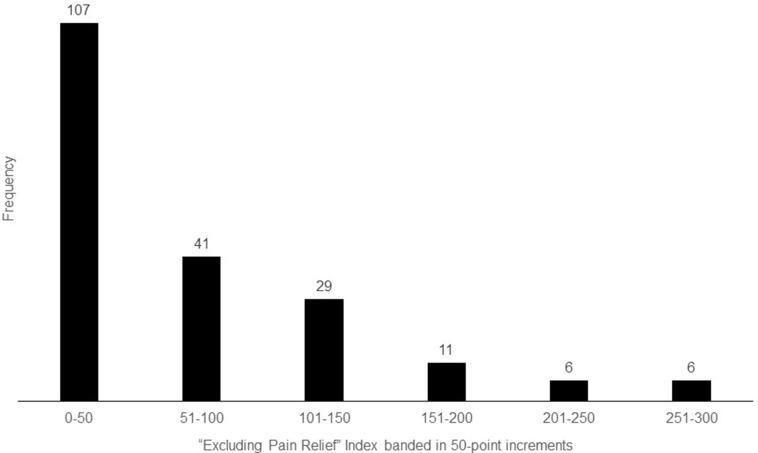
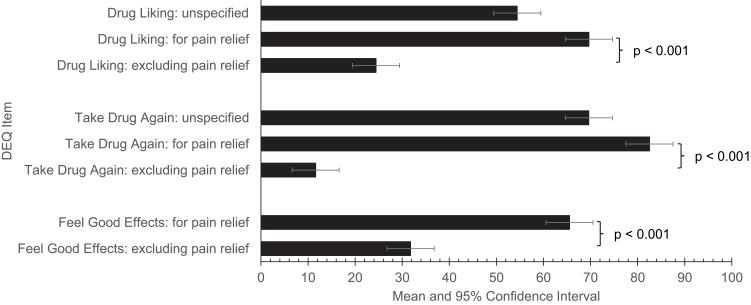
Based on DSM-5 criteria, 9.0% (n = 18) of patients had moderate or severe OUD. The mean (SD) for drug-liking was 54 (33.4) on a 0 to 100 scale. When liking for pain relief was specified, the mean (SD) was significantly higher compared to when excluding pain relief was specified, 70 (27.8) vs 24 (31.2), p<0.001. A similar pattern was observed for patients' ratings of desire to take their medication again, and "feel good effects" of their medications. Higher scores on items that excluded pain relief were associated with other indications of drug misuse.
CONCLUSION
The observed rate of OUD in this patient sample was consistent with findings from other recent research. A better understanding of patients' reasons for using opioid medication may help researchers and health care providers identify those at greatest risk for developing OUD.
目的
在因慢性疼痛而接受阿片类药物治疗的患者中识别阿片类药物使用障碍(OUD)具有挑战性,但至关重要。患者服用药物可能有多种原因,如果未进行恰当询问,他们可能不会透露这些原因。在本研究中,使用改良的药物效应问卷(DEQ)来评估患者因缓解疼痛以及排除缓解疼痛之外的原因而对处方阿片类药物的喜好程度和服用意愿。我们假设,与排除缓解疼痛之外的原因相比,患者会因缓解疼痛的原因而更强烈地认可他们的药物,并且因排除缓解疼痛之外的原因而认可药物的患者可能有更高的发生OUD的风险。
患者与方法
对200名目前正在接受阿片类药物处方治疗的成年门诊患者进行了横断面电话调查。对电子健康记录进行了为期两年的回顾性分析,以补充调查结果。
结果
根据《精神疾病诊断与统计手册》第5版(DSM - 5)标准,9.0%(n = 18)的患者患有中度或重度OUD。在0至100的量表上,药物喜好程度的平均值(标准差)为54(33.4)。当明确是因缓解疼痛而产生的喜好时,其平均值(标准差)显著高于排除缓解疼痛因素时的情况,分别为70(27.8)和24(31.2),p<0.001。在患者再次服用药物的意愿评分以及药物的“良好感觉效应”方面也观察到了类似的模式。排除缓解疼痛因素的项目得分较高与药物滥用的其他指征相关。
结论
该患者样本中观察到的OUD发生率与其他近期研究结果一致。更好地了解患者使用阿片类药物的原因可能有助于研究人员和医疗保健提供者识别出发生OUD风险最高的人群。
 Zotero 插件