
基于分子对接的 SARS-CoV-2 主蛋白酶小分子抑制剂筛选及酶联免疫吸附实验验证
Interaction of small molecules with the SARS-CoV-2 main protease in silico and in vitro validation of potential lead compounds using an enzyme-linked immunosorbent assay.
机构信息
Epigenomic Medicine, Department of Diabetes, Central Clinical School, Monash University, Melbourne, VIC 3004, Australia; School of Science, College of Science, Engineering & Health, RMIT University, VIC 3001, Australia.
School of Science, College of Science, Engineering & Health, RMIT University, VIC 3001, Australia; Food Chemistry, Faculty of Veterinary and Agricultural Sciences, University of Melbourne, Parkville, VIC 3052, Australia.
出版信息
Comput Biol Chem. 2020 Dec;89:107408. doi: 10.1016/j.compbiolchem.2020.107408. Epub 2020 Oct 23.
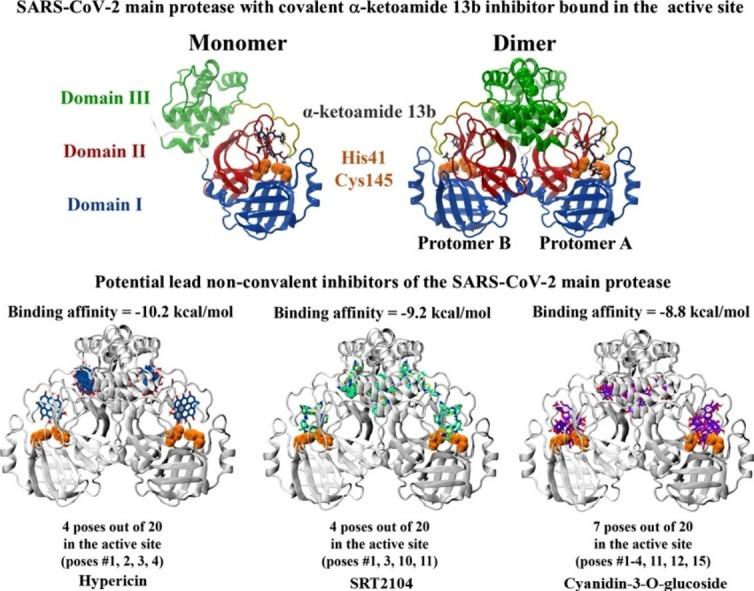
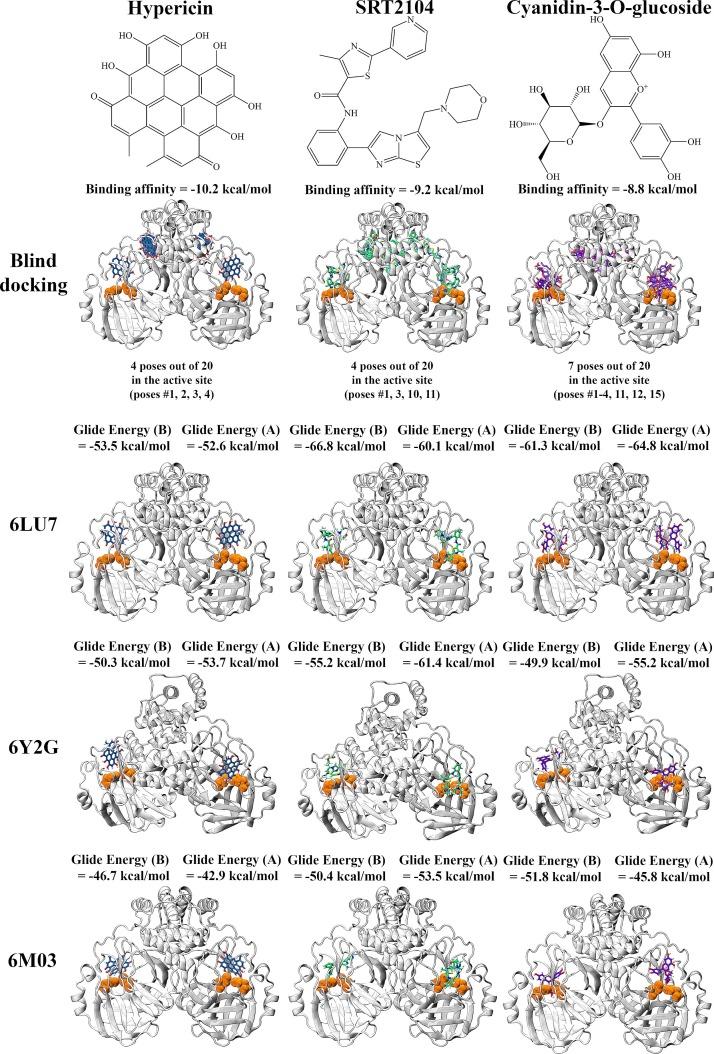
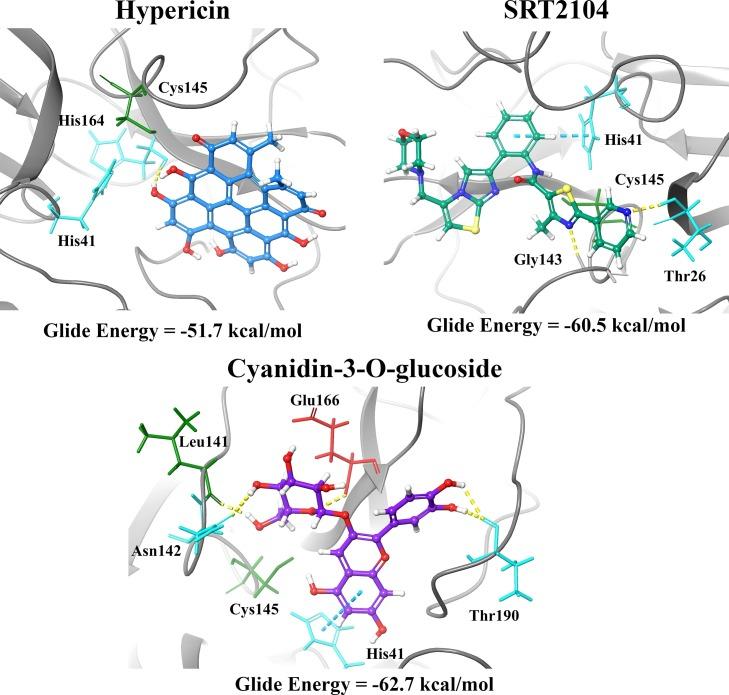
Caused by the severe acute respiratory syndrome coronavirus 2 (SARS-CoV-2), the COVID-19 pandemic is ongoing, with no proven safe and effective vaccine to date. Further, effective therapeutic agents for COVID-19 are limited, and as a result, the identification of potential small molecule antiviral drugs is of particular importance. A critical antiviral target is the SARS-CoV-2 main protease (M), and our aim was to identify lead compounds with potential inhibitory effects. We performed an initial molecular docking screen of 300 small molecules, which included phenolic compounds and fatty acids from our OliveNet™ library (224), and an additional group of curated pharmacological and dietary compounds. The prototypical α-ketoamide 13b inhibitor was used as a control to guide selection of the top 30 compounds with respect to binding affinity to the M active site. Further studies and analyses including blind docking were performed to identify hypericin, cyanidin-3-O-glucoside and SRT2104 as potential leads. Molecular dynamics simulations demonstrated that hypericin (ΔG = -18.6 and -19.3 kcal/mol), cyanidin-3-O-glucoside (ΔG = -50.8 and -42.1 kcal/mol), and SRT2104 (ΔG = -8.7 and -20.6 kcal/mol), formed stable interactions with the M active site. An enzyme-linked immunosorbent assay indicated that, albeit, not as potent as the covalent positive control (GC376), our leads inhibited the M with activity in the micromolar range, and an order of effectiveness of hypericin and cyanidin-3-O-glucoside > SRT2104 > SRT1720. Overall, our findings, and those highlighted by others indicate that hypericin and cyanidin-3-O-glucoside are suitable candidates for progress to in vitro and in vivo antiviral studies.
由严重急性呼吸系统综合征冠状病毒 2(SARS-CoV-2)引起的 COVID-19 大流行仍在持续,目前尚无经过证实的安全有效的疫苗。此外,针对 COVID-19 的有效治疗药物有限,因此,鉴定潜在的小分子抗病毒药物尤为重要。SARS-CoV-2 主要蛋白酶(M)是一个关键的抗病毒靶点,我们的目标是鉴定具有潜在抑制作用的先导化合物。我们对 300 种小分子进行了初步的分子对接筛选,其中包括我们 OliveNet ™ 库中的酚类化合物和脂肪酸(224 种)以及一组经过精心筛选的药理学和饮食化合物。原型 α-酮酰胺 13b 抑制剂被用作对照,以指导选择与 M 活性位点结合亲和力最高的前 30 种化合物。进一步的研究和分析,包括盲法对接,鉴定了金丝桃素、矢车菊素-3-O-葡萄糖苷和 SRT2104 为潜在的先导化合物。分子动力学模拟表明,金丝桃素(ΔG = -18.6 和 -19.3 kcal/mol)、矢车菊素-3-O-葡萄糖苷(ΔG = -50.8 和 -42.1 kcal/mol)和 SRT2104(ΔG = -8.7 和 -20.6 kcal/mol)与 M 活性位点形成稳定的相互作用。酶联免疫吸附试验表明,尽管不如共价阳性对照(GC376)有效,但我们的先导化合物以微摩尔范围的活性抑制了 M,其抑制活性的强弱顺序为:金丝桃素和矢车菊素-3-O-葡萄糖苷>SRT2104>SRT1720。总的来说,我们的研究结果和其他人的研究结果都表明,金丝桃素和矢车菊素-3-O-葡萄糖苷是进一步进行体外和体内抗病毒研究的合适候选药物。




 Zotero 插件