
长链非编码 RNA MALAT1 通过调控 miR-185-5p/MDM4 轴促进非小细胞肺癌进展。
LncRNA MALAT1 accelerates non-small cell lung cancer progression via regulating miR-185-5p/MDM4 axis.
机构信息
Department of Respiratory and Critical Medicine, The Huaihe Hospital of Henan University, Kaifeng, Henan, China.
Department of Urology, The Huaihe Hospital of Henan University, Kaifeng, Henan, China.
出版信息
Cancer Med. 2020 Dec;9(23):9138-9149. doi: 10.1002/cam4.3570. Epub 2020 Nov 4.
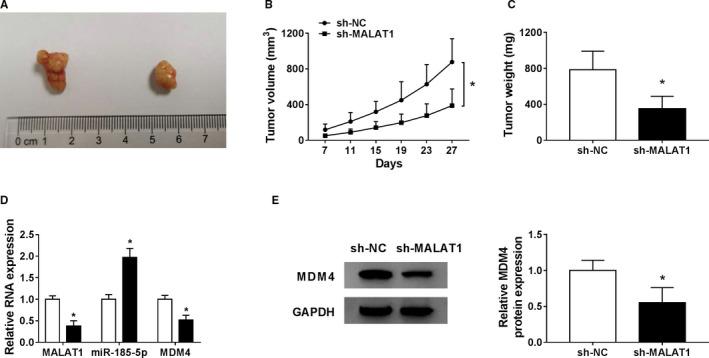
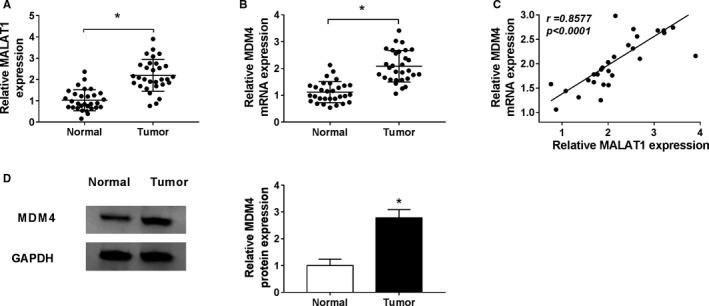
Non-small cell lung cancer (NSCLC) is the commonest malignancy with high death rate around the world. LncRNA metastasis-associated lung adenocarcinoma transcript 1 (MALAT1) is greatly overexpressed in multifarious cancers, including NSCLC. However, the precise mechanism of MALAT1 in NSCLC tumorigenesis is blurry. This paper aims to investigate the theory of MALAT1 action in NSCLC progression. The levels of MALAT1, microRNA (miR)-185-5p, and mouse double minute 4 protein (MDM4) were measured by quantitative real-time polymerase chain reaction (qRT-PCR) or western blot. Cell proliferation and apoptosis were, respectively, determined by 3-(4, 5-dimethyl-2-thiazolyl)-2, 5-diphenyl-2-H-tetrazolium bromide (MTT) assay, and flow cytometry. Cell migratory and invasive abilities were inspected by transwell assay. The binding relationship between miR-185-5p and MALAT1 or MDM4 was confirmed by dual-luciferase reporter assay. The impacts of MALAT1 on tumor growth in vivo were measured by a xenograft experiment. We found MALAT1 and MDM4 were upregulated and MALAT1 positively regulated the MDM4 expression. MALAT1 and MDM4 deletion significantly hindered the proliferation, metastasis, and expedited the apoptosis of NSCLC cells. MDM4 overexpression partly overturned the influence of MALAT1 downregulation on cell development. Moreover, miR-185-5p, as a target of MALAT1, could directly target MDM4, and miR-185-5p upregulation exerted inhibitory effects on NSCLC cells. Besides, knockdown of MALAT1 inhibited tumor growth in vivo through miR-185-5p/MDM4 axis in NSCLC. Collectively, MALAT1 contributed to proliferation, migration, invasion, and impeded apoptosis by regulating the MDM4 expression mediated by miR-185-5p in NSCLC cells.
非小细胞肺癌(NSCLC)是全球最常见的高死亡率恶性肿瘤。长链非编码 RNA 转移相关肺腺癌转录本 1(MALAT1)在多种癌症中过度表达,包括 NSCLC。然而,MALAT1 在 NSCLC 肿瘤发生中的精确机制尚不清楚。本文旨在探讨 MALAT1 在 NSCLC 进展中的作用机制。通过实时定量聚合酶链反应(qRT-PCR)或 Western blot 测定 MALAT1、微小 RNA(miR)-185-5p 和鼠双微体 4 蛋白(MDM4)的水平。通过 3-(4,5-二甲基-2-噻唑基)-2,5-二苯基-2-H-四唑溴盐(MTT)法和流式细胞术分别测定细胞增殖和凋亡。通过 Transwell 测定法检测细胞迁移和侵袭能力。通过双荧光素酶报告基因检测证实 miR-185-5p 与 MALAT1 或 MDM4 的结合关系。通过异种移植实验测定 MALAT1 对体内肿瘤生长的影响。我们发现 MALAT1 和 MDM4 上调,MALAT1 正向调节 MDM4 的表达。MALAT1 和 MDM4 缺失显著抑制 NSCLC 细胞的增殖、转移,并加速其凋亡。MDM4 过表达部分逆转了 MALAT1 下调对细胞发育的影响。此外,miR-185-5p 作为 MALAT1 的靶点,可直接靶向 MDM4,上调 miR-185-5p 对 NSCLC 细胞具有抑制作用。此外,通过 MALAT1/miR-185-5p/MDM4 轴抑制 NSCLC 细胞中的 MALAT1 可抑制体内肿瘤生长。总之,MALAT1 通过调节 miR-185-5p 介导的 MDM4 表达促进 NSCLC 细胞的增殖、迁移、侵袭,并抑制其凋亡。


 Zotero 插件