
新冠大流行期间感染预防和控制措施的意外后果。
Unintended consequences of infection prevention and control measures during COVID-19 pandemic.
机构信息
Singhealth Infectious Diseases Residency, Singapore; Department of Infectious Diseases, Singapore General Hospital, Singapore.
Department of Infection Prevention and Epidemiology, Singapore General Hospital, Singapore.
出版信息
Am J Infect Control. 2021 Apr;49(4):469-477. doi: 10.1016/j.ajic.2020.10.019. Epub 2020 Nov 4.
BACKGROUND
In the current COVID-19 pandemic, aggressive Infection Prevention and Control (IPC) measures have been adopted to prevent health care-associated transmission of COVID-19. We evaluated the impact of a multimodal IPC strategy originally designed for the containment of COVID-19 on the rates of other hospital-acquired-infections (HAIs).
METHODOLOGY
From February-August 2020, a multimodal IPC strategy was implemented across a large health care campus in Singapore, comprising improved segregation of patients with respiratory symptoms, universal masking and heightened adherence to Standard Precautions. The following rates of HAI were compared pre- and postpandemic: health care-associated respiratory-viral-infection (HA-RVI), methicillin-resistant Staphylococcus aureus, and CP-CRE acquisition rates, health care-facility-associated C difficile infections and device-associated HAIs.
RESULTS
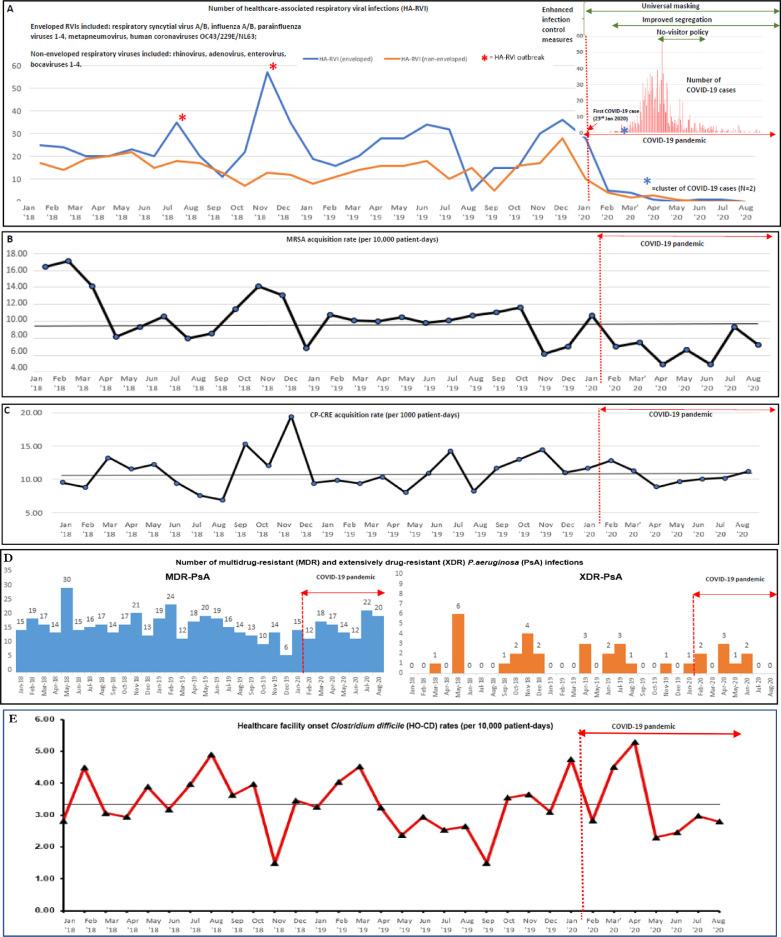
Enhanced IPC measures introduced to contain COVID-19 had the unintended positive consequence of containing HA-RVI. The cumulative incidence of HA-RVI decreased from 9.69 cases per 10,000 patient-days to 0.83 cases per 10,000 patient-days (incidence-rate-ratio = 0.08; 95% confidence interval [CI] = 0.05-0.13, P< .05). Hospital-wide MRSA acquisition rates declined significantly during the pandemic (incidence-rate-ratio = 0.54, 95% CI = 0.46-0.64, P< .05), together with central-line-associated-bloodstream infection rates (incidence-rate-ratio = 0.24, 95% CI = 0.07-0.57, P< .05); likely due to increased compliance with Standard Precautions. Despite the disruption caused by the pandemic, there was no increase in CP-CRE acquisition, and rates of other HAIs remained stable.
CONCLUSIONS
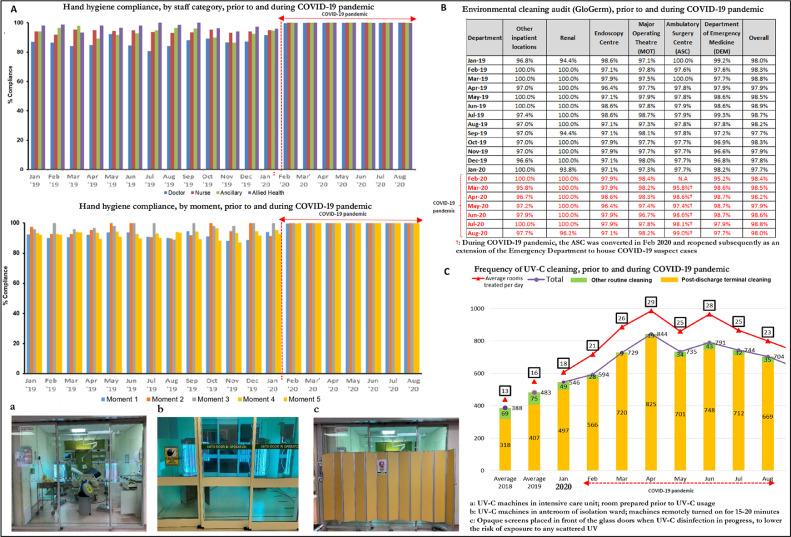
Multimodal IPC strategies can be implemented at scale to successfully mitigate health care-associated transmission of RVIs. Good adherence to personal-protective-equipment and hand hygiene kept other HAI rates stable even during an ongoing pandemic where respiratory infections were prioritized for interventions.
背景
在当前的 COVID-19 大流行中,采取了积极的感染预防和控制(IPC)措施,以防止医疗机构相关的 COVID-19 传播。我们评估了最初为控制 COVID-19 而设计的多模式 IPC 策略对其他医院获得性感染(HAI)发生率的影响。
方法
从 2020 年 2 月至 8 月,在新加坡的一个大型医疗保健园区实施了多模式 IPC 策略,包括改善有呼吸道症状的患者的隔离、普遍戴口罩和加强遵守标准预防措施。在大流行前后比较了以下 HAI 发生率:与医疗相关的呼吸道病毒感染(HA-RVI)、耐甲氧西林金黄色葡萄球菌(MRSA)和 CP-CRE 获得率、医疗机构相关的艰难梭菌感染和器械相关的 HAI。
结果
为控制 COVID-19 而引入的增强 IPC 措施产生了遏制 HA-RVI 的意外积极后果。HA-RVI 的累积发病率从每 10000 名患者天 9.69 例降至每 10000 名患者天 0.83 例(发病率比[IRR] = 0.08;95%置信区间[CI] = 0.05-0.13,P <.05)。大流行期间,医院范围内的 MRSA 获得率显著下降(IRR = 0.54,95%CI = 0.46-0.64,P <.05),与中心静脉导管相关的血流感染率(IRR = 0.24,95%CI = 0.07-0.57,P <.05);可能是由于标准预防措施的遵守度增加。尽管大流行造成了干扰,但 CP-CRE 的获得率没有增加,其他 HAI 的发生率保持稳定。
结论
多模式 IPC 策略可以大规模实施,成功减轻与医疗机构相关的 RVI 传播。即使在呼吸道感染被优先干预的持续大流行期间,个人防护设备和手部卫生的良好依从性也使其他 HAI 率保持稳定。

 Zotero 插件