
疟原虫伯氏疟原虫 K13 突变介导的青蒿素耐药性可被蛋白酶体抑制逆转。
Plasmodium berghei K13 Mutations Mediate Artemisinin Resistance That Is Reversed by Proteasome Inhibition.
机构信息
Institute of Infection, Immunity & Inflammation, Wellcome Centre for Integrative Parasitology, University of Glasgow, Glasgow, United Kingdom.
Department of Microbiology and Immunology, Columbia University Irving Medical Center, New York, New York, USA.
出版信息
mBio. 2020 Nov 10;11(6):e02312-20. doi: 10.1128/mBio.02312-20.
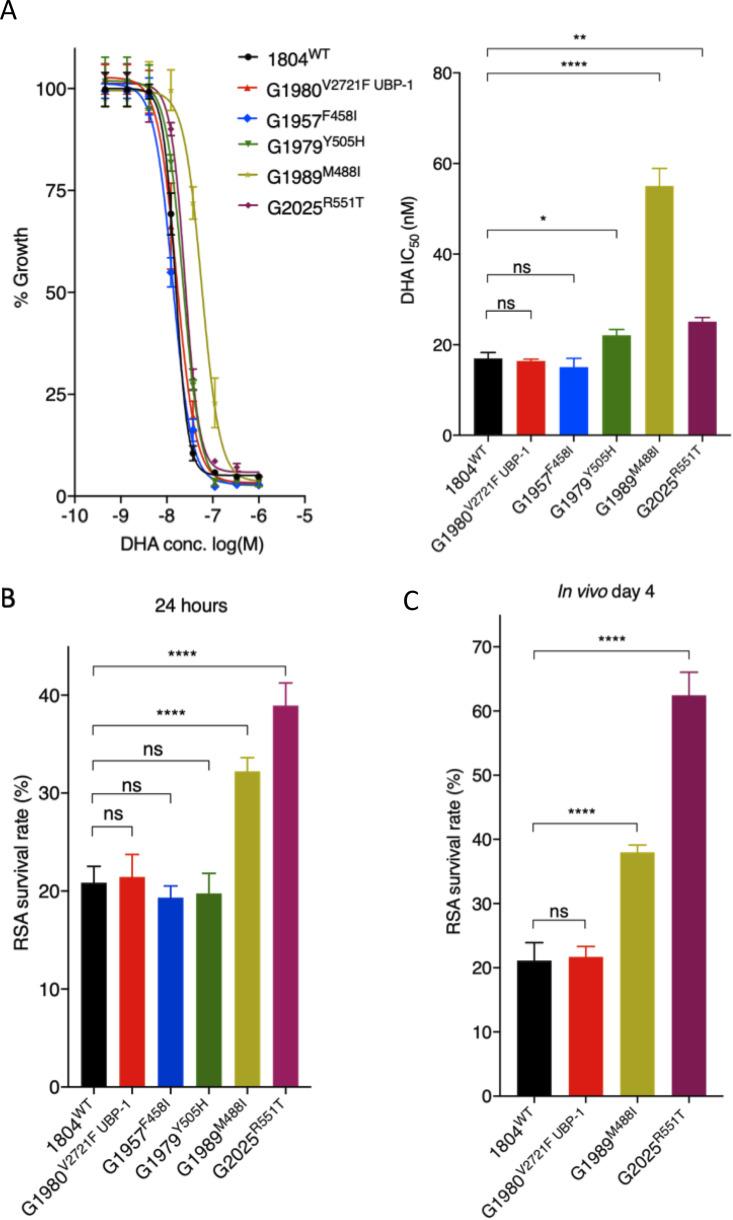
The recent emergence of parasite resistance to the first line antimalarial drug artemisinin is of particular concern. Artemisinin resistance is primarily driven by mutations in the K13 protein, which enhance survival of early ring-stage parasites treated with the artemisinin active metabolite dihydroartemisinin and associate with delayed parasite clearance However, association of K13 mutations with artemisinin resistance has been problematic due to the absence of a tractable model. Herein, we have employed CRISPR/Cas9 genome editing to engineer selected orthologous K13 mutations into the gene of an artemisinin-sensitive rodent model of malaria. Introduction of the orthologous K13 F446I, M476I, Y493H, and R539T mutations into K13 yielded gene-edited parasites with reduced susceptibility to dihydroartemisinin in the standard 24-h assay and increased survival in an adapted ring-stage survival assay. Mutant K13 parasites also displayed delayed clearance upon treatment with artesunate and achieved faster recrudescence upon treatment with artemisinin. Orthologous C580Y and I543T mutations could not be introduced into , while the equivalents of the M476I and R539T mutations resulted in significant growth defects. Furthermore, a -selective proteasome inhibitor strongly synergized dihydroartemisinin action in these K13 mutant lines, providing further evidence that the proteasome can be targeted to overcome artemisinin resistance. Taken together, our findings provide clear experimental evidence for the involvement of K13 polymorphisms in mediating susceptibility to artemisinins and, most importantly, under conditions. Recent successes in malaria control have been seriously threatened by the emergence of parasite resistance to the frontline artemisinin drugs in Southeast Asia. artemisinin resistance is associated with mutations in the parasite K13 protein, which associates with a delay in the time required to clear the parasites upon drug treatment. Gene editing technologies have been used to validate the role of several candidate K13 mutations in mediating artemisinin resistance under laboratory conditions. Nonetheless, the causal role of these mutations under conditions has been a matter of debate. Here, we have used CRISPR/Cas9 gene editing to introduce K13 mutations associated with artemisinin resistance into the related rodent-infecting parasite, Phenotyping of these K13 mutant parasites provides evidence of their role in mediating artemisinin resistance , which supports artemisinin resistance observations. However, we were unable to introduce some of the K13 mutations (C580Y and I543T) into the corresponding amino acid residues, while other introduced mutations (M476I and R539T equivalents) carried pronounced fitness costs. Our study provides evidence of a clear causal role of K13 mutations in modulating susceptibility to artemisinins and using the well-characterized model. We also show that inhibition of the proteasome offsets parasite resistance to artemisinins in these mutant lines.
最近,寄生虫对一线抗疟药物青蒿素的耐药性的出现引起了特别关注。青蒿素耐药性主要是由 K13 蛋白的突变驱动的,这些突变增强了早期环阶段寄生虫对青蒿素活性代谢物二氢青蒿素的生存能力,并与寄生虫清除的延迟有关。然而,由于缺乏可行的模型,K13 突变与青蒿素耐药性的关联一直存在问题。在此,我们使用 CRISPR/Cas9 基因组编辑将选定的同源 K13 突变引入到青蒿素敏感的啮齿动物疟疾模型的基因中。将同源 K13 F446I、M476I、Y493H 和 R539T 突变引入 K13 中,导致对二氢青蒿素的敏感性降低,在标准的 24 小时测定中,以及在适应的环阶段存活测定中,存活能力增强。突变的 K13 寄生虫在用青蒿琥酯治疗时也表现出清除延迟,并在用青蒿素治疗时更快地复发。不能将同源的 C580Y 和 I543T 突变引入到中,而 M476I 和 R539T 突变的等效突变导致明显的生长缺陷。此外,一种 -选择性蛋白酶体抑制剂在这些 K13 突变系中强烈协同二氢青蒿素的作用,进一步证明蛋白酶体可以作为克服青蒿素耐药性的靶点。总之,我们的研究结果为 K13 多态性在介导对青蒿素的敏感性方面提供了明确的实验证据,最重要的是,在条件下。最近在疟疾控制方面取得的成功受到东南亚寄生虫对一线青蒿素药物耐药性的出现的严重威胁。青蒿素耐药性与寄生虫 K13 蛋白的突变有关,与药物治疗时清除寄生虫所需的时间延迟有关。基因编辑技术已被用于在实验室条件下验证几种候选 K13 突变在介导青蒿素耐药性方面的作用。尽管如此,这些突变在条件下的因果关系一直存在争议。在这里,我们使用 CRISPR/Cas9 基因编辑将与青蒿素耐药性相关的 K13 突变引入相关的啮齿动物感染寄生虫中。对这些 K13 突变寄生虫的表型分析提供了它们在介导青蒿素耐药性方面的作用的证据,这支持了青蒿素耐药性的观察结果。然而,我们无法将一些 K13 突变(C580Y 和 I543T)引入相应的氨基酸残基,而其他引入的突变(M476I 和 R539T 等效突变)则带有明显的适应性成本。我们的研究为 K13 突变在调节对青蒿素的敏感性方面的明确因果作用提供了证据,并且使用了经过充分特征描述的模型。我们还表明,在这些突变系中,蛋白酶体的抑制可以抵消寄生虫对青蒿素的耐药性。




 Zotero 插件