
英国养老院中受新冠病毒病影响人群中新冠病毒2型抗体的高流行率:前瞻性队列研究
High prevalence of SARS-CoV-2 antibodies in care homes affected by COVID-19: Prospective cohort study, England.
作者信息
Ladhani Shamez N, Jeffery-Smith Anna, Patel Monika, Janarthanan Roshni, Fok Jonathan, Crawley-Boevey Emma, Vusirikala Amoolya, Fernandez Ruiz De Olano Elena, Perez Marina Sanchez, Tang Suzanne, Dun-Campbell Kate, Evans Edward Wynne-, Bell Anita, Patel Bharat, Amin-Chowdhury Zahin, Aiano Felicity, Paranthaman Karthik, Ma Thomas, Saavedra-Campos Maria, Ellis Joanna, Chand Meera, Brown Kevin, Ramsay Mary E, Hopkins Susan, Shetty Nandini, Chow J Yimmy, Gopal Robin, Zambon Maria
机构信息
Immunisation and Countermeasures Division, Public Health England, London, UK.
Paediatric Infectious Diseases Research Group, St. George's University of London, UK.
出版信息
EClinicalMedicine. 2020 Nov;28:100597. doi: 10.1016/j.eclinm.2020.100597. Epub 2020 Nov 6.
BACKGROUND
We investigated six London care homes experiencing a COVID-19 outbreak and found high rates of SARS-CoV-2 infection among residents and staff. Here we report follow-up investigations including antibody testing in the same care homes five weeks later.
METHODS
Residents and staff in the initial investigation had a repeat nasal swab for SARS-CoV-2 RT-PCR and a blood test for SARS CoV-2 antibodies using ELISA based on SARS-CoV-2 native viral antigens derived from infected cells and virus neutralisation.
FINDINGS
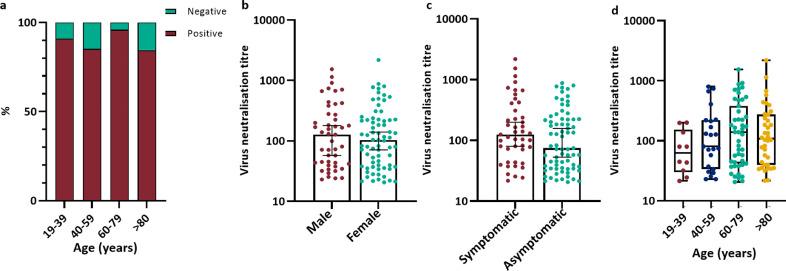
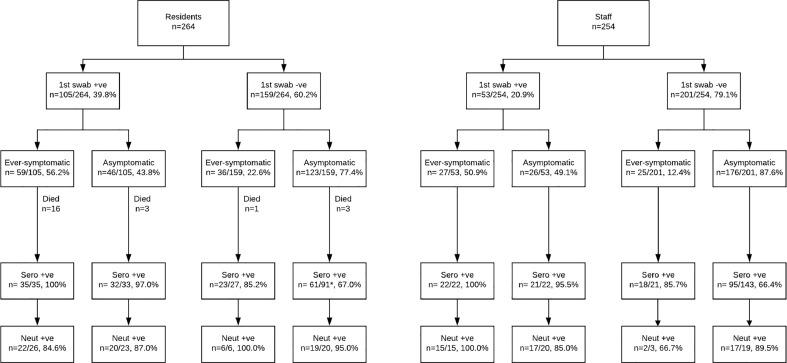
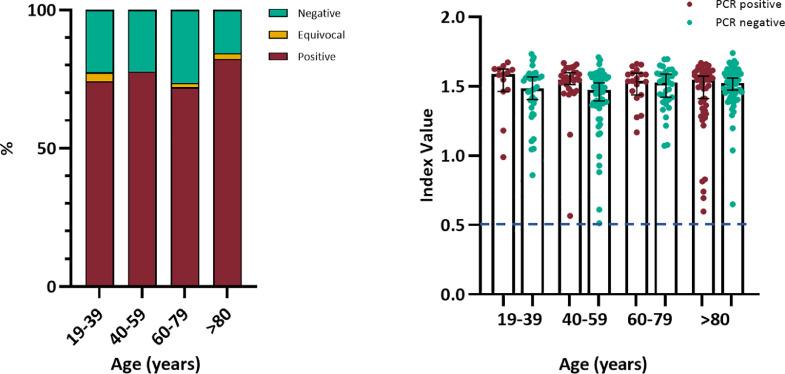
Of the 518 residents and staff in the initial investigation, 186/241 (77.2%) surviving residents and 208/254 (81.9%) staff underwent serological testing. Almost all SARS-CoV-2 RT-PCR positive residents and staff were seropositive five weeks later, whether symptomatic (residents 35/35, 100%; staff, 22/22, 100%) or asymptomatic (residents 32/33, 97.0%; staff 21/22, 95.5%). Symptomatic but SARS-CoV-2 RT-PCR negative residents and staff also had high seropositivity rates (residents 23/27, 85.2%; staff 18/21, 85.7%), as did asymptomatic RT-PCR negative individuals (residents 61/91, 67.0%; staff 95/143, 66.4%). Neutralising antibody was detected in 118/132 (89.4%) seropositive individuals and was not associated with age or symptoms. Ten residents (10/79 re-tested, 12.7%) remained RT-PCR positive but with higher RT-PCR cycle threshold values; 7/10 had serological testing and all were seropositive. New infections were detected in three residents and one staff.
INTERPRETATION
RT-PCR provides a point prevalence of SARS-CoV-2 infection but significantly underestimates total exposure in outbreak settings. In care homes experiencing large COVID-19 outbreaks, most residents and staff had neutralising SARS-CoV-2 antibodies, which was not associated with age or symptoms.
FUNDING
PHE.
背景
我们对六家经历了新冠疫情爆发的伦敦养老院进行了调查,发现居民和工作人员中SARS-CoV-2感染率很高。在此,我们报告后续调查情况,包括五周后在同一养老院进行的抗体检测。
方法
在初始调查中的居民和工作人员再次进行SARS-CoV-2 RT-PCR鼻拭子检测,并使用基于来自受感染细胞的SARS-CoV-2天然病毒抗原的ELISA法进行SARS-CoV-2抗体血液检测及病毒中和检测。
研究结果
在初始调查的518名居民和工作人员中,186/241(77.2%)名存活居民和208/254(81.9%)名工作人员接受了血清学检测。几乎所有SARS-CoV-2 RT-PCR阳性的居民和工作人员在五周后血清学检测呈阳性,无论有无症状(居民35/35,100%;工作人员22/22,100%)还是无症状(居民32/33,97.0%;工作人员21/22,95.5%)。有症状但SARS-CoV-2 RT-PCR阴性的居民和工作人员血清学阳性率也很高(居民23/27,85.2%;工作人员18/21,85.7%),无症状RT-PCR阴性个体也是如此(居民61/91,67.0%;工作人员95/143,66.4%)。在118/132(89.4%)血清学阳性个体中检测到中和抗体,且与年龄或症状无关。10名居民(10/79再次检测,12.7%)RT-PCR仍呈阳性,但RT-PCR循环阈值更高;7/10进行了血清学检测,均为血清学阳性。在三名居民和一名工作人员中检测到新的感染病例。
解读
RT-PCR可提供SARS-CoV-2感染的点患病率,但在疫情爆发环境中会显著低估总暴露情况。在经历大规模新冠疫情爆发的养老院中,大多数居民和工作人员具有中和SARS-CoV-2抗体,且与年龄或症状无关。
资金来源
英国公共卫生署。

 Zotero 插件