
医院污水作为抗生素耐药基因的蓄水池:一项荟萃分析。
Hospital Wastewater as a Reservoir for Antibiotic Resistance Genes: A Meta-Analysis.
机构信息
Department of Clinical Laboratory, Fujian Medical University Union Hospital, Fuzhou, China.
Department of Pharmacy, Fujian Medical University Union Hospital, Fuzhou, China.
出版信息
Front Public Health. 2020 Oct 28;8:574968. doi: 10.3389/fpubh.2020.574968. eCollection 2020.
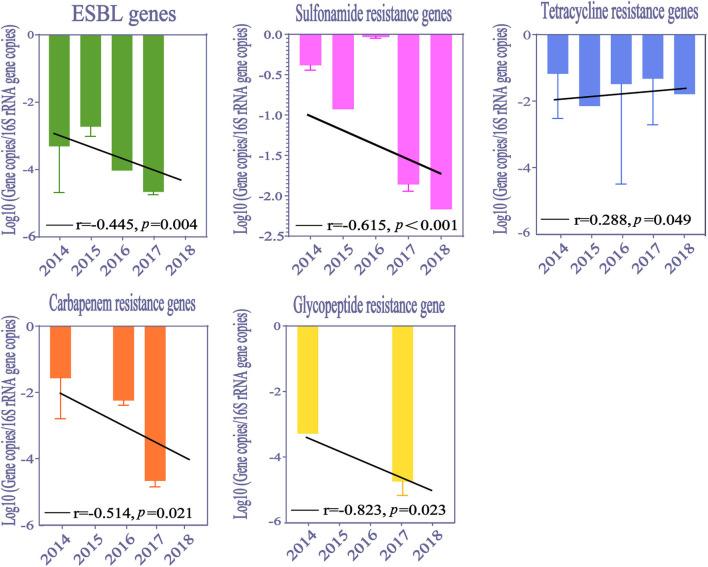
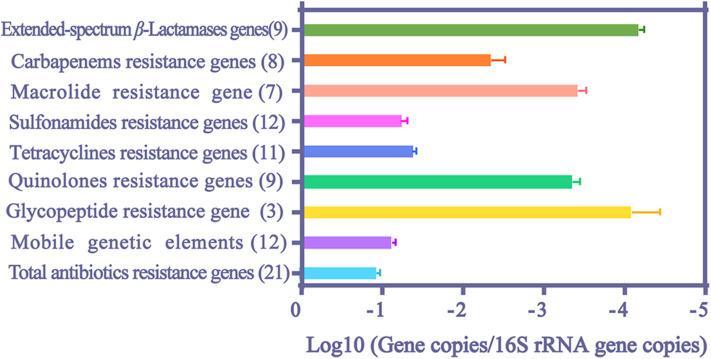
The emergence and dissemination of antibiotic resistance genes (ARGs) in the environment poses a huge global health hazard. Hospital wastewater (HWW), in which a high density of antibiotic residues and antibiotic-resistant bacteria are present, may be a reservoir of ARGs dissemination into the environment. Our meta-analysis comprehensively analyzes the prevalence of ARGs in HWW, as well as the influencing factors in ARGs distribution. Online databases were used to search for literature using the subject terms: "Drug Resistance" AND "Genes" AND "Hospitals" AND "Wastewater." Two reviewers independently applied predefined criteria to assess the literature and extract data including "relative abundance of ARGs," "title," "authors," "country," "location," "sampling year," and "sampling seasons." The median values and 95% confidence intervals of ARGs abundance were calculated by Wilcox.test function in R. Temporal trends, spatial differences, seasonal variations and removal efficiency of ARGs were analyzed by Pearson correlation analysis and Kruskal-Wallis H test. Resistance genes to carbapenems, sulfonamides, tetracyclines and mobile genetic elements were found at high relative abundance (>10 gene copies/16S rRNA gene copies) in HWW. The abundance of resistance genes to extended-spectrum β-lactams, carbapenems, sulfonamides and glycopeptide significantly decreased, while tetracycline resistance genes abundance increased from 2014 to 2018. The abundance of ARGs was significantly different by country but not by season. ARGs could not be completely removed by on-site HWW treatments and the removal efficiency varies for different ARGs. HWW presents more types of ARGs, and their abundance is higher than those in most wastewater systems. HWW may be a reservoir of ARGs and play an important role in the dissemination of ARGs.
抗生素耐药基因(ARGs)在环境中的出现和传播对全球健康构成了巨大威胁。医院废水中(HWW)存在大量抗生素残留和耐药菌,可能是 ARGs 传播到环境中的一个储库。我们的荟萃分析全面分析了 HWW 中 ARGs 的流行情况,以及影响 ARGs 分布的因素。我们使用主题词“Drug Resistance”和“Genes”和“Hospitals”和“Wastewater”在线数据库搜索文献。两名审查员独立应用预设标准评估文献并提取数据,包括“ARGs 的相对丰度”、“标题”、“作者”、“国家”、“位置”、“采样年份”和“采样季节”。通过 R 中的 Wilcox.test 函数计算 ARGs 丰度的中位数和 95%置信区间。通过 Pearson 相关分析和 Kruskal-Wallis H 检验分析 ARGs 的时间趋势、空间差异、季节性变化和去除效率。在 HWW 中发现了碳青霉烯类、磺胺类、四环素类和移动遗传元件的耐药基因相对丰度较高(>16S rRNA 基因拷贝数的 10 个基因拷贝)。对扩展谱β-内酰胺类、碳青霉烯类、磺胺类和糖肽类的耐药基因丰度显著降低,而四环素类耐药基因丰度从 2014 年到 2018 年增加。耐药基因的丰度因国家而异,但不受季节影响。现场 HWW 处理不能完全去除 ARGs,不同 ARGs 的去除效率也不同。HWW 呈现出更多类型的 ARGs,其丰度高于大多数废水系统。HWW 可能是 ARGs 的储库,并在 ARGs 的传播中发挥重要作用。


 Zotero 插件