
秀丽隐杆线虫在抗蠕虫药物研究中的应用——老模型,新视角。
Caenorhabditis elegans in anthelmintic research - Old model, new perspectives.
机构信息
Elanco Animal Health, Monheim, Germany.
Northwestern University, Department of Molecular Biosciences, Evanston, IL, USA.
出版信息
Int J Parasitol Drugs Drug Resist. 2020 Dec;14:237-248. doi: 10.1016/j.ijpddr.2020.09.005. Epub 2020 Oct 2.
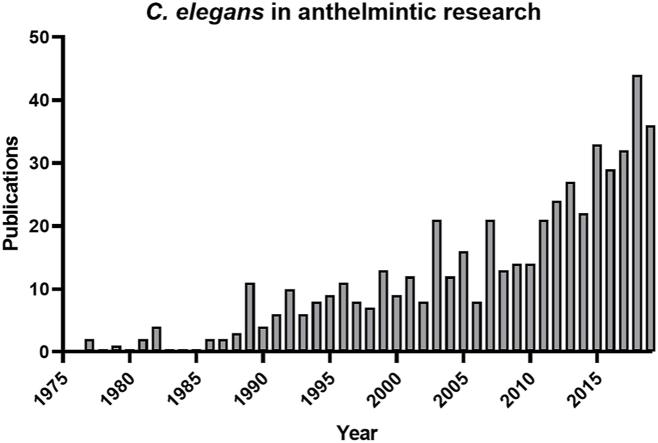
For more than four decades, the free-living nematode Caenorhabditis elegans has been extensively used in anthelmintic research. Classic genetic screens and heterologous expression in the C. elegans model enormously contributed to the identification and characterization of molecular targets of all major anthelmintic drug classes. Although these findings provided substantial insights into common anthelmintic mechanisms, a breakthrough in the treatment and control of parasitic nematodes is still not in sight. Instead, we are facing increasing evidence that the enormous diversity within the phylum Nematoda cannot be recapitulated by any single free-living or parasitic species and the development of novel broad-spectrum anthelmintics is not be a simple goal. In the present review, we summarize certain milestones and challenges of the C. elegans model with focus on drug target identification, anthelmintic drug discovery and identification of resistance mechanisms. Furthermore, we present new perspectives and strategies on how current progress in C. elegans research will support future anthelmintic research.
四十多年来,自由生活的秀丽隐杆线虫一直被广泛用于驱虫药物研究。经典的遗传筛选和秀丽隐杆线虫模型中的异源表达极大地促进了所有主要驱虫药物类别的分子靶标的鉴定和表征。尽管这些发现为常见驱虫机制提供了重要的见解,但在寄生虫线虫的治疗和控制方面仍未取得突破。相反,我们面临越来越多的证据表明,线虫门内的巨大多样性不能被任何单一的自由生活或寄生物种所概括,开发新型广谱驱虫药物也不是一个简单的目标。在本综述中,我们总结了秀丽隐杆线虫模型的某些里程碑和挑战,重点是药物靶标鉴定、驱虫药物发现和耐药机制的鉴定。此外,我们还提出了一些新的观点和策略,说明秀丽隐杆线虫研究的当前进展将如何支持未来的驱虫研究。


 Zotero 插件