
抑郁症状的轨迹及其与认知衰退的关联模式。
Trajectories of depressive symptoms and associated patterns of cognitive decline.
机构信息
National Institute of Mental Health, Klecany, Czech Republic.
Third Faculty of Medicine, Charles University Prague, Ruská 87, 100 00, Prague 10, Czech Republic.
出版信息
Sci Rep. 2020 Nov 30;10(1):20888. doi: 10.1038/s41598-020-77866-6.
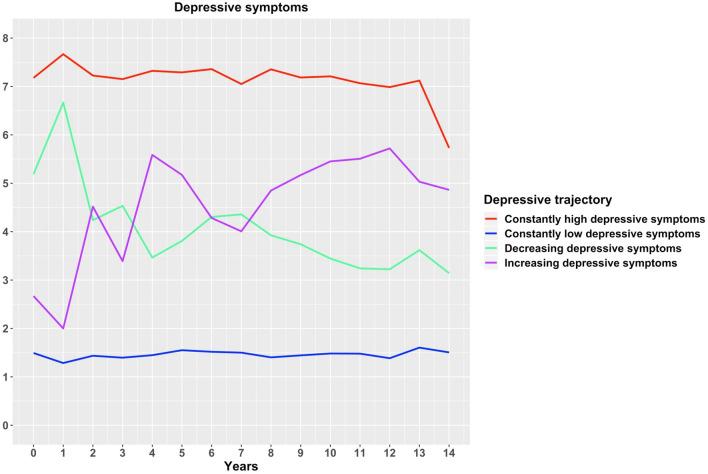
The aim was to investigate the pattern and rate of cognitive decline across distinctive trajectories of depressive symptoms in older adults. In this prospective multinational cohort study on 69,066 participants (on average 64 years at baseline, 55% women), assessments of cognitive functions (immediate recall, delayed recall, verbal fluency) and depressive symptoms (EURO-D scale) were conducted at 2-year intervals. The trajectories of depressive symptoms were obtained using latent growth mixture modelling, cognitive decline was assessed using smoothing splines and linear mixed effects models. Four distinct trajectories of depressive symptoms were identified: constantly low (n = 49,660), constantly high (n = 2999), increasing (n = 6828) and decreasing (n = 9579). Individuals with increasing and constantly high depressive symptoms showed linear cognitive decline, while those with constantly low and decreasing depressive symptoms had fluctuating cognition. Participants with increasing depressive symptoms had the fastest decline, while those with decreasing symptoms were spared from decline in cognition. This study suggests that the pattern as well as the rate of cognitive decline co-occurs with specific patterns of changes in depressive symptoms over time. The most pronounced cognitive decline is present in individuals, in whom depressive symptoms increase late in life. Unique mechanisms of cognitive decline may exist for subgroups of the population, and are associated with the trajectory of depressive symptoms.
目的在于探究老年人中不同抑郁症状轨迹的认知下降模式和速度。在这项针对 69066 名参与者(平均基线年龄 64 岁,55%为女性)的前瞻性多国队列研究中,每两年评估一次认知功能(即时回忆、延迟回忆、言语流畅性)和抑郁症状(EURO-D 量表)。采用潜在增长混合模型获得抑郁症状轨迹,采用平滑样条和线性混合效应模型评估认知下降。确定了四种不同的抑郁症状轨迹:持续低(n=49660)、持续高(n=2999)、递增(n=6828)和递减(n=9579)。递增和持续高抑郁症状的个体表现出线性认知下降,而持续低和递减抑郁症状的个体认知则波动不定。具有递增抑郁症状的参与者下降最快,而具有递减症状的参与者则免于认知下降。本研究表明,认知下降的模式和速度与抑郁症状随时间变化的特定模式共同发生。在生命后期出现抑郁症状增加的个体中,认知下降最为明显。认知下降的独特机制可能存在于人群亚组中,并与抑郁症状轨迹相关。


 Zotero 插件