
使用 MRI 定量评估杜氏肌营养不良症中的骨骼肌病变:系统映射综述。
Using MRI to quantify skeletal muscle pathology in Duchenne muscular dystrophy: A systematic mapping review.
机构信息
Department of Electrical & Computer Engineering, Texas A&M University, Doha, Qatar.
Magnetic Detection and Imaging group, Technical Medical Centre, University of Twente, The Netherlands.
出版信息
Muscle Nerve. 2021 Jul;64(1):8-22. doi: 10.1002/mus.27133. Epub 2021 Jan 8.
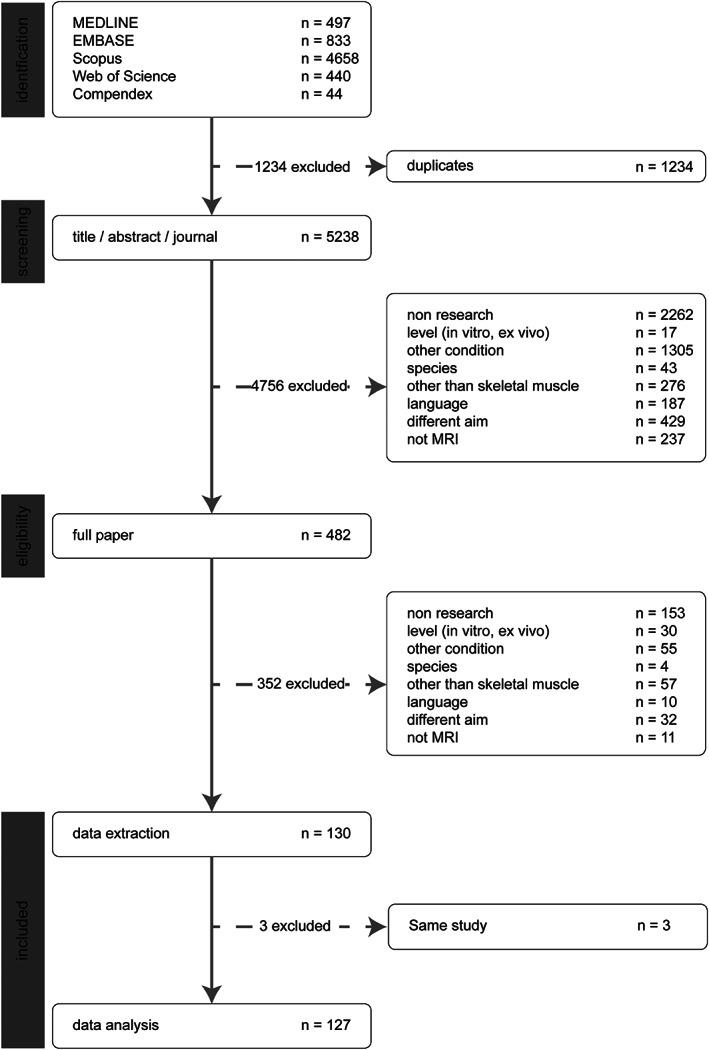
There is a great demand for accurate non-invasive measures to better define the natural history of disease progression or treatment outcome in Duchenne muscular dystrophy (DMD) and to facilitate the inclusion of a large range of participants in DMD clinical trials. This review aims to investigate which MRI sequences and analysis methods have been used and to identify future needs. Medline, Embase, Scopus, Web of Science, Inspec, and Compendex databases were searched up to 2 November 2019, using keywords "magnetic resonance imaging" and "Duchenne muscular dystrophy." The review showed the trend of using T1w and T2w MRI images for semi-qualitative inspection of structural alterations of DMD muscle using a diversity of grading scales, with increasing use of T2map, Dixon, and MR spectroscopy (MRS). High-field (>3T) MRI dominated the studies with animal models. The quantitative MRI techniques have allowed a more precise estimation of local or generalized disease severity. Longitudinal studies assessing the effect of an intervention have also become more prominent, in both clinical and animal model subjects. Quality assessment of the included longitudinal studies was performed using the Newcastle-Ottawa Quality Assessment Scale adapted to comprise bias in selection, comparability, exposure, and outcome. Additional large clinical trials are needed to consolidate research using MRI as a biomarker in DMD and to validate findings against established gold standards. This future work should use a multiparametric and quantitative MRI acquisition protocol, assess the repeatability of measurements, and correlate findings to histologic parameters.
人们迫切需要准确的非侵入性测量方法,以更好地定义杜氏肌营养不良症(DMD)的疾病进展自然史或治疗结果,并为大量 DMD 临床试验参与者提供便利。本综述旨在调查已经使用了哪些 MRI 序列和分析方法,并确定未来的需求。研究人员在 2019 年 11 月 2 日之前,使用“磁共振成像”和“杜氏肌营养不良症”等关键词,在 Medline、Embase、Scopus、Web of Science、Inspec 和 Compendex 数据库中进行了搜索。综述结果显示,T1w 和 T2w MRI 图像用于 DMD 肌肉结构改变的半定量检查的趋势,使用了多种分级量表,T2map、Dixon 和磁共振波谱(MRS)的使用逐渐增多。高场(>3T)MRI 在动物模型研究中占主导地位。定量 MRI 技术能够更精确地估计局部或全身性疾病的严重程度。评估干预效果的纵向研究在临床和动物模型研究中也越来越突出。使用适用于纳入的纵向研究的纽卡斯尔-渥太华质量评估量表(Newcastle-Ottawa Quality Assessment Scale),对其质量进行了评估,该量表包括选择、可比性、暴露和结果偏倚。需要更多的大型临床试验来巩固 MRI 作为 DMD 生物标志物的研究,并将研究结果与既定的金标准进行验证。未来的研究工作应该使用多参数和定量 MRI 采集方案,评估测量的重复性,并将研究结果与组织学参数相关联。


 Zotero 插件