
衰弱指数与中国成年人全因及死因特异性死亡率:一项前瞻性队列研究。
Frailty index and all-cause and cause-specific mortality in Chinese adults: a prospective cohort study.
机构信息
Department of Epidemiology and Biostatistics, School of Public Health, Peking University, Beijing, China.
Peking University Health Science Center, and Key Laboratory of Molecular Cardiovascular Sciences, Ministry of Education, Peking University, Beijing, China.
出版信息
Lancet Public Health. 2020 Dec;5(12):e650-e660. doi: 10.1016/S2468-2667(20)30113-4.
BACKGROUND
The fraily index is a useful proxy measure of accelerated biological ageing and in estimating all-cause and cause-specific mortality in older individuals in European and US populations. However, the predictive value of the frailty index in other populations outside of Europe and the USA and in adults younger than 50 years is unknown. We aimed to examine the association between the frailty index and mortality in a population of Chinese adults.
METHODS
In this prospective cohort study, we used data from the China Kadoorie Biobank. We included adults aged 30-79 years from ten areas (five urban areas and five rural areas) of China who had no missing values for the items that made up the frailty index. We did not exclude participants on the basis of baseline morbidity status. We calculated the follow-up person-years from the baseline date to either the date of death, loss to follow-up, or Dec 31, 2017, whichever came first, through linkage with the registries of China's Disease Surveillance Points system and local residential records. Active follow-up visits to local communities were done annually for participants who were not linked to any established registries. Causes of death from official death certificates were supplemented, if necessary, by reviewing medical records or doing standard verbal autopsy procedures. The frailty index was calculated using 28 baseline variables, all of which were health status deficits measured by use of questionnaires and physical examination. We defined three categories of frailty status: robust (frailty index ≤0·10), prefrail (frailty index >0·10 to <0·25), and frail (frailty index ≥0·25). The primary outcomes were all-cause mortality and cause-specific mortality in Chinese adults aged 30-79 years. We used a Cox proportional hazards model to estimate the associations between the frailty index and all-cause and cause-specific mortality, adjusting for chronological age, education, and lifestyle factors.
FINDINGS
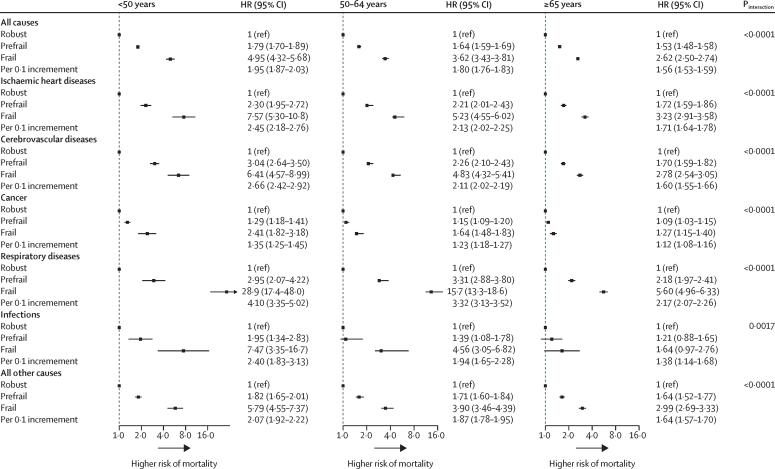
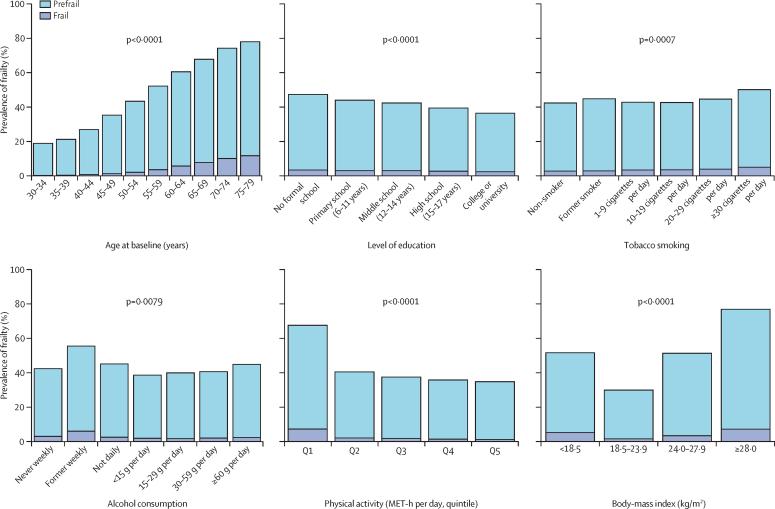
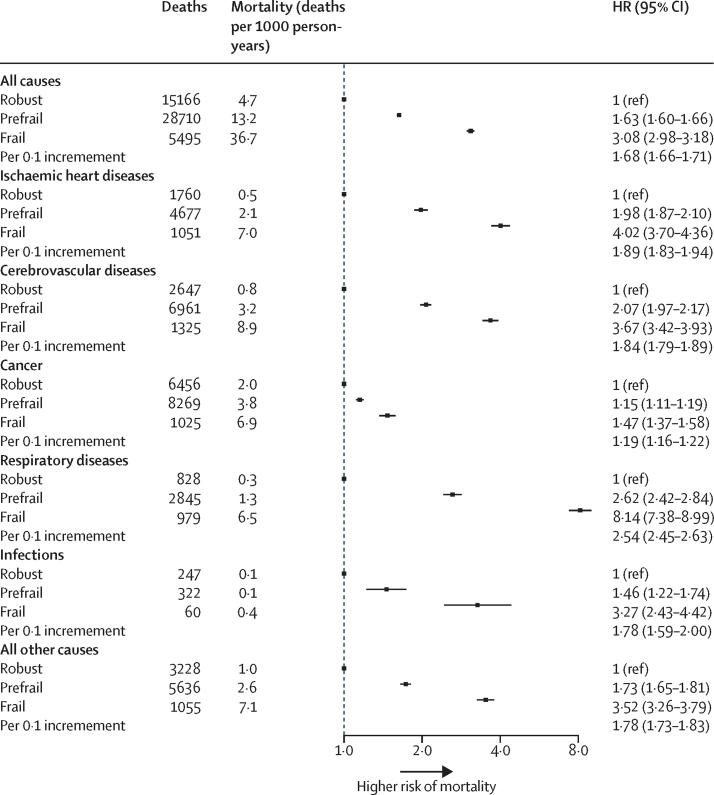
512 723 participants, recruited between June 25, 2004, and July 15, 2008, were followed up for a median of 10·8 years (IQR 10·2-13·1; total follow-up 5 551 974 person-years). 291 954 (56·9%) people were categorised as robust, 205 075 (40·0%) people were categorised as prefrail, and 15 694 (3·1%) people were categorised as frail. Women aged between 45 years and 79 years had a higher mean frailty index and a higher prevalence of frailty than did men. During follow-up, 49 371 deaths were recorded. After adjustment for established and potential risk factors for death, each 0·1 increment in the frailty index was associated with a higher risk of all-cause mortality (hazard ratio [HR] 1·68, 95% CI 1·66-1·71). Such associations were stronger among younger adults than among older adults (p<0·0001), with HRs per 0·1 increment of the frailty index of 1·95 (95% CI 1·87-2·03) for those younger than 50 years, 1·80 (1·76-1·83) for those aged 50-64 years, and 1·56 (1·53-1·59) for those 65 years and older. After adjustments, there was no difference between the sexes in the association between the frailty index and all-cause mortality (p=0·75). For each 0·1 increment of the frailty index, the corresponding HRs for risk of death were 1·89 (95% CI 1·83-1·94) from ischaemic heart disease, 1·84 (1·79-1·89) from cerebrovascular disease, 1·19 (1·16-1·22) from cancer, 2·54 (2·45-2·63) from respiratory disease, 1·78 (1·59-2·00) from infection, and 1·78 (1·73-1·83) from all other causes.
INTERPRETATION
The frailty index is associated with all-cause and cause-specific mortality independent of chronological age in younger and older Chinese adults. The identification of younger adults with accelerated ageing by use of surrogate measures could be useful for the prevention of premature death and the extension of healthy active life expectancy.
FUNDING
The National Natural Science Foundation of China, the National Key R&D Program of China, the Chinese Ministry of Science and Technology, the Kadoorie Charitable Foundation, and the Wellcome Trust.
背景
衰弱指数是衡量生物衰老速度的有用替代指标,可用于估算欧洲和美国人群中老年个体的全因死亡率和死因特异性死亡率。然而,衰弱指数在欧洲和美国以外的其他人群以及 50 岁以下成年人中的预测价值尚不清楚。我们旨在研究衰弱指数与中国成年人死亡率之间的关系。
方法
在这项前瞻性队列研究中,我们使用了中国慢性病前瞻性研究的数据。我们纳入了来自中国十个地区(五个城市地区和五个农村地区)的年龄在 30-79 岁之间、没有构成衰弱指数的项目缺失值的成年人。我们没有根据基线发病状况排除参与者。我们通过与中国疾病监测点系统和当地居民记录的关联,从基线日期到死亡日期、失访日期或 2017 年 12 月 31 日(以先到者为准)计算随访人年。对于未与任何已建立的登记处相关联的参与者,每年在当地社区进行主动随访。如果需要,通过查阅病历或进行标准的口头尸检程序来补充官方死亡证明上的死因。使用 28 个基线变量计算衰弱指数,所有这些变量均为使用问卷和体检测量的健康状况缺陷。我们将衰弱状态分为三个类别:强壮(衰弱指数≤0·10)、虚弱前期(衰弱指数>0·10 至<0·25)和虚弱(衰弱指数≥0·25)。主要结局是中国 30-79 岁成年人的全因死亡率和死因特异性死亡率。我们使用 Cox 比例风险模型估计衰弱指数与全因死亡率和死因特异性死亡率之间的关联,调整了年龄、教育程度和生活方式因素。
发现
2004 年 6 月 25 日至 2008 年 7 月 15 日期间招募的 512723 名参与者中位随访时间为 10·8 年(IQR 10·2-13·1;总随访 5519740 人年)。291954 人(56.9%)被归类为强壮,205075 人(40.0%)被归类为虚弱前期,15694 人(3.1%)被归类为虚弱。45-79 岁的女性比男性平均衰弱指数更高,衰弱的患病率更高。在随访期间,记录了 49371 例死亡。在调整了死亡的既定和潜在风险因素后,衰弱指数每增加 0·1,全因死亡率的风险就会增加(风险比[HR] 1·68,95%CI 1·66-1·71)。这种关联在年轻成年人中比在老年成年人中更强(p<0·0001),衰弱指数每增加 0·1,年龄小于 50 岁的成年人全因死亡率的 HR 为 1·95(95%CI 1·87-2·03),50-64 岁的成年人为 1·80(1·76-1·83),65 岁及以上的成年人为 1·56(1·53-1·59)。调整后,衰弱指数与全因死亡率之间的关联在性别之间没有差异(p=0·75)。对于衰弱指数每增加 0·1,相应的死亡风险 HR 为缺血性心脏病 1·89(95%CI 1·83-1·94),脑血管疾病 1·84(95%CI 1·79-1·89),癌症 1·19(1·16-1·22),呼吸道疾病 2·54(2·45-2·63),感染 1·78(1·59-2·00),以及所有其他原因 1·78(1·73-1·83)。
解释
衰弱指数与中国年轻和老年成年人的全因死亡率和死因特异性死亡率独立于年龄有关。通过替代指标识别出衰老速度加快的年轻成年人,可能有助于预防过早死亡和延长健康活跃预期寿命。
资金
国家自然科学基金、国家重点研发计划、中国科学技术部、中国凯德基金会、英国惠康信托基金会。

 Zotero 插件