
1990 年至 2017 年全球 195 个国家和地区的胰腺炎负担:2017 年全球疾病负担研究的系统分析。
The global, regional, and national burden of pancreatitis in 195 countries and territories, 1990-2017: a systematic analysis for the Global Burden of Disease Study 2017.
机构信息
Department of Hepatobiliary Surgery, Liuzhou People's Hospital, Liuzhou, Guangxi, China.
Department of General Surgery, The Second Xiangya Hospital, Central South University, Changsha, Hunan, China.
出版信息
BMC Med. 2020 Dec 10;18(1):388. doi: 10.1186/s12916-020-01859-5.
BACKGROUND
Pancreatitis is a critical public health problem, and the burden of pancreatitis is increasing. We report the rates and trends of the prevalence, incidence, and years lived with disability (YLDs) for pancreatitis at the global, regional, and national levels in 195 countries and territories from 1990 to 2017, stratified by sex, age, and sociodemographic index (SDI).
METHODS
Data on pancreatitis were available from the Global Burden of Diseases, Injuries, and Risk Factors Study (GBD) 2017. Numbers and age-standardized prevalence, incidence, and YLDs' rates per 100,000 population were estimated through a systematic analysis of modeled data from the 2017 GBD study. Both acute and chronic pancreatitis are being modeled separately in the GBD 2017; however, our data show acute and chronic pancreatitis together. Estimates were reported with uncertainty intervals (UIs).
RESULTS
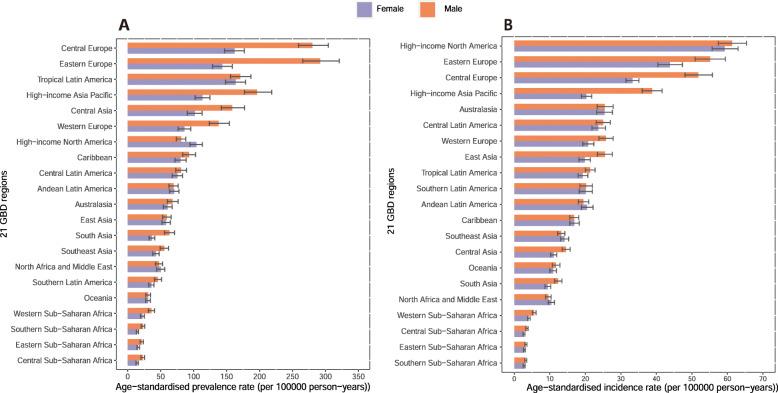
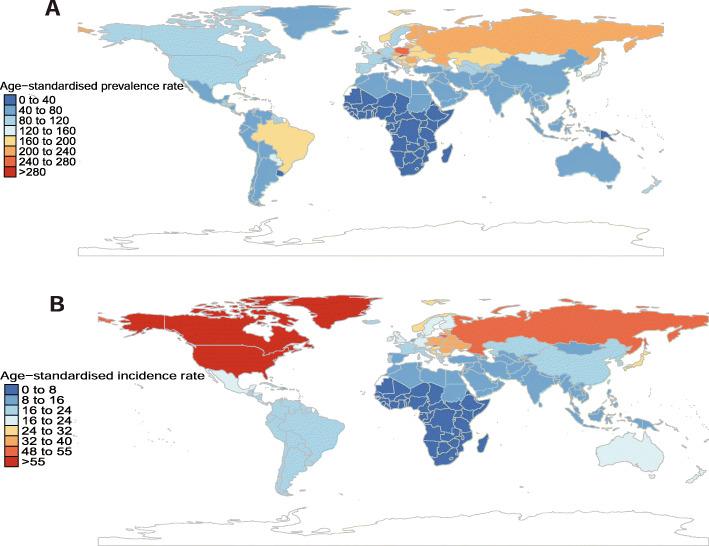
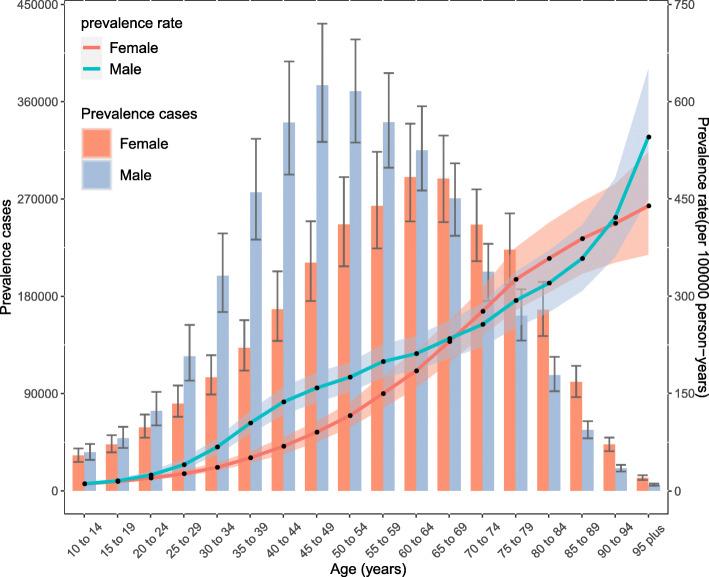
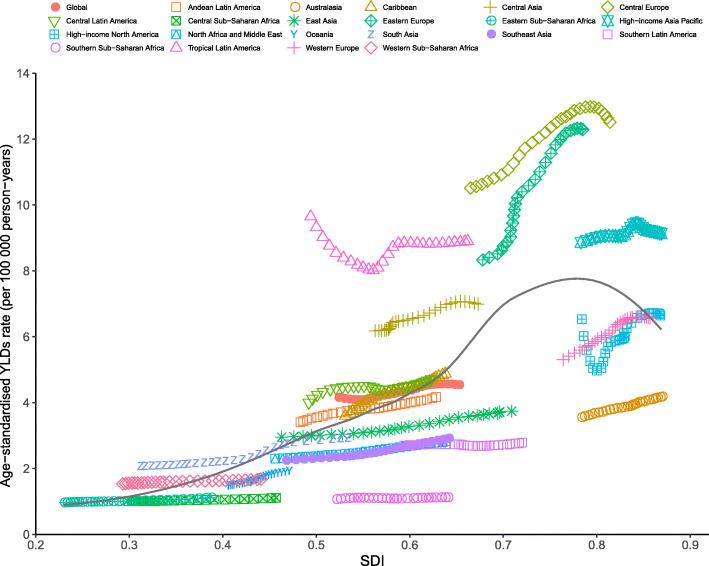
Globally, in 2017, the age-standardized rates were 76.2 (95% UIs 68.9 to 83.4), 20.6 (19.2 to 22.1), and 4.5 (2.3 to 7.6) per 100,000 population for the point prevalence, incidence, and YLDs, respectively. From 1990 to 2017, the percent changes in the age-standardized prevalence and YLDs rates increased, whereas the age-standardized incidence rate decreased. The global prevalence increased with age up to 60-64 years and 44-49 years in females and males, respectively, and then decreased, with no significant difference between females and males. The global prevalence rate increased with age, peaking in the 95+ age group, with no difference between sexes. Generally, positive correlation between age-standardized YLDs and SDIs at the regional and national levels was observed. Slovakia (297.7 [273.4 to 325.3]), Belgium (274.3 [242.6 to 306.5]), and Poland (266.7 [248.2 to 284.4]) had the highest age-standardized prevalence rates in 2017. Taiwan (Province of China) (104.2% [94.8 to 115.2%]), Maldives (72.4% [66.5 to 79.2%]), and Iceland (64.8% [57.2 to 72.9%]) had the largest increases in age-standardized prevalence rates from 1990 to 2017.
CONCLUSIONS
Pancreatitis is a major public health issue worldwide. The age-standardized prevalence and YLDs rates increased, but the age-standardized incidence rate decreased from 1990 to 2017. Improving the quality of pancreatitis health data in all regions and countries is strongly recommended for better monitoring the burden of pancreatitis.
背景
胰腺炎是一个严重的公共卫生问题,其负担正在增加。我们报告了全球 195 个国家和地区 1990 年至 2017 年期间胰腺炎的患病率、发病率和伤残调整生命年(YLDs)的全球、区域和国家水平的发生率和趋势,按性别、年龄和社会人口指数(SDI)进行分层。
方法
胰腺炎的数据来自全球疾病、伤害和风险因素研究(GBD)2017 年。通过对 2017 年 GBD 研究中建模数据的系统分析,估计了每 100,000 人口中患病率、发病率和 YLDs 的标准化发生率、发病率和 YLDs 率。GBD 2017 中分别对急性和慢性胰腺炎进行了建模;然而,我们的数据显示了急性和慢性胰腺炎一起。估计结果用不确定区间(UI)报告。
结果
在全球范围内,2017 年的年龄标准化率分别为每 100,000 人口 76.2(95%UI 68.9 至 83.4)、20.6(19.2 至 22.1)和 4.5(2.3 至 7.6)。从 1990 年到 2017 年,年龄标准化患病率和 YLDs 率的百分比变化增加,而年龄标准化发病率则下降。全球患病率随年龄增长至女性 60-64 岁和男性 44-49 岁达到峰值,然后下降,男女之间无显著差异。全球患病率随年龄增长而上升,在 95+年龄组达到峰值,男女之间没有差异。一般来说,在区域和国家一级,年龄标准化 YLDs 和 SDI 之间存在正相关关系。2017 年,斯洛伐克(297.7 [273.4 至 325.3])、比利时(274.3 [242.6 至 306.5])和波兰(266.7 [248.2 至 284.4])的年龄标准化患病率最高。2017 年,中国台湾(104.2%[94.8%至 115.2%])、马尔代夫(72.4%[66.5%至 79.2%])和冰岛(64.8%[57.2%至 72.9%])的年龄标准化患病率增幅最大。
结论
胰腺炎是全球范围内的一个主要公共卫生问题。从 1990 年到 2017 年,年龄标准化患病率和 YLDs 率增加,但年龄标准化发病率下降。强烈建议所有地区和国家提高胰腺炎健康数据的质量,以更好地监测胰腺炎的负担。

 Zotero 插件