
外周血中的纵向数据证实 PM20D1 是阿尔茨海默病的数量性状位点 (QTL),并暗示其在疾病进展中的动态作用。
Longitudinal data in peripheral blood confirm that PM20D1 is a quantitative trait locus (QTL) for Alzheimer's disease and implicate its dynamic role in disease progression.
机构信息
ASU-Banner Neurodegenerative Disease Research Center, Arizona State University, Tempe, AZ, USA.
Banner Alzheimer's Institute, Phoenix, AZ, USA.
出版信息
Clin Epigenetics. 2020 Dec 9;12(1):189. doi: 10.1186/s13148-020-00984-5.
BACKGROUND
While Alzheimer's disease (AD) remains one of the most challenging diseases to tackle, genome-wide genetic/epigenetic studies reveal many disease-associated risk loci, which sheds new light onto disease heritability, provides novel insights to understand its underlying mechanism and potentially offers easily measurable biomarkers for early diagnosis and intervention.
METHODS
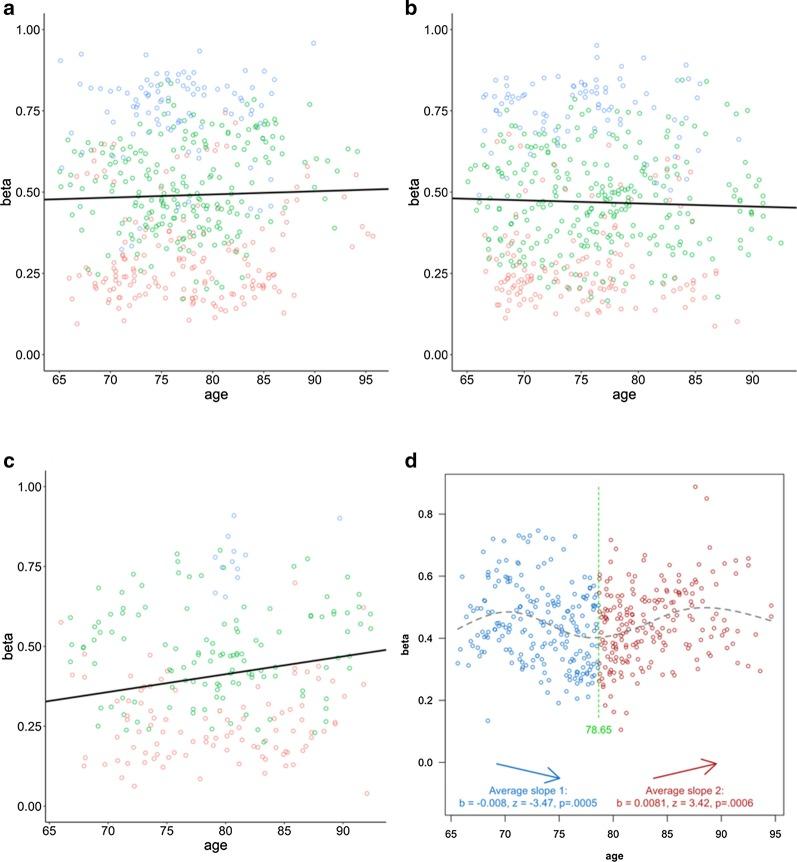
We analyzed whole-genome DNA methylation data collected from peripheral blood in a cohort (n = 649) from the Alzheimer's Disease Neuroimaging Initiative (ADNI) and compared the DNA methylation level at baseline among participants diagnosed with AD (n = 87), mild cognitive impairment (MCI, n = 175) and normal controls (n = 162), to identify differentially methylated regions (DMRs). We also leveraged up to 4 years of longitudinal DNA methylation data, sampled at approximately 1 year intervals to model alterations in methylation levels at DMRs to delineate methylation changes associated with aging and disease progression, by linear mixed-effects (LME) modeling for the unchanged diagnosis groups (AD, MCI and control, respectively) and U-shape testing for those with changed diagnosis (converters).
RESULTS
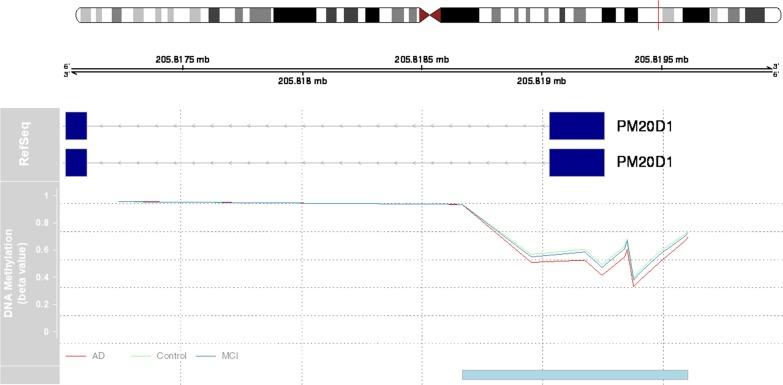
When compared with controls, patients with MCI consistently displayed promoter hypomethylation at methylation QTL (mQTL) gene locus PM20D1. This promoter hypomethylation was even more prominent in patients with mild to moderate AD. This is in stark contrast with previously reported hypermethylation in hippocampal and frontal cortex brain tissues in patients with advanced-stage AD at this locus. From longitudinal data, we show that initial promoter hypomethylation of PM20D1 during MCI and early stage AD is reversed to eventual promoter hypermethylation in late stage AD, which helps to complete a fuller picture of methylation dynamics. We also confirm this observation in an independent cohort from the Religious Orders Study and Memory and Aging Project (ROSMAP) Study using DNA methylation and gene expression data from brain tissues as neuropathological staging (Braak score) advances.
CONCLUSIONS
Our results confirm that PM20D1 is an mQTL in AD and demonstrate that it plays a dynamic role at different stages of the disease. Further in-depth study is thus warranted to fully decipher its role in the evolution of AD and potentially explore its utility as a blood-based biomarker for AD.
背景
尽管阿尔茨海默病(AD)仍然是最难攻克的疾病之一,但全基因组遗传/表观遗传研究揭示了许多与疾病相关的风险基因座,这为疾病遗传率提供了新的认识,为理解其潜在机制提供了新的见解,并为早期诊断和干预提供了易于测量的生物标志物。
方法
我们分析了来自阿尔茨海默病神经影像学倡议(ADNI)队列(n=649)的外周血全基因组 DNA 甲基化数据,并比较了基线时被诊断为 AD(n=87)、轻度认知障碍(MCI,n=175)和正常对照组(n=162)参与者的 DNA 甲基化水平,以确定差异甲基化区域(DMR)。我们还利用了长达 4 年的纵向 DNA 甲基化数据,大约每年采样一次,通过线性混合效应(LME)模型对 DMR 处的甲基化水平进行建模,以描绘与衰老和疾病进展相关的甲基化变化,对于未改变诊断组(AD、MCI 和对照),采用线性混合效应模型(LME)进行建模,对于诊断改变组(转化组),采用 U 形测试进行建模。
结果
与对照组相比,MCI 患者在 PM20D1 甲基化 QTL(mQTL)基因座处始终表现出启动子低甲基化。在轻度至中度 AD 患者中,这种启动子低甲基化更为明显。这与之前在该基因座报道的晚期 AD 患者海马体和额叶皮质脑组织中高甲基化形成鲜明对比。从纵向数据来看,我们发现 PM20D1 在 MCI 和早期 AD 期间的初始启动子低甲基化在晚期 AD 中最终逆转为启动子高甲基化,这有助于更全面地了解甲基化动态。我们还在来自宗教秩序研究和记忆与衰老项目(ROSMAP)研究的独立队列中使用脑组织的 DNA 甲基化和基因表达数据作为神经病理学分期(Braak 评分)的进展,证实了这一观察结果。
结论
我们的结果证实 PM20D1 是 AD 中的 mQTL,并表明它在疾病的不同阶段发挥着动态作用。因此,有必要进行进一步的深入研究,以充分揭示其在 AD 演变中的作用,并探索其作为 AD 血液生物标志物的潜力。





 Zotero 插件