
乳铁蛋白及其衍生肽:一种对抗病原体产生的毒力机制的替代方法。
Lactoferrin and Its Derived Peptides: An Alternative for Combating Virulence Mechanisms Developed by Pathogens.
机构信息
Departamento de Biología Celular, Centro de Investigación y de Estudios Avanzados del Instituto Politécnico Nacional (CINVESTAV-IPN), Zacatenco 07360, CdMx, Mexico.
Facultad de Medicina Veterinaria y Zootecnia, Universidad Nacional Autónoma de México (UNAM), Coyoacán 04510, CdMx, Mexico.
出版信息
Molecules. 2020 Dec 8;25(24):5763. doi: 10.3390/molecules25245763.
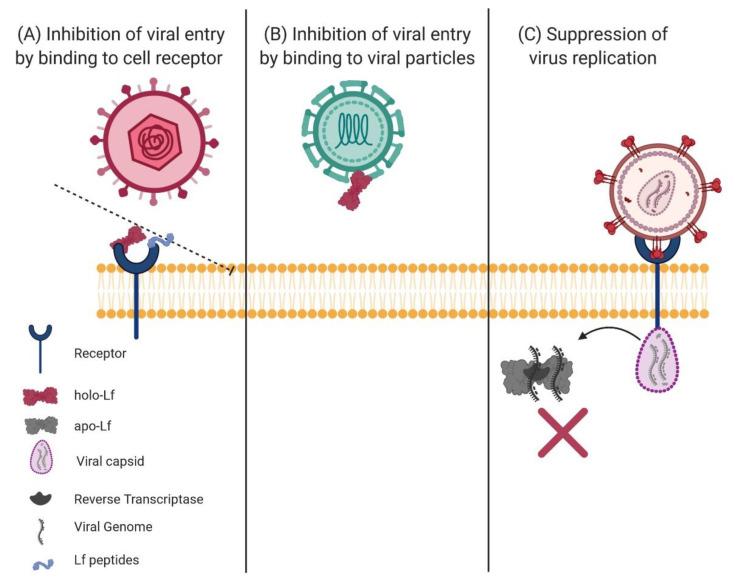
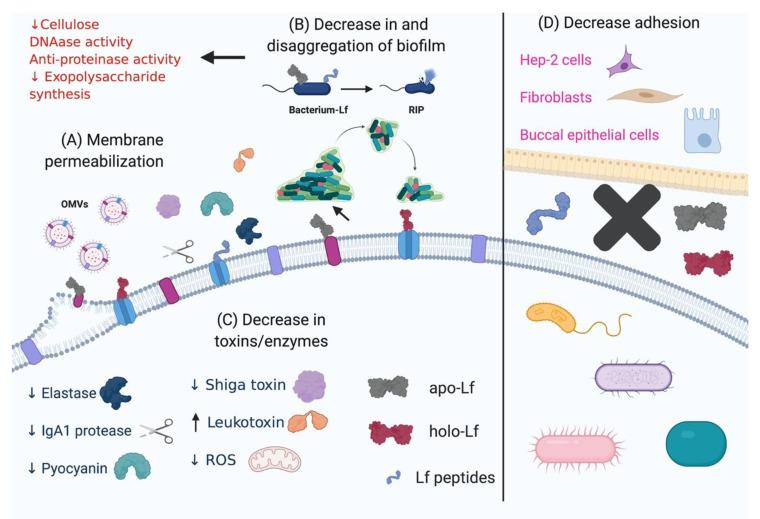
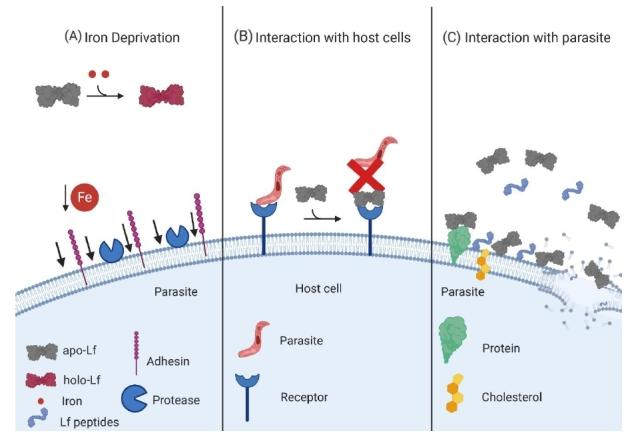
Due to the emergence of multidrug-resistant pathogens, it is necessary to develop options to fight infections caused by these agents. Lactoferrin (Lf) is a cationic nonheme multifunctional glycoprotein of the innate immune system of mammals that provides numerous benefits. Lf is bacteriostatic and/or bactericidal, can stimulate cell proliferation and differentiation, facilitate iron absorption, improve neural development and cognition, promote bone growth, prevent cancer and exert anti-inflammatory and immunoregulatory effects. Lactoferrin is present in colostrum and milk and is also produced by the secondary granules of polymorphonuclear leukocytes, which store this glycoprotein and release it at sites of infection. Lf is also present in many fluids and exocrine secretions, on the surfaces of the digestive, respiratory and reproductive systems that are commonly exposed to pathogens. Apo-Lf (an iron-free molecule) can be microbiostatic due to its ability to capture ferric iron, blocking the availability of host iron to pathogens. However, apo-Lf is mostly microbicidal via its interaction with the microbial surface, causing membrane damage and altering its permeability function. Lf can inhibit viral entry by binding to cell receptors or viral particles. Lf is also able to counter different important mechanisms evolved by microbial pathogens to infect and invade the host, such as adherence, colonization, invasion, production of biofilms and production of virulence factors such as proteases and toxins. Lf can also cause mitochondrial and caspase-dependent regulated cell death and apoptosis-like in pathogenic yeasts. All of these mechanisms are important targets for treatment with Lf. Holo-Lf (the iron-saturated molecule) can contain up to two ferric ions and can also be microbicidal against some pathogens. On the other hand, lactoferricins (Lfcins) are peptides derived from the N-terminus of Lf that are produced by proteolysis with pepsin under acidic conditions, and they cause similar effects on pathogens to those caused by the parental Lf. Synthetic analog peptides comprising the N-terminus Lf region similarly exhibit potent antimicrobial properties. Importantly, there are no reported pathogens that are resistant to Lf and Lfcins; in addition, Lf and Lfcins have shown a synergistic effect with antimicrobial and antiviral drugs. Due to the Lf properties being microbiostatic, microbicidal, anti-inflammatory and an immune modulator, it represents an excellent natural alternative either alone or as adjuvant in the combat to antibiotic multidrug-resistant bacteria and other pathogens. This review aimed to evaluate the data that appeared in the literature about the effects of Lf and its derived peptides on pathogenic bacteria, protozoa, fungi and viruses and how Lf and Lfcins inhibit the mechanisms developed by these pathogens to cause disease.
由于多药耐药病原体的出现,有必要开发针对这些药物引起的感染的治疗选择。乳铁蛋白(Lf)是哺乳动物先天免疫系统中的一种阳离子非血红素多功能糖蛋白,具有多种益处。Lf 具有抑菌和/或杀菌作用,可刺激细胞增殖和分化,促进铁吸收,改善神经发育和认知功能,促进骨骼生长,预防癌症,并发挥抗炎和免疫调节作用。Lf 存在于初乳和牛奶中,也由多形核白细胞的次级颗粒产生,这些颗粒储存这种糖蛋白并在感染部位释放它。Lf 也存在于许多体液和外分泌分泌物中,存在于消化道、呼吸道和生殖系统的表面,这些部位通常会接触病原体。由于其捕获三价铁的能力,无铁的 apo-Lf(铁游离分子)可以具有抑菌作用,从而阻断宿主铁对病原体的可用性。然而,apo-Lf 主要通过与微生物表面相互作用而具有杀菌作用,导致膜损伤并改变其通透性功能。Lf 可以通过与细胞受体或病毒颗粒结合来抑制病毒进入。Lf 还能够对抗微生物病原体进化而来的不同重要机制,以感染和侵入宿主,例如粘附、定植、入侵、生物膜的产生以及蛋白酶和毒素等毒力因子的产生。Lf 还可以引起致病性酵母中的线粒体和半胱天冬酶依赖性调节细胞死亡和凋亡样死亡。所有这些机制都是用 Lf 治疗的重要靶点。全铁结合的 holo-Lf(铁饱和分子)可以包含多达两个三价铁离子,并且对一些病原体也具有杀菌作用。另一方面,乳铁肽(Lfcins)是在酸性条件下用胃蛋白酶进行蛋白水解从 Lf 的 N 端产生的肽,它们对病原体的作用与亲本 Lf 相似。包含 Lf N 端区域的合成模拟肽也表现出很强的抗微生物特性。重要的是,没有报道称有对 Lf 和 Lfcins 耐药的病原体;此外,Lf 和 Lfcins 与抗菌和抗病毒药物表现出协同作用。由于 Lf 的抑菌、杀菌、抗炎和免疫调节剂特性,它是一种很好的天然替代品,无论是单独使用还是作为辅助剂,都可以对抗抗生素多药耐药细菌和其他病原体。本综述旨在评估文献中关于 Lf 及其衍生肽对致病菌、原生动物、真菌和病毒的影响的数据,以及 Lf 和 Lfcins 如何抑制这些病原体引起疾病的机制。


 Zotero 插件