
靶向 NK 细胞抑制性受体的多发性骨髓瘤精准免疫治疗。
Targeting NK Cell Inhibitory Receptors for Precision Multiple Myeloma Immunotherapy.
机构信息
Department of Biology, University of New Brunswick, Saint John, NB, Canada.
Department of Oncology, Saint John Regional Hospital, Saint John, NB, Canada.
出版信息
Front Immunol. 2020 Nov 12;11:575609. doi: 10.3389/fimmu.2020.575609. eCollection 2020.
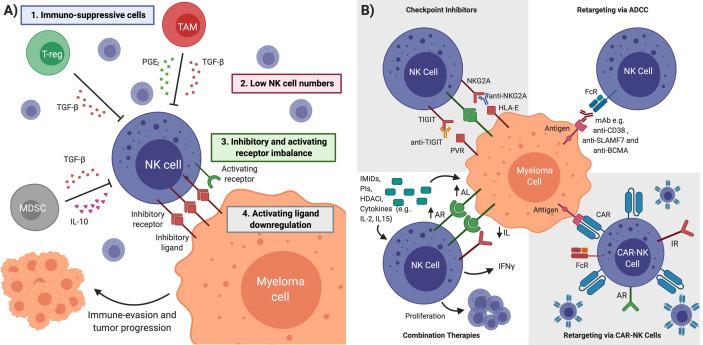
Innate immune surveillance of cancer involves multiple types of immune cells including the innate lymphoid cells (ILCs). Natural killer (NK) cells are considered the most active ILC subset for tumor elimination because of their ability to target infected and malignant cells without prior sensitization. NK cells are equipped with an array of activating and inhibitory receptors (IRs); hence NK cell activity is controlled by balanced signals between the activating and IRs. Multiple myeloma (MM) is a hematological malignancy that is known for its altered immune landscape. Despite improvements in therapeutic options for MM, this disease remains incurable. An emerging trend to improve clinical outcomes in MM involves harnessing the inherent ability of NK cells to kill malignant cells by recruiting NK cells and enhancing their cytotoxicity toward the malignant MM cells. Following the clinical success of blocking T cell IRs in multiple cancers, targeting NK cell IRs is drawing increasing attention. Relevant NK cell IRs that are attractive candidates for checkpoint blockades include KIRs, NKG2A, LAG-3, TIGIT, PD-1, and TIM-3 receptors. Investigating these NK cell IRs as pathogenic agents and therapeutic targets could lead to promising applications in MM therapy. This review describes the critical role of enhancing NK cell activity in MM and discusses the potential of blocking NK cell IRs as a future MM therapy.
天然免疫监视肿瘤涉及多种类型的免疫细胞,包括固有淋巴细胞(ILC)。自然杀伤(NK)细胞因其能够在没有预先致敏的情况下靶向感染和恶性细胞而被认为是最活跃的 ILC 亚群,用于肿瘤消除。NK 细胞配备了一系列激活和抑制受体(IR);因此,NK 细胞的活性受激活和 IR 之间的平衡信号控制。多发性骨髓瘤(MM)是一种血液恶性肿瘤,以其改变的免疫景观而闻名。尽管 MM 的治疗选择有所改善,但这种疾病仍然无法治愈。一种提高 MM 临床疗效的新兴趋势是利用 NK 细胞固有杀死恶性细胞的能力,通过招募 NK 细胞并增强其对恶性 MM 细胞的细胞毒性来实现。在多种癌症中阻断 T 细胞 IR 的临床成功之后,针对 NK 细胞 IR 的靶向治疗越来越受到关注。有吸引力的 NK 细胞 IR 作为检查点阻断的候选物包括 KIRs、NKG2A、LAG-3、TIGIT、PD-1 和 TIM-3 受体。研究这些 NK 细胞 IR 作为致病因子和治疗靶点可能会为 MM 治疗带来有前景的应用。本文描述了增强 NK 细胞活性在 MM 中的关键作用,并讨论了阻断 NK 细胞 IR 作为未来 MM 治疗的潜力。


 Zotero 插件