
母体免疫反应和孕期空气污染暴露:自闭症早期标志物(EMA)研究的新见解。
Maternal immune response and air pollution exposure during pregnancy: insights from the Early Markers for Autism (EMA) study.
机构信息
Department of Mental Health, Wendy Klag Center for Autism and Developmental Disabilities, Bloomberg School of Public Health, Johns Hopkins University, Kennedy Krieger Institute Intellectual and Developmental Disabilities Research Center, 624 N. Broadway, HH833, Baltimore, MD, 21205, USA.
Department of Public Health, California State University, Fullerton, CA, USA.
出版信息
J Neurodev Disord. 2020 Dec 16;12(1):42. doi: 10.1186/s11689-020-09343-0.
BACKGROUND
Perinatal exposure to air pollution and immune system dysregulation are two factors consistently associated with autism spectrum disorders (ASD) and other neurodevelopmental outcomes. However, little is known about how air pollution may influence maternal immune function during pregnancy.
OBJECTIVES
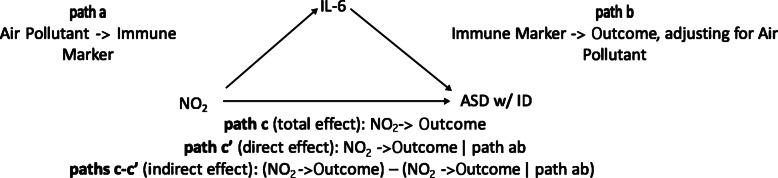
To assess the relationship between mid-gestational circulating levels of maternal cytokines/chemokines and previous month air pollution exposure across neurodevelopmental groups, and to assess whether cytokines/chemokines mediate the relationship between air pollution exposures and risk of ASD and/or intellectual disability (ID) in the Early Markers for Autism (EMA) study.
METHODS
EMA is a population-based, nested case-control study which linked archived maternal serum samples collected during weeks 15-19 of gestation for routine prenatal screening, birth records, and Department of Developmental Services (DDS) records. Children receiving DDS services for ASD without intellectual disability (ASD without ID; n = 199), ASD with ID (ASD with ID; n = 180), ID without ASD (ID; n = 164), and children from the general population (GP; n = 414) with no DDS services were included in this analysis. Serum samples were quantified for 22 cytokines/chemokines using Luminex multiplex analysis technology. Air pollution exposure for the month prior to maternal serum collection was assigned based on the Environmental Protection Agency's Air Quality System data using the maternal residential address reported during the prenatal screening visit.
RESULTS
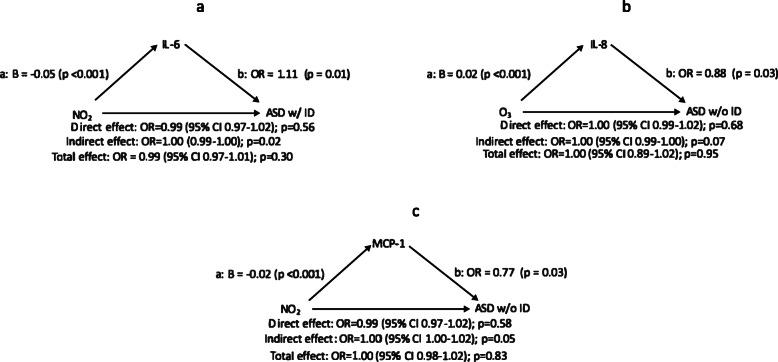
Previous month air pollution exposure and mid-gestational maternal cytokine and chemokine levels were significantly correlated, though weak in magnitude (ranging from - 0.16 to 0.13). Ten pairs of mid-pregnancy immune markers and previous month air pollutants were significantly associated within one of the child neurodevelopmental groups, adjusted for covariates (p < 0.001). Mid-pregnancy air pollution was not associated with any neurodevelopmental outcome. IL-6 remained associated with ASD with ID even after adjusting for air pollution exposure.
CONCLUSION
This study suggests that maternal immune activation is associated with risk for neurodevelopmental disorders. Furthermore, that prenatal air pollution exposure is associated with small, but perhaps biologically relevant, effects on maternal immune system function during pregnancy. Additional studies are needed to better evaluate how prenatal exposure to air pollution affects the trajectory of maternal immune activation during pregnancy, if windows of heightened susceptibility can be identified, and how these factors influence neurodevelopment of the offspring.
背景
围产期暴露于空气污染和免疫系统失调是与自闭症谱系障碍(ASD)和其他神经发育结果一致的两个因素。然而,人们对空气污染如何在怀孕期间影响母体免疫功能知之甚少。
目的
评估在神经发育障碍组中,妊娠中期母体细胞因子/趋化因子的循环水平与前一个月空气污染暴露之间的关系,并评估细胞因子/趋化因子是否介导空气污染暴露与自闭症早期标志物(EMA)研究中 ASD 和/或智力障碍(ID)风险之间的关系。
方法
EMA 是一项基于人群的嵌套病例对照研究,该研究将在妊娠 15-19 周期间收集的存档母体血清样本与出生记录和发育服务部(DDS)记录相关联。在此分析中,纳入了接受 DDS 服务的无智力障碍自闭症儿童(ASD 无 ID;n = 199)、有智力障碍自闭症儿童(ASD 有 ID;n = 180)、无自闭症智力障碍儿童(ID;n = 164)和来自一般人群(GP;n = 414)的无 DDS 服务儿童。使用 Luminex 多重分析技术对 22 种细胞因子/趋化因子进行了定量。根据母体住所报告在产前筛查访问期间,使用环境保护署的空气质量系统数据来确定在收集母体血清前一个月的空气污染暴露情况。
结果
前一个月的空气污染暴露和妊娠中期母体细胞因子和趋化因子水平呈显著相关,尽管相关性较弱(范围从-0.16 到 0.13)。在一个儿童神经发育障碍组中,有 10 对妊娠中期的免疫标志物和前一个月的空气污染物存在显著相关性,调整了协变量(p < 0.001)。妊娠中期的空气污染与任何神经发育结果均无关。即使在调整了空气污染暴露后,IL-6 仍与 ASD 有 ID 相关。
结论
这项研究表明,母体免疫激活与神经发育障碍的风险相关。此外,产前空气污染暴露与妊娠期间母体免疫系统功能的微小但可能具有生物学意义的影响相关。需要进一步的研究来更好地评估产前暴露于空气污染如何影响妊娠期间母体免疫激活的轨迹,如果可以确定易感性的窗口期,以及这些因素如何影响后代的神经发育。
 Zotero 插件