
[F]FDG PET/CT 有助于预测转移性黑色素瘤患者对 PD-1 治疗的反应。
Interim [F]FDG PET/CT can predict response to anti-PD-1 treatment in metastatic melanoma.
机构信息
Clinical Cooperation Unit Nuclear Medicine, German Cancer Research Center (DKFZ), Im Neuenheimer Feld 280, 69210, Heidelberg, Germany.
Department of Biostatistics, German Cancer Research Center (DKFZ), Heidelberg, Germany.
出版信息
Eur J Nucl Med Mol Imaging. 2021 Jun;48(6):1932-1943. doi: 10.1007/s00259-020-05137-7. Epub 2020 Dec 18.
PURPOSE
In an attempt to identify biomarkers that can reliably predict long-term outcomes to immunotherapy in metastatic melanoma, we investigated the prognostic role of [F]FDG PET/CT, performed at baseline and early during the course of anti-PD-1 treatment.
METHODS
Twenty-five patients with stage IV melanoma, scheduled for treatment with PD-1 inhibitors, were enrolled in the study (pembrolizumab, n = 8 patients; nivolumab, n = 4 patients; nivolumab/ipilimumab, 13 patients). [F]FDG PET/CT was performed before the start of treatment (baseline PET/CT) and after the initial two cycles of PD-1 blockade administration (interim PET/CT). Seventeen patients underwent also a third PET/CT scan after administration of four cycles of treatment. Evaluation of patients' response by means of PET/CT was performed after application of the European Organization for Research and Treatment of Cancer (EORTC) 1999 criteria and the PET Response Evaluation Criteria for IMmunoTherapy (PERCIMT). Response to treatment was classified into 4 categories: complete metabolic response (CMR), partial metabolic response (PMR), stable metabolic disease (SMD), and progressive metabolic disease (PMD). Patients were further grouped into two groups: those demonstrating metabolic benefit (MB), including patients with SMD, PMR, and CMR, and those demonstrating no MB (no-MB), including patients with PMD. Moreover, patterns of [F]FDG uptake suggestive of radiologic immune-related adverse events (irAEs) were documented. Progression-free survival (PFS) was measured from the date of interim PET/CT until disease progression or death from any cause.
RESULTS
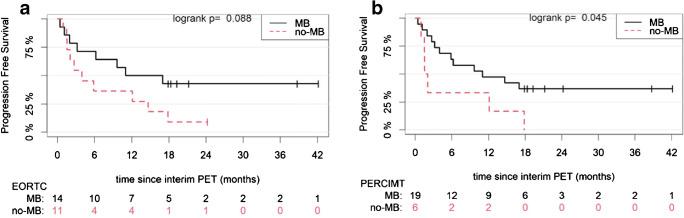
Median follow-up from interim PET/CT was 24.2 months (19.3-41.7 months). According to the EORTC criteria, 14 patients showed MB (1 CMR, 6 PMR, and 7 SMD), while 11 patients showed no-MB (PMD). Respectively, the application of the PERCIMT criteria revealed that 19 patients had MB (1 CMR, 6 PMR, and 12 SMD), and 6 of them had no-MB (PMD). With regard to PFS, no significant difference was observed between patients with MB and no-MB on interim PET/CT according to the EORTC criteria (p = 0.088). In contrary, according to the PERCIMT criteria, patients demonstrating MB had a significantly longer PFS than those showing no-MB (p = 0.045). The emergence of radiologic irAEs (n = 11 patients) was not associated with a significant survival benefit. Regarding the sub-cohort undergoing also a third PET/CT, 14/17 patients (82%) showed concordant responses and 3/17 (18%) had a mismatch of response assessment between interim and late PET/CT.
CONCLUSION
PET/CT-based response of metastatic melanoma to PD-1 blockade after application of the recently proposed PERCIMT criteria is significantly correlated with PFS. This highlights the potential ability of [F]FDG PET/CT for early stratification of response to anti-PD-1 agents, a finding with possible significant clinical and financial implications. Further studies including larger numbers of patients are necessary to validate these results.
目的
为了寻找能够可靠预测转移性黑色素瘤免疫治疗长期结果的生物标志物,我们研究了基线和抗 PD-1 治疗早期 [F]FDG PET/CT 对预后的影响。
方法
本研究纳入了 25 例计划接受 PD-1 抑制剂治疗的 IV 期黑色素瘤患者(帕博利珠单抗,n = 8 例;纳武利尤单抗,n = 4 例;纳武利尤单抗/伊匹单抗,n = 13 例)。所有患者均在治疗前(基线 PET/CT)和 PD-1 阻断治疗初始 2 个周期后(中期 PET/CT)进行 [F]FDG PET/CT 检查。17 例患者在接受四个周期治疗后还进行了第三次 PET/CT 扫描。根据欧洲癌症研究与治疗组织(EORTC)1999 标准和免疫治疗的 PET 反应评估标准(PERCIMT)进行了患者的治疗反应评估。将治疗反应分为 4 类:完全代谢缓解(CMR)、部分代谢缓解(PMR)、稳定的代谢性疾病(SMD)和进行性代谢性疾病(PMD)。根据有无代谢获益(MB)将患者进一步分为两组:有 MB 的患者包括 SMD、PMR 和 CMR 患者,无 MB 的患者包括 PMD 患者。此外,还记录了提示影像学免疫相关不良事件(irAEs)的 [F]FDG 摄取模式。无进展生存期(PFS)从中期 PET/CT 检查的日期计算至疾病进展或任何原因死亡。
结果
从中期 PET/CT 检查到中位随访时间为 24.2 个月(19.3-41.7 个月)。根据 EORTC 标准,14 例患者表现为 MB(1 例 CMR、6 例 PMR 和 7 例 SMD),11 例患者表现为无-MB(PMD)。相应地,根据 PERCIMT 标准,19 例患者表现为 MB(1 例 CMR、6 例 PMR 和 12 例 SMD),6 例患者表现为无-MB(PMD)。根据 EORTC 标准,MB 和无-MB 的患者在中期 PET/CT 检查时 PFS 无显著差异(p = 0.088)。相反,根据 PERCIMT 标准,表现为 MB 的患者的 PFS 明显长于表现为无-MB 的患者(p = 0.045)。出现影像学 irAEs(n = 11 例)与生存获益无显著相关性。对于还进行了第三次 PET/CT 检查的亚组,17 例患者中有 14 例(82%)的反应一致,3 例(18%)在中期和晚期 PET/CT 之间的反应评估中存在不匹配。
结论
根据最近提出的 PERCIMT 标准,转移性黑色素瘤患者在接受 PD-1 阻断治疗后,基于 [F]FDG PET/CT 的反应与 PFS 显著相关。这突出了 [F]FDG PET/CT 早期分层对抗 PD-1 药物反应的潜力,这一发现可能具有重要的临床和经济意义。需要进一步包括更多患者的研究来验证这些结果。


 Zotero 插件