
CRISPR-Cas9 基因编辑系统的各个方面。
Various Aspects of a Gene Editing System-CRISPR-Cas9.
机构信息
Biohazard Prevention Centre, Faculty of Biology and Environmental Protection, University of Lodz, Pomorska 141/143, 90-236 Lodz, Poland.
Military Institute of Armament Technology, Prymasa Stefana Wyszyńskiego 7, 05-220 Zielonka, Poland.
出版信息
Int J Mol Sci. 2020 Dec 16;21(24):9604. doi: 10.3390/ijms21249604.
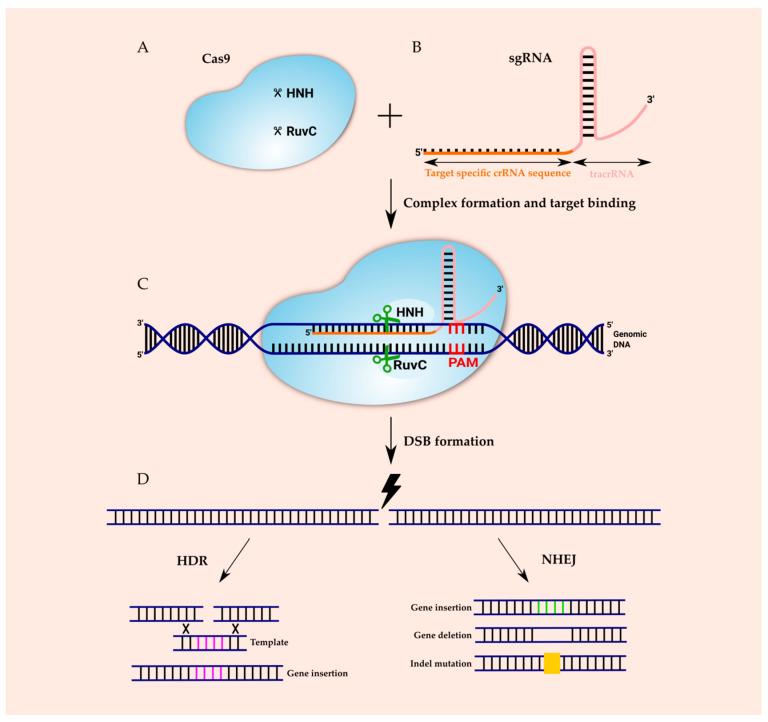
The discovery of clustered, regularly interspaced short palindromic repeats (CRISPR) and their cooperation with CRISPR-associated (Cas) genes is one of the greatest advances of the century and has marked their application as a powerful genome engineering tool. The CRISPR-Cas system was discovered as a part of the adaptive immune system in bacteria and archaea to defend from plasmids and phages. CRISPR has been found to be an advanced alternative to zinc-finger nucleases (ZFN) and transcription activator-like effector nucleases (TALEN) for gene editing and regulation, as the CRISPR-Cas9 protein remains the same for various gene targets and just a short guide RNA sequence needs to be altered to redirect the site-specific cleavage. Due to its high efficiency and precision, the Cas9 protein derived from the type II CRISPR system has been found to have applications in many fields of science. Although CRISPR-Cas9 allows easy genome editing and has a number of benefits, we should not ignore the important ethical and biosafety issues. Moreover, any tool that has great potential and offers significant capabilities carries a level of risk of being used for non-legal purposes. In this review, we present a brief history and mechanism of the CRISPR-Cas9 system. We also describe on the applications of this technology in gene regulation and genome editing; the treatment of cancer and other diseases; and limitations and concerns of the use of CRISPR-Cas9.
簇状、规律间隔短回文重复序列 (CRISPR) 及其与 CRISPR 相关 (Cas) 基因的发现是本世纪最伟大的进步之一,并标志着它们作为一种强大的基因组工程工具的应用。CRISPR-Cas 系统是作为细菌和古菌适应性免疫系统的一部分被发现的,以抵御质粒和噬菌体。CRISPR 已被发现是锌指核酸酶 (ZFN) 和转录激活因子样效应核酸酶 (TALEN) 的基因编辑和调控的高级替代方法,因为 CRISPR-Cas9 蛋白对于各种基因靶标保持不变,只需改变短的向导 RNA 序列即可重新定向特异性切割。由于其高效性和精确性,源自 II 型 CRISPR 系统的 Cas9 蛋白已被发现可用于科学的许多领域。尽管 CRISPR-Cas9 允许轻松进行基因组编辑并具有许多优势,但我们不应忽视重要的伦理和生物安全问题。此外,任何具有巨大潜力并提供重要功能的工具都存在被用于非法目的的风险。在这篇综述中,我们介绍了 CRISPR-Cas9 系统的简要历史和机制。我们还描述了该技术在基因调控和基因组编辑、癌症和其他疾病的治疗方面的应用;以及 CRISPR-Cas9 使用的局限性和关注点。
 Zotero 插件