
靶向多发性骨髓瘤中的磷酸甘油酸脱氢酶
Targeting phosphoglycerate dehydrogenase in multiple myeloma.
作者信息
Elsaadi Samah, Steiro Ida, Abdollahi Pegah, Vandsemb Esten N, Yang Rui, Slørdahl Tobias S, Rø Torstein Baade, Menu Eline, Sponaas Anne-Marit, Børset Magne
机构信息
Center for Myeloma Research, Department of Clinical and Molecular Medicine, Faculty of Medicine and Health Sciences, Norwegian University of Science and Technology (NTNU), Prinsesse Kristinas gate 1, 7030, Trondheim, Norway.
Laboratory Clinic, St. Olavs University Hospital, Trondheim, Norway.
出版信息
Exp Hematol Oncol. 2021 Jan 4;10(1):3. doi: 10.1186/s40164-020-00196-w.
BACKGROUND
Multiple myeloma (MM) is a hematological malignancy characterized by the clonal expansion of plasma cells in the bone marrow. To date, this disease is still incurable and novel therapeutic approaches are required. Phosphoglycerate dehydrogenase (PHGDH) is the first and rate-limiting enzyme in the de novo serine synthesis pathway, and it has been attributed to bortezomib-resistance in MM.
METHODS
Two different PHGDH inhibitors, CBR5884 and NCT-503, were tested against human myeloma cell lines, primary MM cells from patients, and peripheral blood mononuclear cells isolated from healthy donors. The PHGDH inhibitors were then tested in combination with proteasome inhibitors in different MM cell lines, including proteasome-resistant cell lines. Furthermore, we confirmed the effects of PHGDH inhibition through knocking down PHGDH and the effect of NCT-503 in vivo in the 5T33MM mouse model.
RESULTS
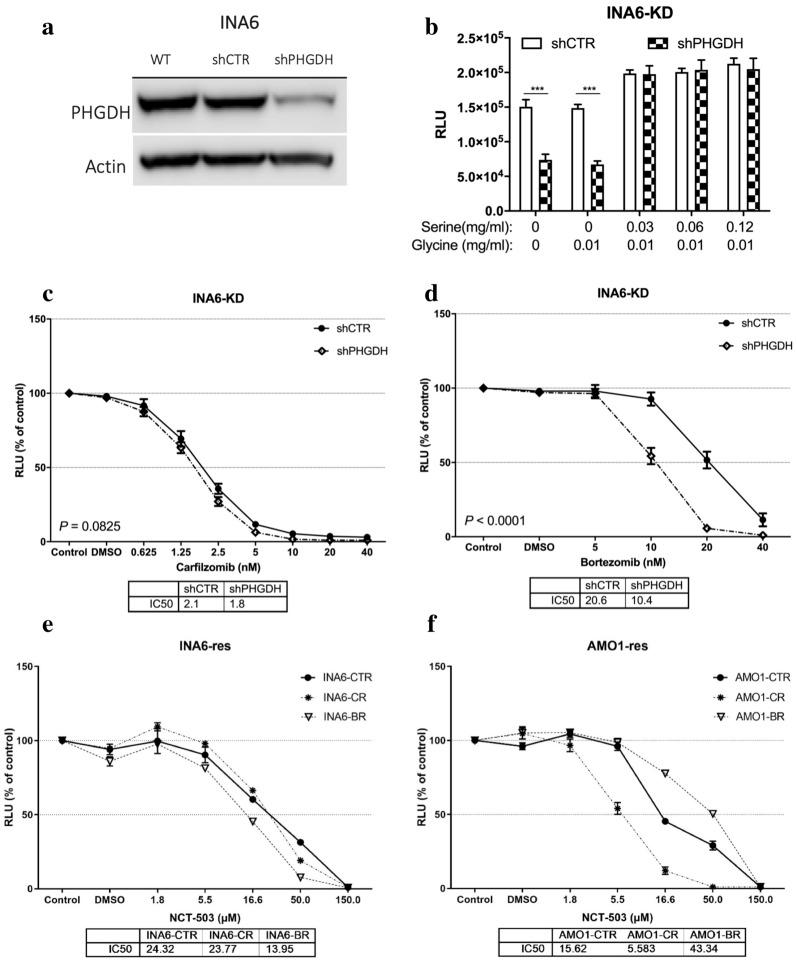
All the tested myeloma cell lines expressed PHGDH and were sensitive to doses of NCT-503 that were tolerated by peripheral blood mononuclear cells isolated from healthy donors. Upon testing bortezomib in combination with NCT-503, we noticed a clear synergy in several HMCLs. The sensitivity to bortezomib also increased after PHGDH knockdown, mimicking the effect of NCT-503 treatment. Interestingly, targeting PHGDH reduced the intracellular redox capacity of the cells. Furthermore, combination treatment with NCT-503 and bortezomib exhibited a therapeutic advantage in vivo.
CONCLUSIONS
Our study shows the therapeutic potential of targeting PHGDH in MM, and suggest it as a way to overcome the resistance to proteasome inhibitors.
背景
多发性骨髓瘤(MM)是一种血液系统恶性肿瘤,其特征是骨髓中浆细胞的克隆性增殖。迄今为止,这种疾病仍然无法治愈,需要新的治疗方法。磷酸甘油酸脱氢酶(PHGDH)是从头合成丝氨酸途径中的第一个限速酶,它与MM中的硼替佐米耐药有关。
方法
针对两种不同的PHGDH抑制剂CBR5884和NCT-503,对人骨髓瘤细胞系、患者的原发性MM细胞以及从健康供体分离的外周血单个核细胞进行了测试。然后在不同的MM细胞系(包括蛋白酶体耐药细胞系)中,将PHGDH抑制剂与蛋白酶体抑制剂联合进行测试。此外,我们通过敲低PHGDH证实了抑制PHGDH的效果以及NCT-503在5T33MM小鼠模型中的体内效果。
结果
所有测试的骨髓瘤细胞系均表达PHGDH,并且对从健康供体分离的外周血单个核细胞可耐受剂量的NCT-503敏感。在将硼替佐米与NCT-503联合测试时,我们注意到在几种人骨髓瘤细胞系(HMCLs)中有明显的协同作用。敲低PHGDH后对硼替佐米的敏感性也增加,这与NCT-503治疗的效果相似。有趣的是,靶向PHGDH降低了细胞的细胞内氧化还原能力。此外,NCT-503与硼替佐米的联合治疗在体内显示出治疗优势。
结论
我们的研究显示了靶向PHGDH在MM中的治疗潜力,并表明它是克服对蛋白酶体抑制剂耐药的一种方法。


 Zotero 插件